Correction, September 23, 2026: the January 2025 cohort in the original version of this post included 14.8 million EC2 public hostnames (ec2-…compute-1.amazonaws.com), which the Public Suffix List's private wildcard rules make look like registrable domains. They are not websites, and because AWS answers for them indefinitely, 99.2% of them "survived". Removing them shrinks the cohort to 232.0 million and lowers its survival: 78.5% at 16.5 months (not 79.8%), 84.5% at twelve months (not 85.4%), a 16.2% annualized death rate (not 15.2%) and .com at 85.7% twelve-month survival (not 87.2%). The April 2023 cohort — the basis of the headline half-life, the TLD life tables and the Freenom analysis — contained essentially none of them and is unchanged. The problem was found while building How Many Computers Host the Web?.
Every link you have ever bookmarked is a bet that a domain will keep existing. Every citation in a paper, every backlink in an SEO profile, every dependency pinned to a project homepage is an unhedged position on the continued survival of a name in the DNS. The industry publishes renewal rates for registrations — Verisign will tell you, to a decimal, what fraction of .com renews each quarter — but nobody publishes the number that actually matters for the web you can see: how long does a domain that resolves — that answers DNS with an address, that is, at minimum, connected to something — keep resolving?
The two literatures that exist both measure something else. Registry studies measure registration lifetimes: the TMA'22 zone-file study of ten years of zone data found that in most large TLDs, roughly 95% of closed registration lifetimes end at exactly the one-year minimum term — a churn statistic dominated by speculative names that are registered once, never renewed, and in many cases never used. Threat-intel studies measure the other extreme: malicious domains with median lifetimes measured in days. Between those two poles sits the actual web — the hundreds of millions of names that resolve today — and its mortality has never been measured at full scale, because doing so requires the same census, run the same way, over years.
We have that. DomainsProject has been running A-record crawls of its full hostname corpus since April 2023 — 26 snapshots, sparse through 2023–2024 and monthly from December 2024, ending in a full-corpus pass on 9 June 2026. For this study we reduced every snapshot to its set of resolving apexes — registrable domains under ICANN public-suffix rules with at least one A record, one domain one vote — and then followed two cohorts forward through every subsequent snapshot: the 181,137,831 apexes that resolved in April 2023, across 38.1 months; and the 232,009,996 apexes of January 2025, across 16.5 months. Russian-administered TLDs are excluded throughout, per project policy. This is the longitudinal sequel to The Dead Web, which counted the accumulated stock of dead hostnames at one instant; this post measures the rate of dying, per TLD, per year, at census scale — and to our knowledge it is the first domain-survival measurement at this scale that starts from resolution rather than registration.
The headline: 63.5% of the resolving web of April 2023 was still alive in June 2026. The resolving web loses 13–16% of itself every year, for a half-life of roughly five years — twice as durable as the registration pool, whose ~75% renewal rate implies a quarter of it gone every year. But that single number hides three different internets. The identity-verified European and Japanese ccTLDs keep 76–85% of their web alive across the full window. The .com heartland holds 65%. And the cheap-promo gTLD belt loses 59–95% of itself, topped by the five Freenom TLDs, which suffered the largest extinction event ever recorded in the DNS: 7.0 million resolving domains — 3.9% of the April 2023 web — collapsed to 5.7% alive in the seven weeks around the registry's February 2024 shutdown, and sit at 0.9% today. Mortality, it turns out, is not a property of domains. It is a property of registries.
The Data
| Property | Value |
|---|---|
| Snapshots | 26 A-record crawls, 7 Apr 2023 → 9 Jun 2026 |
| Cadence | 5 passes Apr 2023 – Nov 2024, then monthly Dec 2024 → Jun 2026 |
| Cohort 1 | 181,137,831 resolving apexes (7 Apr 2023), followed 38.1 months |
| Cohort 2 | 232,009,996 resolving apexes (24 Jan 2025), followed 16.5 months |
| Endpoint | Full-corpus typed crawl, 9 Jun 2026: 290,981,000 resolving apexes |
| Unit | ICANN registrable apex (eTLD+1), ≥1 A record, one domain one vote |
| Deaths observed | 66,155,285 cohort-1 apexes no longer resolve at endpoint |
| Excluded | Russian-administered TLDs; wildcard registries .ws and .ph (see Methodology); EC2 public hostnames (removed in the September 2026 correction) |
The corpus itself grew from roughly 1,200 to 3,170 archive shards over the window — the resolving-apex universe expanded from 181M to 291M — but cohort tracking is immune to that growth: we only ever ask whether a fixed set of names is still present. Growth affects the comparison between cohorts (the 2025 cohort contains the 2023 survivors plus everything born since), and we account for that where it matters.
Methodology
Definitions. A resolving apex is a registrable domain — reduced under ICANN public-suffix rules, so www.example.co.uk and shop.example.co.uk both count once as example.co.uk — for which at least one hostname in the corpus answered an A query with an address in that snapshot. A cohort member is present in a later snapshot if it appears in that snapshot's resolving-apex set, and alive at time t if it is present in any snapshot at or after t. A domain is dead at the endpoint if it is absent from the 9 June 2026 full-corpus pass. Deaths are name-level, not registrant-level: a domain that expires, is re-registered by a squatter, and resolves again counts as alive. We measure the persistence of names, not owners.
Why "alive at or after" rather than simple presence. Crawl coverage varies month to month — the late-2024 passes were visibly partial (164–174M apexes against 210M in December 2024). Simple presence/absence would count a domain missed by a thin crawl as dead. The monotone estimator absorbs this: a domain absent in September 2024 but seen in January 2025 was alive in September 2024. The maximum gap between the two estimators is 6.1 percentage points (at the November 2024 coverage dip), which is the amount of error this correction removes. Its one cost is a right-edge bias: the final one or two points have few future snapshots left to catch temporarily-missing domains, so we read hazard rates from the interior of the series, never from the last two points. The endpoint itself is unaffected — it is a direct intersection with the full June 2026 crawl.
Verification. We live-resolved random samples after the endpoint crawl: of 400 apexes our pipeline calls dead, 90.5% return NXDOMAIN today, 3% return NOERROR with no A record, and 4.5% SERVFAIL — 98% non-resolving in total, with 2% resolving again (consistent with re-registration in the weeks since the crawl). Of 400 apexes called alive, 97% resolve today; the 1.5% that went NXDOMAIN in the three weeks since the crawl is almost exactly the attrition our own annual rate predicts for that interval. A dedicated 120-name sample of dead .br apexes — the finding that most surprised us — confirmed 98% dead. Treat every survival figure in this post as carrying roughly a ±2-point error bound.
Wildcard registries. .ws and .ph operate registry-level wildcards: any name under them, registered or not, resolves to a registry address. We verified this by resolving nonsense names. Both TLDs show ~98% "survival" — an artifact, not a finding — and are excluded from every table. No other TLD in our tables exhibits this behavior.
What this cohort is — and is not. The April 2023 cohort is the standing stock of the resolving web on that date: a mixture of domains of every age, from registered-last-week to older-than-Google. The 4.8-year half-life is therefore the remaining half-life of the web as it exists at any moment — not the life expectancy of a newly registered domain, which is far shorter (the registration-lifetime literature and the churn-belt table below both attest to that). This left-truncation is a feature for our question — "how durable is the web I can see?" — but it means our numbers deliberately do not match first-registration studies.
Resolution is not life. A parked page resolves; a for-sale lander resolves; half the CNAME-visible web points at parking lots. Our cohorts include such names, so "alive" here means "still connected to the DNS," not "still a website someone maintains." The stickiness gap against registrations survives this caveat — parked names resolve in both populations — but do not read 63.5% as "63.5% of websites still exist."
Reproducibility. A Go extractor (fast-path line scanner validated byte-for-byte against a full JSON parse on both the 2023 and 2025 record formats) reduces each snapshot to a sorted unique apex set; survival is set intersection under C collation; life tables come from per-TLD tallies of the intersections. Same two-stage design as the published MX, NS and hosting censuses. Benchmark your own portfolio against the dataset.
The Scorecard: How Fast the Web Dies
| Metric | Apr 2023 cohort | Jan 2025 cohort |
|---|---|---|
| Cohort size | 181,137,831 | 232,009,996 |
| Window | 38.1 months | 16.5 months |
| Survivors at end of window | 63.5% | 78.5% |
| Survival at 12 months | ~83% | 84.5% |
| Annualized death rate (constant-hazard) | 13.3% | 16.2% |
| Constant-hazard half-life | 4.8 years | 3.9 years |
| Deaths in window | 66.2M | 49.8M |
Two cohorts, launched 21 months apart into different market conditions, die at nearly the same pace. At the same age — 16.5 to 16.9 months after cohort entry — the April 2023 cohort stood at 79.4% and the January 2025 cohort at 78.5%. Nine tenths of a point apart, on populations of 181 million and 232 million. The survival curve of the resolving web is not an artifact of one era's events; it reproduces.
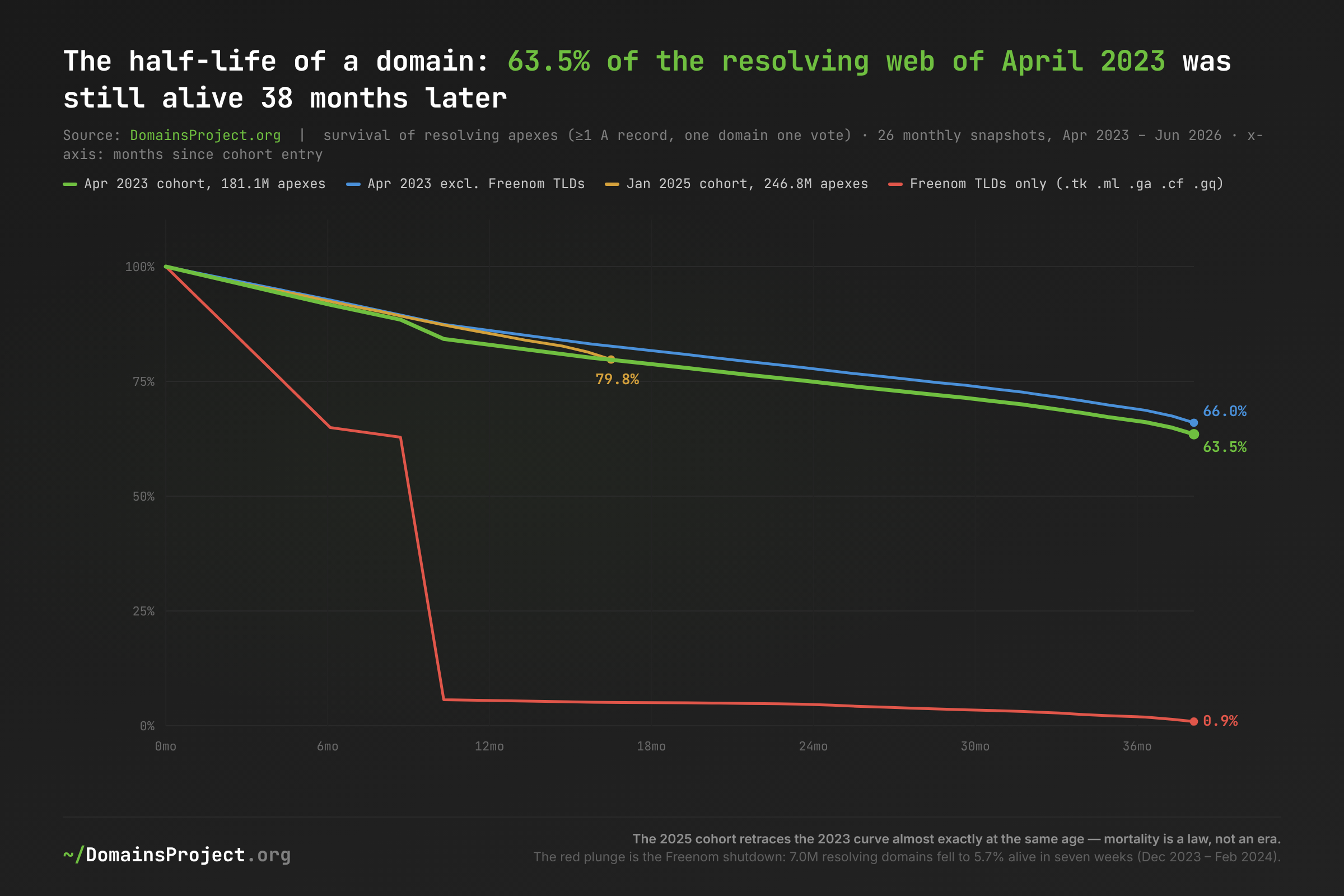
The hazard is front-loaded, then declines — the web has a Lindy effect. The April 2023 cohort lost 14–16% annualized in its first year, ~10% in its second, and 9–13% in its third. Domains that survive get harder to kill: every year a name endures raises the odds it endures the next. This is why the constant-hazard half-life of 4.8 years is a floor estimate — at the marginal pace of the cohort's third year, the 50% crossing lands somewhat later, and the honest summary is a half-life of roughly five years for the standing resolving web. Two second-order signals are worth flagging: the 2025 cohort dies slightly faster than the 2023 cohort did at the same age once Freenom is excluded (16.2% vs ~13% annualized), and the 2023 cohort's marginal rate ticked up from ~10% to ~13% during late 2025 — both consistent with mortality slowly accelerating in calendar time, though two points do not make a trend and we will re-read this in next year's edition.
Where the deaths concentrate
| Segment (Apr 2023 cohort) | Cohort share | Survival at 38.1mo |
|---|---|---|
| Freenom TLDs (.tk .ml .ga .cf .gq) | 3.9% (7.0M) | 0.9% |
| Cheap-promo gTLD belt (.xyz .top .shop .site .store .online .club .vip .icu .buzz .cyou .click) | 3.5% (6.3M) | 4.6–41% by TLD |
| Legacy gTLDs (.com .net .org .info .biz) | 54.4% (98.5M) | 65.3% |
| Identity/European ccTLD spine (.de .jp .it .ch .nl .eu) | 10.1% (18.3M) | 80.1% |
A domain's TLD is the single strongest publicly visible predictor of its death. The spread between the durable spine and the Freenom bucket is not 20 points — it is 79 points. The rest of this post walks through those tiers.
The Extinction Event: Freenom's Seven-Week Collapse
Freenom's five free ccTLDs — .tk, .ml, .ga, .cf, .gq — contributed 6,997,963 resolving apexes to the April 2023 cohort: one in every 26 domains on the resolving web. The registry was already dying — Meta's lawsuit landed in December 2022, and new registrations had stopped — and the cohort's Freenom members had already bled to 62.8% alive by late December 2023. Then the registry infrastructure itself was switched off.
| Date | Freenom cohort alive |
|---|---|
| Apr 2023 | 100% |
| Oct 2023 | 64.9% |
| Dec 2023 | 62.8% |
| Feb 2024 | 5.7% |
| Jun 2025 | 4.0% |
| Jun 2026 | 0.9% |
Between 27 December 2023 and 14 February 2024, four million resolving domains went dark — the largest single die-off ever recorded in the DNS. The Dead Web measured the wreckage as a stock: 98.94% of all Freenom hostnames ever observed are dead. This is the same event as a flow, and the flow shape matters: it was not a decay, it was a cliff. An entire national-TLD-sized region of the web depended on one Amsterdam company's decision to keep nameservers running, and when that decision reversed, no grace period, no redemption window, and no market mechanism intervened. The 0.9% that survives today is almost exactly the slice that migrated to the successor registries that took over the ccTLDs' technical operation.
For the aggregate numbers, the exclusion test matters: strip Freenom out entirely and the April 2023 cohort's 38-month survival rises from 63.5% to 66.0%, and its first-year death rate drops from ~17% to ~14%. One registry's collapse moved the mortality of the entire web by 2.5 points.
The Durable Spine: Where the Web Does Not Die
At the other end of the table sit the registries The Dead Web called the healthy spine, and the life tables confirm it with a different instrument.
| TLD | Cohort (Apr 2023) | Alive Jun 2026 | Annualized death | Half-life |
|---|---|---|---|---|
| .jp | 1.00M | 85.1% | 5.0% | 13.6y |
| .ai | 92K | 84.3% | 5.2% | 12.9y |
| .de | 7.04M | 84.1% | 5.3% | 12.7y |
| .it | 2.30M | 79.1% | 7.1% | 9.4y |
| .nl | 3.66M | 76.8% | 8.0% | 8.3y |
| .ch | 2.02M | 75.9% | — | — |
| .eu | 2.32M | 75.6% | — | — |
| .uk | 5.28M | 69.2% | 10.9% | 6.0y |
| .org | 9.08M | 69.1% | 11.0% | 6.0y |
| .fr | 3.50M | 68.4% | 11.3% | 5.8y |
| .com | 75.41M | 65.1% | 12.7% | 5.1y |
| .net | 10.41M | 64.8% | 12.8% | 5.1y |
| .info | 2.69M | 60.8% | 14.5% | 4.4y |
| .br | 2.39M | 59.5% | 15.1% | 4.2y |
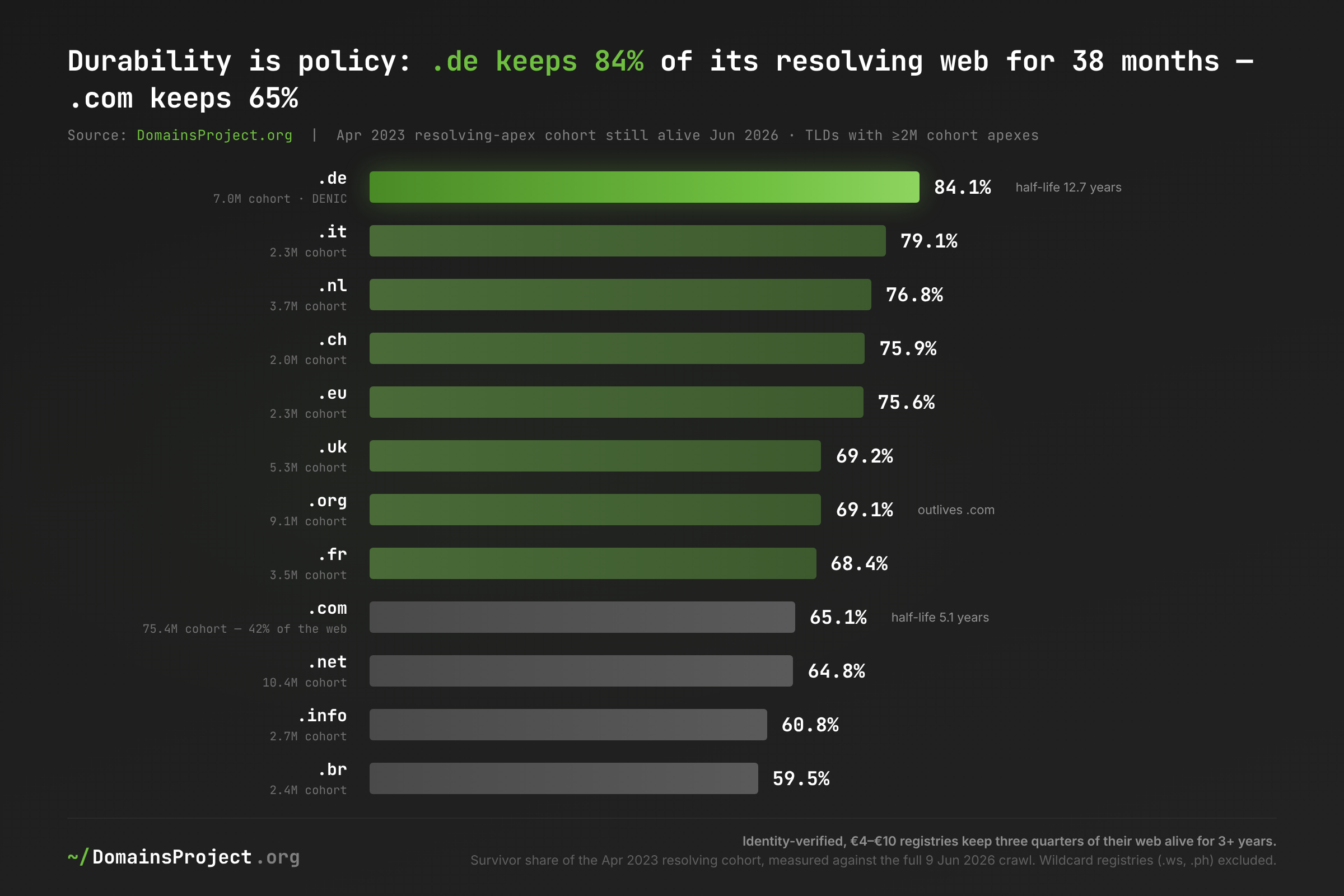
A resolving .de domain has a half-life of 12.7 years — two and a half times .com's. The pattern is the same one that predicted dead-hostname stocks: registries with meaningful registration requirements, €4–€10 wholesale pricing, and no promo culture (DENIC's cooperative model, JPRS's pricing, the Swiss and Dutch registries) hold three quarters or more of their web for three-plus years. Their domains were more deliberate purchases at registration time, and deliberateness compounds: the composition of the namespace, not registry operations, is doing the work — consistent with the finding that survival tracks acquisition context everywhere in this study.
Two rows deserve their own sentences. .ai retains like Germany, not like a gold rush: 84.3% of its April 2023 resolving cohort survives — and the fresher test agrees, with the January 2025 .ai cohort holding 89.0% at twelve months, above .com's 85.7%. Composition explains part of it (Anguilla's two-year minimum registration term filters out one-year speculators by construction, and the April 2023 resolving cohort largely predates the deepest bubble registrations), but the utilization follow-up points the same direction: the .ai web that actually resolves is disproportionately real. And at the other end, .br is the durability table's negative surprise: 59.5% survival, below .info, despite CPF/CNPJ-verified registration. The dead are not artifacts — a dedicated live-DNS sample confirmed 98% of them — and they are overwhelmingly ordinary small-business .com.br names (inns, architects, supplement shops). The number is consistent with high small-business churn in the namespace's SMB-heavy composition rather than speculative flipping, though our data cannot separate business failure from hosting migration; we flag it as the finding most worth a registry-side look.
The Churn Belt: Price Predicts Death
| TLD | Cohort (Apr 2023) | Alive Jun 2026 | Annualized death | Half-life |
|---|---|---|---|---|
| .xyz | 1.64M | 41.1% | 24.4% | 2.5y |
| .online | 990K | 34.9% | 28.2% | 2.1y |
| .store | 433K | 28.1% | 33.0% | 1.7y |
| .site | 517K | 27.2% | 33.7% | 1.7y |
| .shop | 809K | 26.9% | 33.9% | 1.7y |
| .top | 704K | 25.1% | 35.3% | 1.6y |
| .icu | 66K | 23.6% | 36.5% | 1.5y |
| .click | 146K | 12.1% | 48.5% | 1.0y |
| .cyou | 94K | 6.1% | 58.7% | 0.8y |
| .buzz | 172K | 4.6% | 62.0% | 0.7y |
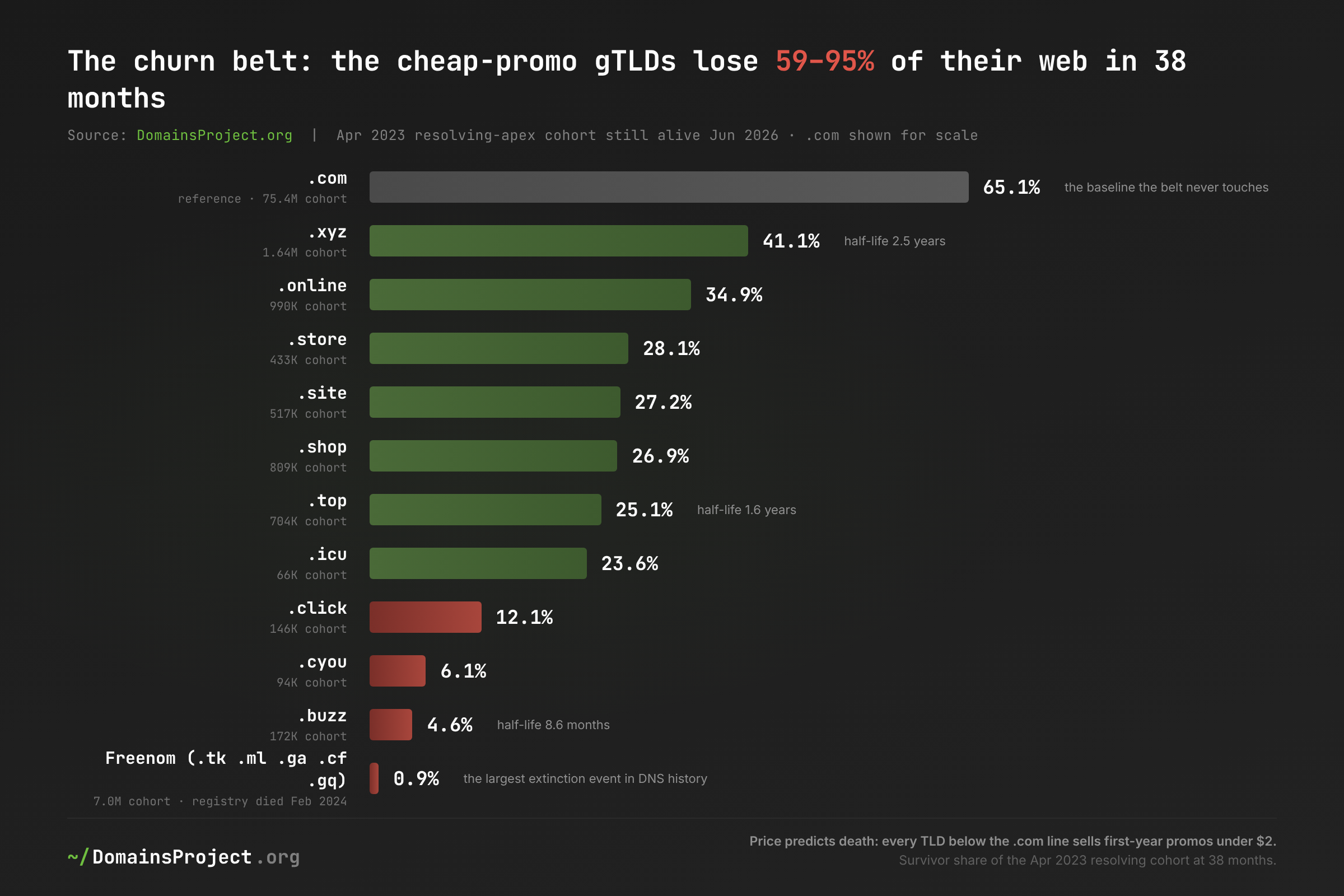
Every TLD in this table sells first-year registrations under $2 in routine promotions, and every one of them loses its web at least twice as fast as .com. The mechanism is not mysterious — a $0.99 first year recruits registrants whose commitment is $0.99, the renewal reprices to $10–$30, and the 410-day registration-lifetime cliff documented in zone-file studies does the rest — but the magnitude is: these are not registrations that never resolved. Everything in this table answered DNS in April 2023, and .buzz still lost 95% of it in three years, a half-life of eight and a half months.
The belt also moves. In the January 2025 cohort the fastest-dying TLDs are a new set — .sbs at 14.2% twelve-month survival, .bond at 15.3%, .cfd at 28.0% — promo waves that barely existed in the 2023 cohort. Registry promo calendars rotate through TLDs, and the mortality follows the promos, not the strings. This is the strongest evidence in the study that the survival curve is set at acquisition time: the same registrant population, recruited the same way at the same price point, produces the same death curve under whatever TLD the promo lands on. It is also why the aggregate curve reproduces so precisely across cohorts — every era has its own Freenom-shaped population; only the names change.
Two Clocks: Registrations Expire, the Resolving Web Persists
Our numbers deliberately measure a different clock from the industry's, and putting them side by side is where the triangulation gets interesting.
| 12-month survival of... | Rate | Source |
|---|---|---|
| A resolving .de apex | 94.0% | this study, Jan 2025 cohort |
| A resolving .com apex | 85.7% | this study, Jan 2025 cohort |
| A resolving apex, any TLD | 84.5% | this study, Jan 2025 cohort |
| A .com/.net registration | 75.0% | Verisign DNIB, Q4 2025 renewal rate |
| A resolving .top apex | 49.5% | this study, Jan 2025 cohort |
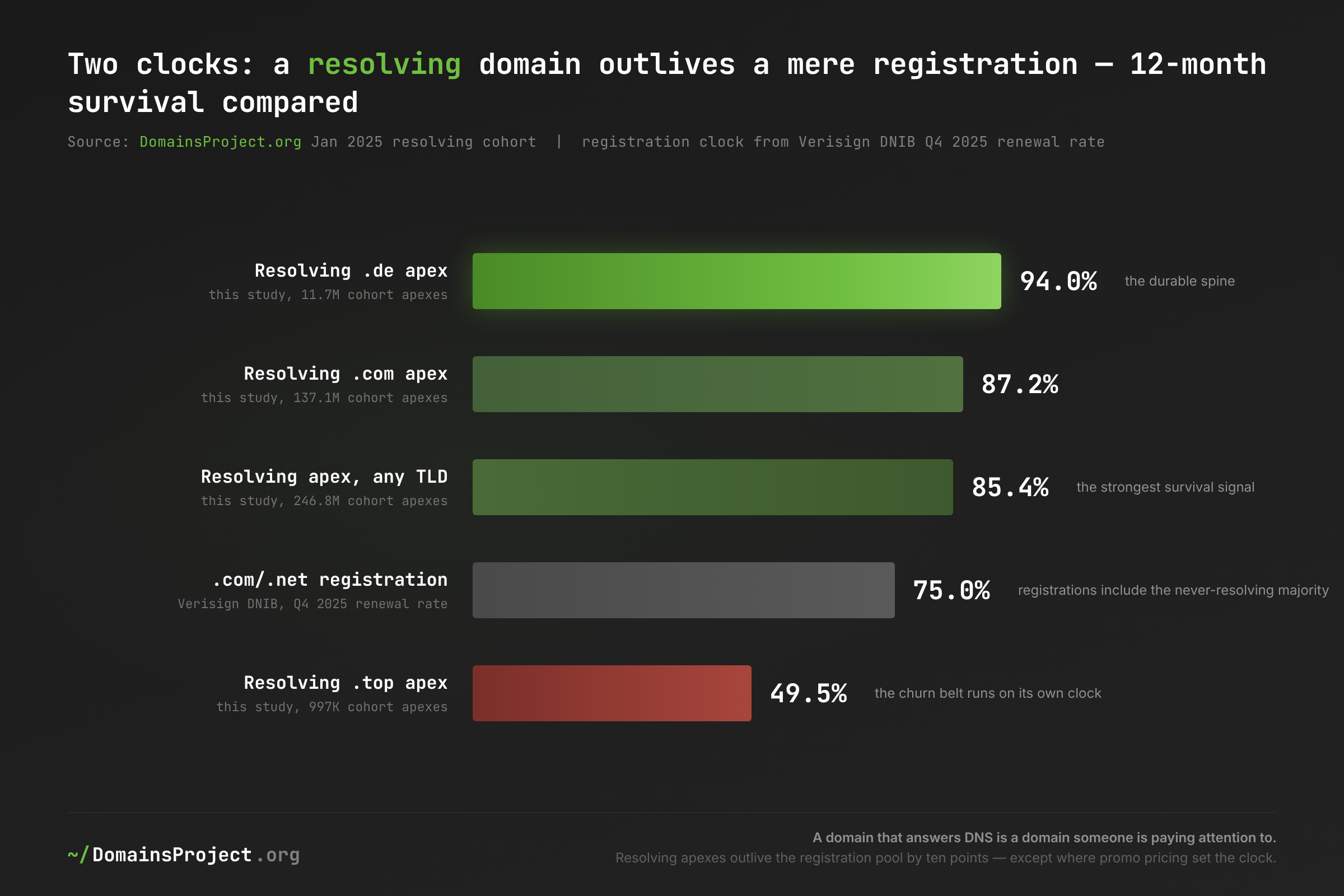
A domain that resolves outlives a domain that is merely registered by ten percentage points a year. The registration pool includes the never-connected majority — zone-file studies find most closed registration lifetimes end at the one-year minimum, which coexists with Verisign's 75% pool-level renewal precisely because the standing pool is dominated by accumulated survivors while the churn happens in each year's new-registration vintage. Connecting a name to an address is the cheapest observable signal that someone cares about it, and it is worth nine to ten points of annual survival — except in the churn belt, where even resolution cannot rescue a promo-priced vintage. The external anchors agree in direction and diverge exactly where they should: AFNIC has measured the average lifespan of a .fr registration at 3.8 years, while our .fr resolving half-life is 5.8 years — registrations, again, churning faster than the connected web built on top of them.
What's at Stake
- 13–16% of the web you can see will not answer DNS a year from now — every link graph, citation index, training corpus, and bookmark file decays at that rate, and at five-year half-life, half of today's resolving web is gone by mid-2031. Link rot is not an edge case; it is the base rate.
- 66 million domains died in 38 months, and every one is a re-registration opportunity — dropped names with residual backlinks, mail flows, and OAuth callbacks are the raw material of subdomain takeovers and phishing infrastructure. The death rate of the web is also the supply curve of its abuse economy.
- The Freenom collapse is the concentration argument nobody made — 92.5% of delegated domains have a single-provider DNS dependency, and Freenom demonstrated the failure mode at registry level: 4 million resolving names dark in seven weeks, no redemption process, no successor obligation. Registry continuity is infrastructure risk, not paperwork.
- TLD choice is a measurable survival variable — a brand or archive that must exist in ten years has a 12.7-year half-life neighborhood available (.de, .jp) and a 1.6-year one (.top); they differ by a factor of eight, and the difference is visible in advance, at registration time, for free.
- Domain-count growth statistics hide the churn underneath — the resolving web grew from 181M to 291M apexes while shedding 66M of its members; net growth of 110M masked gross birth of ~191M. Any analysis that treats namespace growth as retention — registry investor decks included — is off by the size of the churn belt.
What Would Help
1. Registries: publish survival curves, not just registration counts. DENIC can say "84% of our resolving web survives three years" and .top cannot; that asymmetry is information the market never sees. A standard annual cohort-survival disclosure — the DNS equivalent of an actuarial table — would price durability into TLD choice.
2. Registrars: surface expected-survival at the point of sale. The $0.99 promo and the €9 .de registration look identical in a shopping cart. A "domains like this one are still active after 3 years: 25% / 84%" label, derived from exactly the kind of data in this post, is the single highest-leverage churn disclosure the industry could adopt.
3. Security teams: treat TLD half-life as a reputation prior. A resolving .buzz apex has a 62% annualized death rate; a resolving .jp apex has 5%. Every allow-list, link-scanner, and domain-reputation model should weight domain longevity expectations by these priors — and treat fresh re-registrations of recently-dead names (2% of our dead sample already resolves again) as the highest-risk class.
4. Archivists and researchers: the five-year half-life sets your snapshot budget. Anything worth citing is worth archiving within the year; at 13–16% annual decay, a ten-year-old link list is a 17–25% link list. Wayback-style archiving and dataset snapshotting should be planned against measured decay, and our dataset provides the baseline.
5. ICANN and ccTLD overseers: make registry shutdown a managed process. Freenom ended with a cliff, not a wind-down — no bulk grace period, no migration window for the 5% of its web that was demonstrably real. A continuity requirement for registry operators — even just a mandated 12-month resolution sunset — would have saved millions of legitimate names and would cost a functioning registry nothing.
This analysis followed the 181,137,831 resolving apexes of 7 April 2023 and the 232,009,996 of 24 January 2025 across 26 A-record crawls of the DomainsProject corpus, ending with the full-corpus pass of 9 June 2026 — one domain, one vote, reduced to ICANN registrable apexes, Russian-administered TLDs excluded, wildcard registries (.ws, .ph) excluded from TLD tables, and every survival label spot-verified by live resolution. It is the longitudinal companion to The Dead Web and the second post in the longitudinal series begun with Where the Web Lives. Explore the TLD statistics or work with the dataset yourself.