Every market-share chart for business email tells the same story: Microsoft and Google split the world between them, with Microsoft comfortably ahead. By revenue it is not close — Microsoft 365 crossed 450 million paid commercial seats in its fiscal Q2 2026, and analysts give the two companies a combined ~96% of the productivity-suite market. The duopoly is real, and at the top of the market it is overwhelming.
But "the top of the market" is doing a lot of work in that sentence. Seat counts and revenue measure the enterprises and the knowledge workers. They do not measure domains — the hundreds of millions of registered names that make up the actual Internet, most of which belong to a plumber, a restaurant, a parked investment, a side project, or a small business in a country where neither Google nor Microsoft is the default. To find out who runs email at that scale you cannot ask vendors how many seats they sold. You have to ask the domains themselves, one MX record at a time.
So we did. DomainsProject runs full-corpus, typed DNS measurement passes against its master hostname dataset, and the 9 June 2026 pass queried the MX record — the mail-exchanger record that decides where a domain's email is delivered — for every name we track. That is 3,165 result archives, roughly 52 GB compressed, reduced to the registrable apex of every domain, because mail to [email protected] is routed by the MX of example.com and nothing else. We recorded, for each apex, whether it can receive mail at all and which operator runs the server it points to. Russian-territorial TLDs are excluded throughout, per project policy.
The headline: most domains cannot receive email, and among those that can, the cloud duopoly is a minority. Of 390,520,120 apex domains observed, only 151,070,140 — 38.7% — publish a working MX record. Within that mail-capable population, Google Workspace leads at 13.2% and Microsoft 365 trails at 9.4% — a 1.4-to-1 Google lead that exactly inverts the enterprise picture, because counting domains weights the small business that Google owns rather than the enterprise seat that Microsoft owns. And both are beaten by a category no one names: registrar- and host-bundled email — GoDaddy, IONOS, Namecheap, Hostinger, OVH, Strato and a thousand regional web hosts — which serves 32.9% of mail-capable domains directly and the overwhelming majority of the unclassified long tail on top of that. The single most common answer to "who runs your email" is not Google or Microsoft. It is whoever sold you the domain.
The Data
Every record in this study is a single MX query answered from the public DNS, in June 2026, against the DomainsProject master corpus, reduced to the registrable apex.
| Measure | Count | Share |
|---|---|---|
| Apex domains observed (MX query, RU excluded) | 390,520,120 | denominator |
| Mail-capable (≥1 real MX record) | 151,070,140 | 38.68% |
| No MX at all (SOA-only response) | 227,696,287 | 58.31% |
| Null MX only — RFC 7505 "we send/receive no mail" | 11,753,693 | 3.01% |
| Distinct primary-MX operators (registrable domains) | 33,513,996 | — |
| Mail-capable apexes classified to a known operator | 99,366,665 | 65.78% of mail-capable |
The unit that matters is the mail-capable apex: a registrable domain whose own MX query returns at least one real mail exchanger. We reduce every queried name to its eTLD+1 with ICANN public-suffix rules and keep only records where the queried name is its apex, because a wildcard MX on anything.example.com tells you nothing about where @example.com mail goes — and counting those wildcards would inflate whichever provider a host happens to wildcard. This is a deliberately conservative denominator. It lands almost exactly where our May 2026 State of TXT census did (150.0 million mail-capable apexes then, 151.1 million now), and the provider shares — which are the story — are stable regardless of where the denominator is drawn.
Methodology
A census that ranks Google against Microsoft against "your web host" needs its definitions spelled out, because the wrong denominator or a single greedy substring can move a provider by millions of domains.
Mail-capable. An apex is mail-capable if its MX query returns at least one mail exchanger that is not the RFC 7505 "null MX" (a single record of preference 0 and exchange .). A response with no MX records (just an SOA authority) is counted as no MX; a response whose only MX is the null record is counted as null MX. These three populations are disjoint and sum to the observed total.
Primary operator. Each mail-capable apex is attributed to the operator of its lowest-preference MX host — the server mail is delivered to first. We reduce that host to its registrable domain (alt1.aspmx.l.google.com → google.com, mx00.ionos.fr → ionos.fr) and classify the registrable, not the full host. Where one operator runs many ccTLD registrables — IONOS alone answers on ionos.de, ionos.fr, ionos.co.uk, ionos.es, kundenserver.de and more — those are folded into one operator with ordered substring rules; everything else is matched exactly, so that mail.com does not silently swallow hostedemail.com.
Operator categories. Each operator is assigned one of nine categories: Google Workspace and Microsoft 365 (called out individually); other cloud suites (Zoho, Apple iCloud, Fastmail, Proton, GMX, Yahoo); registrar/host-bundled (email that ships with a domain or hosting plan — GoDaddy, IONOS, Namecheap, Hostinger, OVH, Strato, and hundreds of regional web hosts); security gateways (Proofpoint, Mimecast, Cisco, Barracuda — an MX that filters mail and forwards it to a mailbox elsewhere); regional (Tencent, NetEase, Alibaba, Yandex, Naver); forwarders/routing (Cloudflare Email Routing, ImprovMX, Mailgun, Amazon SES); parking/for-sale; and broken/non-deliverable (an MX pointing at localhost, a literal IP, or another address mail can never reach).
What classification can and cannot see. 65.8% of mail-capable apexes resolve to a named operator. The unclassified 34.2% is not noise — manual review of the largest 200 unmapped registrables, which cover most of that residual, shows it is overwhelmingly more of the same: small regional web hosts (h-email.net, kv.de, transip.email, mijndomein.nl, seznam.cz, web.de, lima-city.de, websupport.sk) each running their own mail server for a few tens of thousands of domains. The unclassified tail therefore reinforces the host-bundled finding rather than hiding a missing giant; we report it as its own bar and never fold it into a named provider.
The gateway and reseller undercount — read this before trusting the duopoly ratio. An MX record names the first hop, not the mailbox. Enterprises running Microsoft 365 routinely sit behind a secure email gateway — Proofpoint, Mimecast, Cisco — so their MX points at the filter, not at Microsoft. GoDaddy resells Microsoft 365 but routes it through its own secureserver.net infrastructure. Both effects hide Microsoft mailboxes behind a non-Microsoft MX, and both are concentrated in exactly the enterprise tier where Microsoft is strongest. Our 9.4% for Microsoft is therefore a floor, and the 1.4-to-1 Google lead is an upper bound on Google's true advantage. Google, whose Workspace MX almost always points directly at google.com, is measured close to completely; Microsoft is not. We flag this everywhere the duopoly is discussed rather than pretending an MX census can see mailboxes it structurally cannot.
Prior art. The closest precedent is the UCSD/ICANN IMC 2021 measurement "Who's Got Your Mail?", which scanned MX records for popular domains and found Google 28.5%, Microsoft 10.8%, and — critically — GoDaddy leading the smaller domains at ~29%. Our census pushes far deeper into the long tail than "popular domains," which is exactly why our Google and Microsoft shares are lower and our host-bundled share is higher: we are measuring the part of the Internet that study's denominator excluded. The shape — Google ahead of Microsoft, hosting enormous below them — replicates.
Limitations. MX records can be stale, and a domain that publishes one need not actually use it. Gateways and resellers undercount the cloud duopoly as described above. This is a single June 2026 snapshot; no growth or trend is claimed from it. Operator classification is heuristic, validated by manual sampling of the largest registrables, not exhaustively audited. Reproduction requires the typed-crawl archives, a public-suffix library, and the operator rule set described here.
The Scorecard
Among 151,070,140 mail-capable domains, here is who delivers the mail.
| Operator | Mail-capable domains | Share | Category |
|---|---|---|---|
| Google Workspace | 19,963,561 | 13.21% | cloud suite |
| Microsoft 365 | 14,184,931 | 9.39% | cloud suite |
| GoDaddy | 9,337,277 | 6.18% | host-bundled |
| IONOS | 6,451,910 | 4.27% | host-bundled |
| Namecheap | 6,294,034 | 4.17% | host-bundled |
| Hostinger | 4,368,227 | 2.89% | host-bundled |
| OVH | 2,926,245 | 1.94% | host-bundled |
| Strato | 2,764,402 | 1.83% | host-bundled |
| Open-Xchange hosts | 1,957,703 | 1.30% | host-bundled |
| Zoho | 1,903,434 | 1.26% | cloud suite |
localhost (broken) |
1,883,367 | 1.25% | broken |
| Cloudflare Email Routing | 1,815,390 | 1.20% | forwarder |
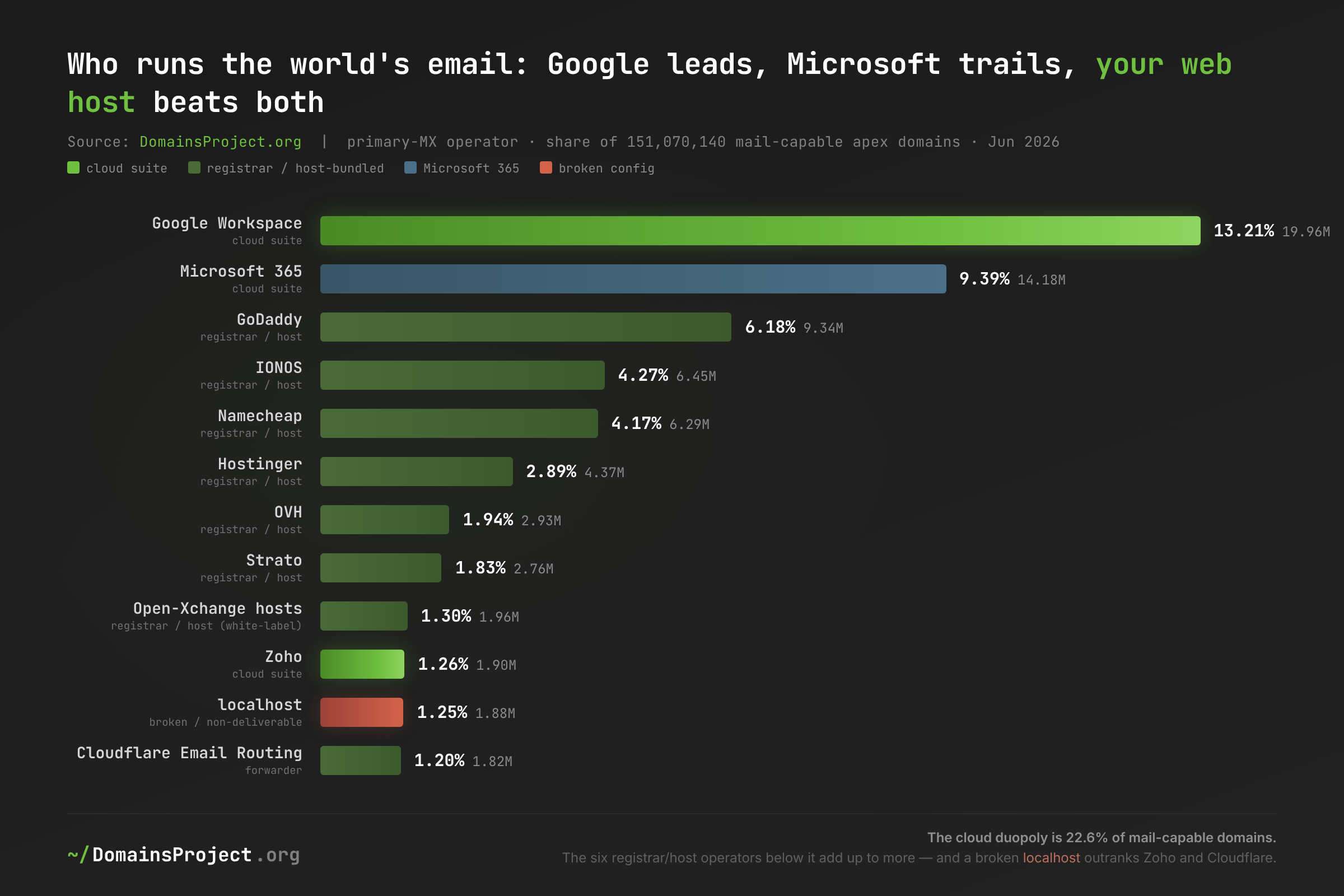
Google Workspace leads, Microsoft 365 trails, and the gap is the whole story. Counting paid seats, Microsoft wins by a landslide; counting domains, Google wins 13.21% to 9.39%. Neither number is wrong — they measure different Internets. Microsoft's strength is the enterprise, where one tenant can mean a hundred thousand seats and exactly one MX record; Google's strength is the small business and the side project, where one domain means five seats but still exactly one MX record. An MX census counts domains, so it counts Google's territory. This is the same split Gartner describes qualitatively — Google in the SMB market, Microsoft dominating enterprise — rendered as a hard number for the first time across the whole registered Internet.
The eleventh-largest "email provider" on the Internet is a mistake. 1,883,367 domains — more than Zoho, more than Cloudflare, more than every regional Asian provider combined — publish an MX record pointing at localhost. Mail to those domains is handed to the sending server's own loopback address and silently dropped. These are not parked domains opting out; they are live domains whose owners believe they have working email and do not. It is the clearest single illustration of the gap between publishing a mail configuration and having one.
Concentration, by category
| Category | Mail-capable domains | Share |
|---|---|---|
| Registrar/host-bundled | 49,673,434 | 32.88% |
| (unclassified long tail — overwhelmingly more small hosts) | 51,703,475 | 34.22% |
| Google Workspace | 19,963,561 | 13.21% |
| Microsoft 365 | 14,184,931 | 9.39% |
| Other cloud suites | 3,452,064 | 2.29% |
| Security gateways | 3,477,349 | 2.30% |
| Forwarders/routing | 3,074,434 | 2.04% |
| Broken/non-deliverable | 2,109,682 | 1.40% |
| Regional (Asia/East) | 1,790,744 | 1.19% |
| Parking/for-sale | 1,640,466 | 1.09% |
The cloud duopoly is 22.6% of mail-capable domains. Host-bundled email, before counting the long tail, is 32.9%. Add the unclassified residual — which manual review shows is almost entirely more small hosts — and the share of the Internet that gets its email bundled with its domain or hosting is on the order of 60%, roughly three times the Google-plus-Microsoft total. The concentration story everyone tells about email is true only at the top of the market. Across the whole of it, email is the least concentrated infrastructure layer DomainsProject measures: where our CNAME census found a handful of platforms serving most aliases and our IPv6 study found Cloudflare generating 45% of all domain IPv6, the mail layer has no such center of gravity.
The Duopoly That Isn't: Google, Microsoft, and the Enterprise Inversion
The two-company race is real, but it runs in the opposite direction from the one the seat-count charts show.
Google's 1.4-to-1 lead is a property of the denominator, not a contradiction of Microsoft's dominance. Microsoft 365's 450 million seats and Google Workspace's smaller-but-broader base coexist without contradiction the moment you separate seats from domains. The commercial technographic tools split exactly along this line: Datanyze and 6sense, which sample business-tracked domains, rank Microsoft Exchange Online first; BuiltWith and W3Techs, which crawl MX records across the broad web, rank Google first. Our full-DNS census sits with the latter group because it shares their method — count the domains, not the deals — and it pushes the method to the entire registered Internet.
Microsoft's real mailbox share is higher than 9.4%, and the honest version of this finding says so. The 2.30% of domains whose MX points at a security gateway are disproportionately enterprises — Proofpoint alone is 0.72% of all mail-capable domains and holds ~27% of the email-security market — and the mailbox behind those gateways is, more often than not, Microsoft. GoDaddy's 6.18% includes an unknown slice of resold Microsoft 365 riding on secureserver.net. Strip those disguises away and Microsoft's mailbox share climbs while Google's barely moves, because Google's MX hides behind almost nothing. The defensible claim is therefore narrow and specific: by the count of domains whose mail is delivered directly to each provider, Google leads; by the count of mailboxes actually hosted, the race is closer and may well favor Microsoft. An MX census can establish the first and only bound the second.
Self-hosting has collapsed into this duopoly, slowly. The IMC 2021 study found more than a quarter of domains that abandoned self-hosted mail moved to Google or Microsoft, and the on-premises Exchange mailbox is now a shrinking minority of all Exchange mailboxes. But the destination for most fleeing self-hosters is not the cloud duopoly at all — it is the host-bundled mailbox, which asks no migration and is included in a plan the owner already pays for.
The Real Winner: Your Web Host
The largest email operator on the Internet is a category, not a company, and almost no market-share report names it.
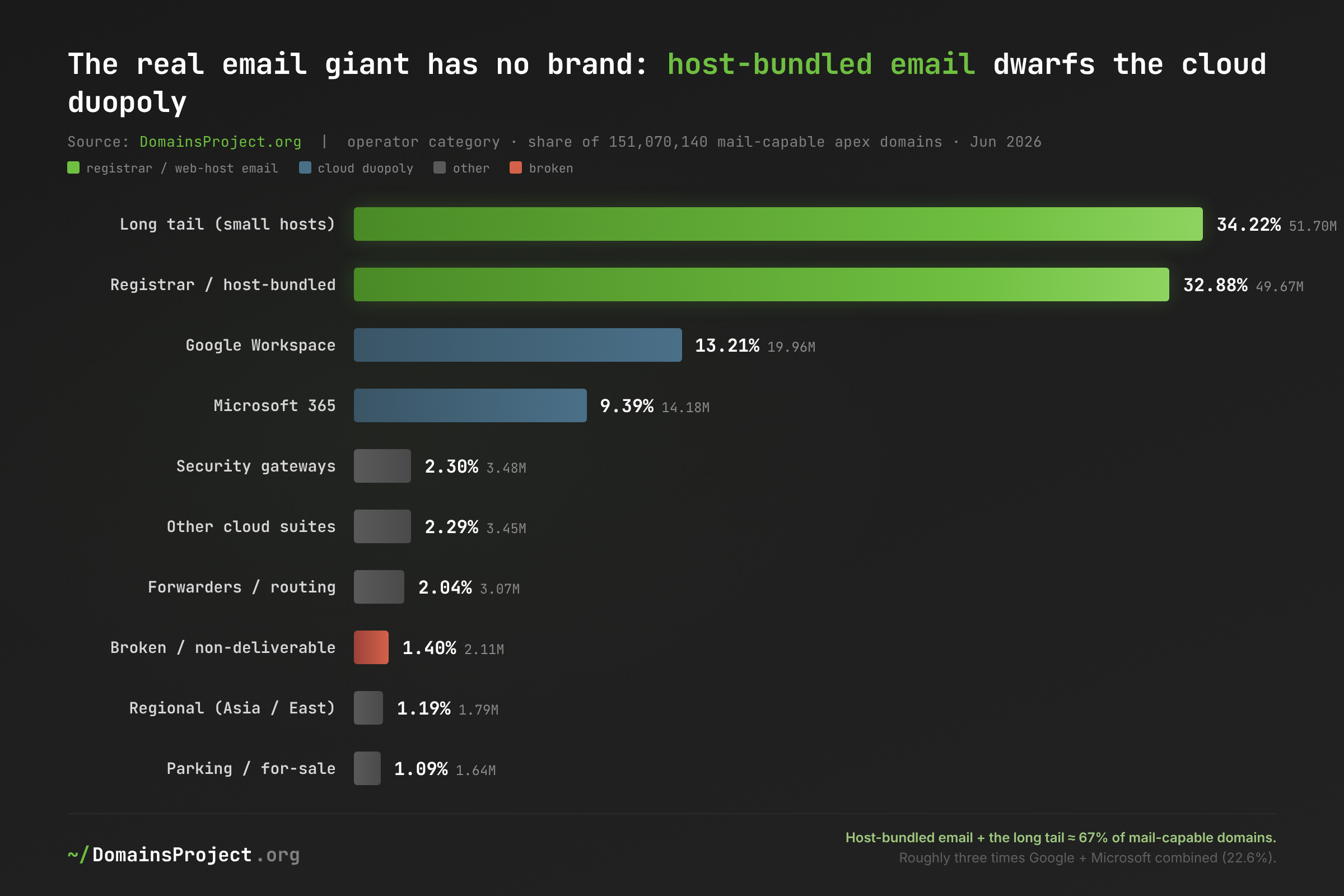
Registrar- and host-bundled email serves 32.88% of mail-capable domains before the long tail is counted, and well over half once it is. GoDaddy (6.18%), IONOS (4.27%), Namecheap (4.17%), Hostinger (2.89%), OVH (1.94%) and Strato (1.83%) are the visible giants, but the category's real mass is in its fragmentation: the 34.22% unclassified residual is not a missing major provider, it is thousands of regional web hosts — transip.email in the Netherlands, kv.de and lima-city.de in Germany, websupport.sk in Slovakia, seznam.cz and web.de for consumers, locaweb.com.br in Brazil — each running its own mail server for a few tens of thousands of domains. The white-label platform underneath many of them is visible too: nearly 2 million domains route to a generic Open-Xchange host, the engine a large share of European and Asian web hosts resell as "your email."
This is the structural fact the seat-count charts miss: for most of the world, email is not a product you choose, it is a checkbox that came with the domain. A small business that registers example.de at IONOS gets IONOS email by default; it never evaluates Google or Microsoft, and it appears in this census as an IONOS domain. That default is why the host-bundled category is both enormous and invisible — no host markets itself as an "email provider," yet collectively they out-deliver Google and Microsoft combined. It is also why email is so much less concentrated than the rest of the stack: domains follow their registrar, registrars are national, and there are a great many national registrars.
Two single operators serve more than a million domains each and almost no one has heard of them. A host advertising itself only as mx.plingest.com (1.19 million domains) and another as mx1-hosting.jellyfish.systems (1.03 million) each run more apex MX records than Apple iCloud or Proton. Their exact nature — pure hosting, or a domain-portfolio operator — is unverified, but their scale is a reminder that the mail layer's long tail contains operators larger than household-name suites, hidden only by the absence of a brand.
Email Is a Map: Where Google and Microsoft Each Win
Reduce the duopoly to a single global number and you lose the most striking pattern in the data: the Google–Microsoft race has a geography, and it is sharp.
| TLD | Mail-capable | Microsoft 365 | Local incumbent | |
|---|---|---|---|---|
| .com | 70,386,805 | 17.69% | 10.87% | GoDaddy 8.70% |
| .com.au (Australia) | 1,577,673 | 19.53% | 31.81% | — |
| .ca (Canada) | 1,554,454 | 17.03% | 20.56% | GoDaddy 9.81% |
| .co.uk (UK) | 3,922,081 | 11.27% | 16.85% | IONOS 8.89% |
| .nl (Netherlands) | 3,012,860 | 4.83% | 12.45% | — |
| .no (Norway) | 403,586 | 6.43% | 18.80% | — |
| .de (Germany) | 10,145,657 | 1.53% | 5.28% | IONOS 16.31% |
| .fr (France) | 3,114,887 | 4.40% | 5.71% | IONOS 11.75% |
| .es (Spain) | 1,024,111 | 4.88% | 5.03% | IONOS 16.52% |
| .com.br (Brazil) | 2,212,526 | 11.01% | 4.77% | — |
| .in (India) | 1,027,153 | 15.96% | 4.21% | GoDaddy 12.49% |
| .io (developer) | 505,046 | 30.39% | 9.37% | — |
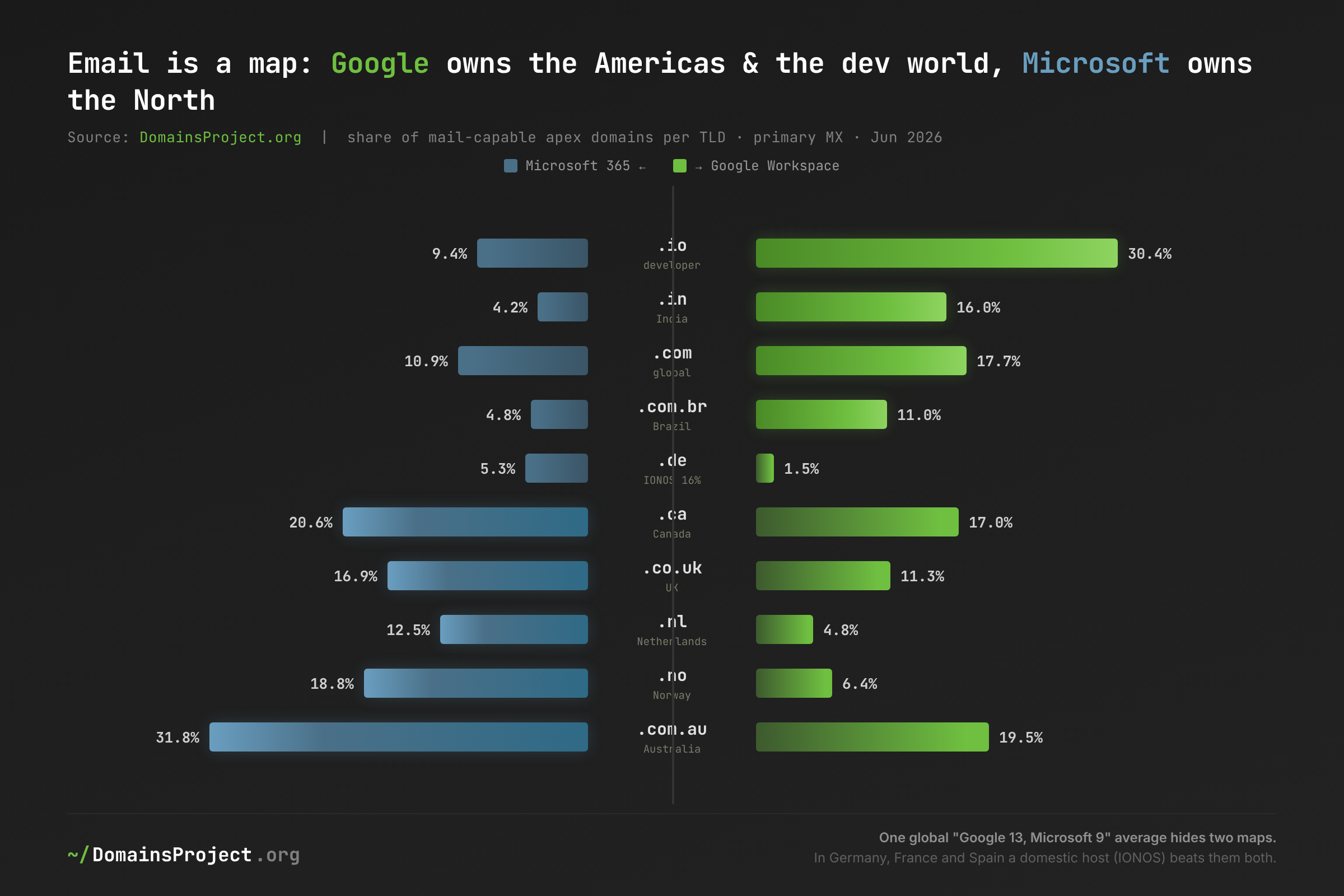
Microsoft owns the Commonwealth and Northern Europe; Google owns the Americas and the developer world. Microsoft 365 beats Google outright in Australia (31.8% to 19.5%), Canada, the United Kingdom, the Netherlands, and across the Nordics and Alpine countries — .no 18.8%, .se 15.0%, .be 15.4%, .dk 13.5%, .ch 9.5%, .at 10.7% — a belt of Microsoft-first email running through the wealthier, English- and Germanic-language, enterprise-heavy markets. Google inverts it everywhere else: it leads the global .com (17.7% to 10.9%), Brazil, India, Mexico, and dominates the developer namespaces outright, taking 30.4% of .io. The single worldwide "Google 13, Microsoft 9" average is the sum of two different maps, not a description of any one country.
In the largest European markets, neither global giant wins at all. Germany's most common email operator is not Google or Microsoft but IONOS, at 16.3% — Google reaches just 1.5% of German domains. The same domestic-incumbent pattern holds in France (IONOS 11.8%) and Spain (IONOS 16.5%), and the host-bundled long tail is thickest in exactly these markets. Where a country has a strong national hosting industry, its domains take the email that came with their hosting, and the duopoly is a rounding error. Email's geography is, underneath, a map of which registrars each country grew up with.
The Broken and the Silent: What an MX Record Doesn't Mean
The most-overlooked column in this census is the one for domains that publish no working mail configuration at all — and it is the majority.
| Deliverability state | Apex domains | Share of observed |
|---|---|---|
| No MX record (SOA-only) | 227,696,287 | 58.31% |
| Mail-capable (working MX) | 151,070,140 | 38.68% |
| Null MX — RFC 7505 "no mail here" | 11,753,693 | 3.01% |
(of mail-capable) MX points at localhost/broken |
2,109,682 | 1.40% of mail-capable |
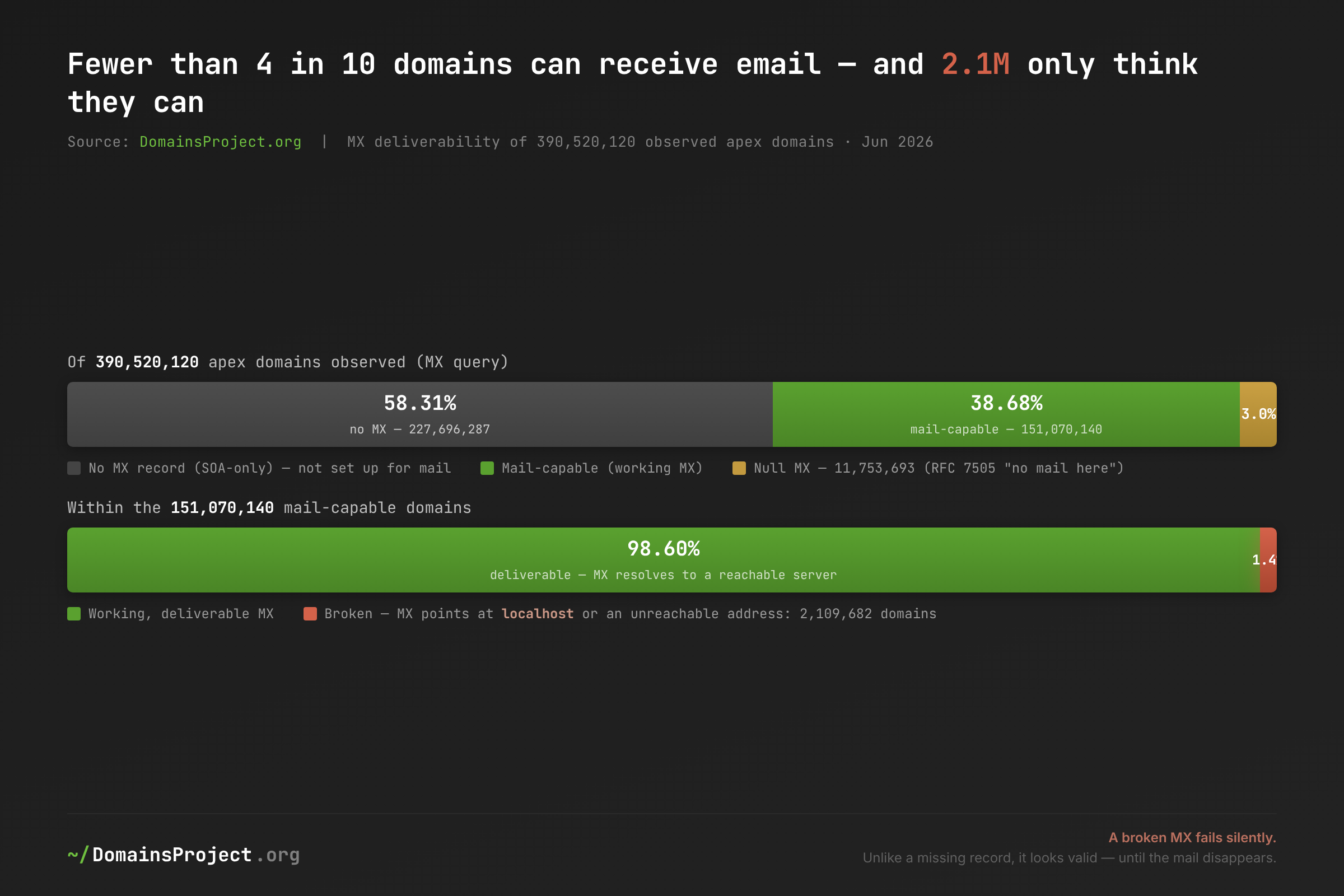
Fewer than four in ten registered domains can receive email. The 58.3% with no MX are not all dormant — many are redirect-only sites, app domains, or brand-defensive registrations that were never meant to carry mail — but the scale is a useful corrective to the assumption that a domain implies a mailbox. Most domains are not addresses you can write to.
3.01% of domains have explicitly said "do not send us mail," and that number has never been measured at this scale. RFC 7505 defines the null MX — a single MX record of preference 0 and exchange . — as a domain's way of declaring it sends and receives no mail, so that a sending server fails immediately instead of retrying for days. There is no published Internet-wide adoption figure for it the way there is for SPF or DMARC; 11,753,693 domains, or 3.01% of everything we observed, is, to our knowledge, the first full-corpus measurement of null-MX adoption. It is a small but deliberate and growing hygiene signal — and notably one Cloudflare's DNS does not yet support, which caps how high it can climb on the Internet's most popular DNS host.
And 2.1 million domains have email that cannot work. Beyond the deliberate null-MX opt-outs sit the 1.40% of mail-capable domains whose lowest-preference MX is localhost, a literal IP address, a ~, or another exchange no external server can ever reach. These owners did not opt out of mail; they misconfigured into it, and unlike a missing MX — which at least fails cleanly — a broken MX looks valid to the domain owner right up until the mail silently disappears. It is the deliverability equivalent of the broken AAAA records the IPv6 census found: a configuration that exists, validates, and does not function.
What's at Stake
- The "Microsoft vs Google" framing is incomplete without the denominator. A vendor comparison that cites seats reaches the opposite conclusion from one that cites domains, and both are correct about different populations. Any claim about email market share that does not say what it is counting is unfalsifiable.
- Host-bundled email is a single point of failure no one tracks. When most of a country's domains take the mail that came with their registrar, an outage or breach at one national host is an outage for an entire economy's small businesses — a concentration risk that is invisible precisely because it is distributed across thousands of unbranded hosts.
- The gateway and reseller layers make MX-based market share systematically wrong about Microsoft. Researchers, journalists, and competitors who rank email providers by MX records are undercounting the enterprise incumbent by an unknown but non-trivial margin. The first hop is not the mailbox.
- Deliverability is a security and continuity problem, not just a marketing one. 2.1 million domains with broken MX records cannot receive password resets, invoices, or breach notifications, and their owners do not know it. The 58% with no MX are a phishing consideration: a domain with no mail policy is easier to spoof.
- Email is the counter-example to platform concentration. Every other infrastructure layer DomainsProject measures — DNS, CDN, IPv6, CNAME targets — is concentrating into a few hands. Email, uniquely, is not, because its defaults are national and its long tail is genuine. That fragmentation is both a resilience and an interoperability story worth defending.
What Would Help
- Operators: verify your MX resolves to something that exists. The cheapest reliability win available is to confirm your lowest-preference MX is a reachable mail server and not
localhost, a stale IP, or a typo — 2.1 million domains would pass a test they are currently failing silently. If your domain genuinely handles no mail, publish a null MX and say so deliberately. Benchmark your own apexes against the dataset. - Hosting providers: your default is the market. The host-bundled category is enormous because email ships switched-on with the domain; that same default is your customers' deliverability floor. Run a working, monitored mail platform — or partner with one — because for most of your customers you are the email provider whether you market it or not.
- Analysts and journalists: report seats and domains as two different metrics, always. "Microsoft leads" and "Google leads" are both true, of seats and of domains respectively. Separate them, name the gateway and reseller undercount, and the contradiction dissolves into two clean, defensible facts instead of one misleading average.
- Security teams: inventory mail policy from the records, the way an attacker does. Every fact in this post came from public MX queries in seconds. Resolve your own apexes, confirm the MX is intended and reachable, publish DMARC and a null MX where appropriate, and treat any
localhostor unreachable exchange as an incident to fix. Cross-reference the statistics dashboard and the State of TXT authentication census. - Registries and policy makers: a national hosting industry is an email-sovereignty asset. The markets where neither US giant leads — Germany, France, Spain — are precisely those with strong domestic hosts, and their domains keep their mail at home by default. ccTLD programs that support local hosting are, whether they intend it or not, the most effective email-localization policy available. Benchmark per-TLD provider mixes against the per-TLD statistics.
Methodology: 151,070,140 apex MX records from a DomainsProject full-corpus typed DNS crawl dated 9 June 2026 (3,165 archives, ~52 GB compressed), drawn from 390,520,120 observed apex domains and reduced via ICANN public-suffix rules; each mail-capable apex attributed to the operator of its lowest-preference MX. Operator classification is heuristic, validated by manual sampling of the largest registrables, with 65.8% of mail-capable domains assigned to a named operator and the unclassified remainder shown to be predominantly small regional hosts. Provider shares are read as domain counts, not seats; the cloud duopoly is undercounted by secure-email-gateway and reseller layers as described in the methodology, so Microsoft's share is a floor. External triangulation from the UCSD/ICANN IMC 2021 measurement "Who's Got Your Mail?", Gartner, Microsoft FY26 financials, 6sense, Datanyze, BuiltWith, W3Techs, and RFC 7505. Russian-administered TLDs excluded throughout. This is a single snapshot; no growth claims are drawn from it. Companion measurements of the same corpus appear in The Landlords of the Web, The IPv6 Mirage, Where the Fortune 500 Actually Live, and A State of TXT. Explore the full dataset at /dataset and per-TLD statistics at /stats/.