India reaches the Internet better than almost anyone on Earth. As of April 2025, 78.2% of Indian users were IPv6-capable by APNIC Labs' measurement — the second-highest national figure in the world, ahead of every G7 country and nearly double China's. Reliance Jio, the all-IP mobile network that added 400 million subscribers in five years, runs at roughly 95% IPv6 capability. A billion-plus people went online over infrastructure that the United States and most of Europe are still struggling to retrofit.
The conventional story stops there: India as the great connectivity success of the 2010s, leapfrogging the desktop era straight into mobile, IPv6, and a billion users on cheap data. It is a true story, and it is only half of one. Connectivity is the eyeball side — who can reach the Internet. The other side is the content side — where the Internet that Indians reach actually lives, who operates it, and under whose flag. Those two halves are usually assumed to move together. In India, they have come apart.
We measured the content side directly. We parsed 20,223,718 hostnames in the .in namespace — the country-grouped extract of our 22.6-million-entry .in dataset, the 18th-largest TLD we track — and then ran the resolving subset through a battery of typed DNS crawls from June 2026: forward-DNS (A and AAAA), mail (MX), nameserver (NS), and email-authentication (DMARC, MTA-STS, BIMI) records, cross-referenced against an IP-to-ASN mapping built from the full dataset. The question was simple: does India's world-class access network have a world-class content layer behind it?
It does not. Only 20.3% of resolving .in domains are hosted on Indian soil — the United States alone hosts 42.7%, more than twice as much. Only 20.3% of .in domains offer IPv6 at all, against the 78% of Indian users who can use it, and the single largest operator of the Indian web is Amazon Web Services, an American company, which hosts roughly a quarter of all .in domains — more than the entire share hosted on Indian soil. India built the world's #2 IPv6 access network and a content layer that ignores it, registered through American registrars, parked on German monetization farms, and served from Virginia.
The Data
DomainsProject continuously crawls and indexes domains across every delegated TLD in the IANA root zone. For this analysis we combined the static namespace (what names exist) with live typed DNS crawls (what those names resolve to and how they are configured).
| Layer | Source | Scope |
|---|---|---|
.in namespace |
DomainsProject dataset | 20,223,718 hostnames / 5,305,866 registrable apexes |
Canonical .in count |
DomainsProject /stats/tld/in |
22,565,110 (rank #18, 0.71% of 3.18B) |
| Forward DNS (A) | bigone crawl, 9 Jun 2026 | 10,208,576 resolving .in hostnames, geolocated |
| IPv6 (AAAA) | bigone crawl, 9 Jun 2026 | 11,056,770 .in names queried |
| Mail (MX) | bigone crawl, 9 Jun 2026 | 11,005,579 .in names queried |
| Nameservers (NS) | bigone crawl, 9 Jun 2026 | ~5.6M .in apexes with NS |
| Email auth (DMARC/MTA-STS/BIMI) | bigone crawl, 5 May 2026 | 4.23M / 3.30M / 3.31M .in names |
| IP-to-ASN | DomainsProject ASN mapping | 9,789,768 .in domains across 6,691 ASNs |
Two counts diverge and both are correct. Our 5.3 million registrable .in apexes exceed the registry: NIXI, the National Internet Exchange of India, describes .in as "trusted by 3.0 million plus" users, and Verisign's industry briefs put 2024 registrations near 4.1 million. We capture more than are currently registered because our dataset is cumulative — it includes names that resolved historically, lapsed registrations still in propagation, and the long tail of subdomains that the registry never counts. This is the normal pattern for a ccTLD crawl, and the inverse of what we found in China, where the Great Firewall hid most of the registry from us.
Methodology
Every quantitative claim below traces to one of the data layers above. The classification labels:
- Hostname / FQDN — a fully-qualified name (
www.example.in). The unit of the namespace count. - Registrable apex — the name a registrant actually pays for, computed against the Public Suffix List for
.in(sobrand.in,brand.co.in, anddept.gov.inare each one apex, whilemail.brand.inis not). The unit of the registry comparison. - Resolving — returns at least one A (IPv4) answer in the forward-DNS crawl. The crawl carries
NOERRORresponses only, so non-resolving andNXDOMAINnames are absent from the denominator; resolving shares are computed against names that answered. - Hosted in country X — the serving IPv4 address of the primary (first) A record geolocates to X (MaxMind GeoIP). For names behind Cloudflare's anycast ranges (detected by published CIDR), we label the host Cloudflare rather than a country, because the origin is hidden behind the edge.
- Offers IPv6 — returns at least one AAAA answer. Origin-native IPv6 strips names whose only AAAA is a Cloudflare anycast address, isolating IPv6 the operator deliberately enabled.
- Mail-enabled — returns at least one MX record. Provider is classified from the lowest-preference MX hostname; self-hosted means the MX lives under the domain's own name.
- DMARC enforcing — a valid
v=DMARC1record with policyp=quarantineorp=reject(notp=none).
Known limitations. Hosting geolocation reflects the serving IP, not corporate ownership — an .in domain on Amazon's Mumbai region (ap-south-1) geolocates to India but is operated by a US company, a distinction we return to explicitly in the ASN section. GeoIP for anycast and domain-parking IP ranges is unreliable; we cross-check the country view against the IP-to-ASN view, which identifies operators directly. Parked domains inflate apex counts and can carry registrar-default DMARC and NS records that do not reflect an active publisher's choices. IPv6 geolocation is unavailable in this crawl, so the AAAA analysis is presence-only. The eyeball IPv6 figure is APNIC Labs' sampled capability metric; Google's measurement runs materially lower because the two reach different ISP customer bases — we cite APNIC throughout and flag the metric. Russian-territorial TLDs are out of scope and were not involved in this analysis.
The Scorecard: Two Indias
| Metric | Access side (eyeballs) | Content side (.in domains) |
|---|---|---|
| IPv6 | 78.2% of users capable (APNIC, #2 worldwide) | 20.3% of domains offer AAAA (≈14.8% origin-native) |
| Location | 954M users on domestic ISPs/mobile | 20.3% hosted in India; 42.7% in the US |
| Largest operator | Reliance Jio (~470M subscribers) | Amazon AWS (~24% of .in domains) |
| WhatsApp Business (~500M users) | 28% of domains run mail at all | |
| Email leader | — | Google 11.4% / Microsoft 3.2% — Zoho (India) outranks Microsoft |
The two columns describe the same country and barely agree on anything. The left column is the India of the connectivity narrative: world-leading, domestic, mobile-first, a billion strong. The right column is the India of the namespace: a minority hosted at home, a fifth IPv6-enabled, run by foreign clouds and foreign registrars, with most domains carrying no mail because the conversation moved to WhatsApp. The rest of this analysis is the right column, measured layer by layer.
The Flat Namespace: India Skipped the .co.in Era
Every ccTLD inherits a structure decision made at birth, and most never escape it. The United Kingdom built its namespace under .co.uk, and 83% of British domains still live there. Brazil enforced .com.br and dozens of category second levels. China kept .com.cn alongside direct .cn. India did something different — and the data shows it worked.
.in second-level composition
| Second level | Hostnames | Share | Role |
|---|---|---|---|
.in (direct) |
16,296,366 | 80.58% | General registration |
.co.in |
3,112,713 | 15.39% | Legacy commercial (third level) |
.org.in |
259,585 | 1.28% | Organizations |
blogspot.in |
209,863 | 1.04% | Google Blogger subdomains |
.net.in |
116,031 | 0.57% | Network operators |
.ac.in |
89,926 | 0.44% | Academic (ERNET-administered) |
.edu.in |
63,941 | 0.32% | Education |
.ind.in |
34,955 | 0.17% | Individuals |
.gov.in |
26,462 | 0.13% | Government (NIC-administered) |
.gen.in / .firm.in / .res.in |
13,805 | 0.07% | Legacy category SLDs |
.nic.in / .mil.in |
71 | <0.01% | Internal / military |
80.6% of all .in hostnames register directly under the TLD — the exact inverse of the United Kingdom, where 83% sit under .co.uk. When NIXI liberalized .in on 16 February 2005 and opened direct second-level registration — more than 33,000 names were claimed in the first minutes — it offered registrants a choice between the modern flat form (brand.in) and the inherited third-level form (brand.co.in). India chose flat, decisively. The legacy .co.in retains a meaningful 15.4% minority, but the category second levels meant to organize the namespace by registrant type — .firm.in, .gen.in, .ind.in — never gained traction, together accounting for less than 0.3% of names.
The government namespace is strikingly small: 26,462 .gov.in hostnames represent the online footprint of India's union and state governments, and the once-standard .nic.in is functionally extinct at 71 names. .gov.in is administered exclusively by the National Informatics Centre under MeitY, which makes it a clean census of official web presence rather than a registrar free-for-all. For a federal democracy of 28 states and 1.4 billion citizens, fewer than 27,000 government hostnames is a thin layer — consistent with a state that delivers most digital services through a handful of large platforms (Aadhaar, UPI, DigiLocker, the national data centres) rather than thousands of independent departmental sites.
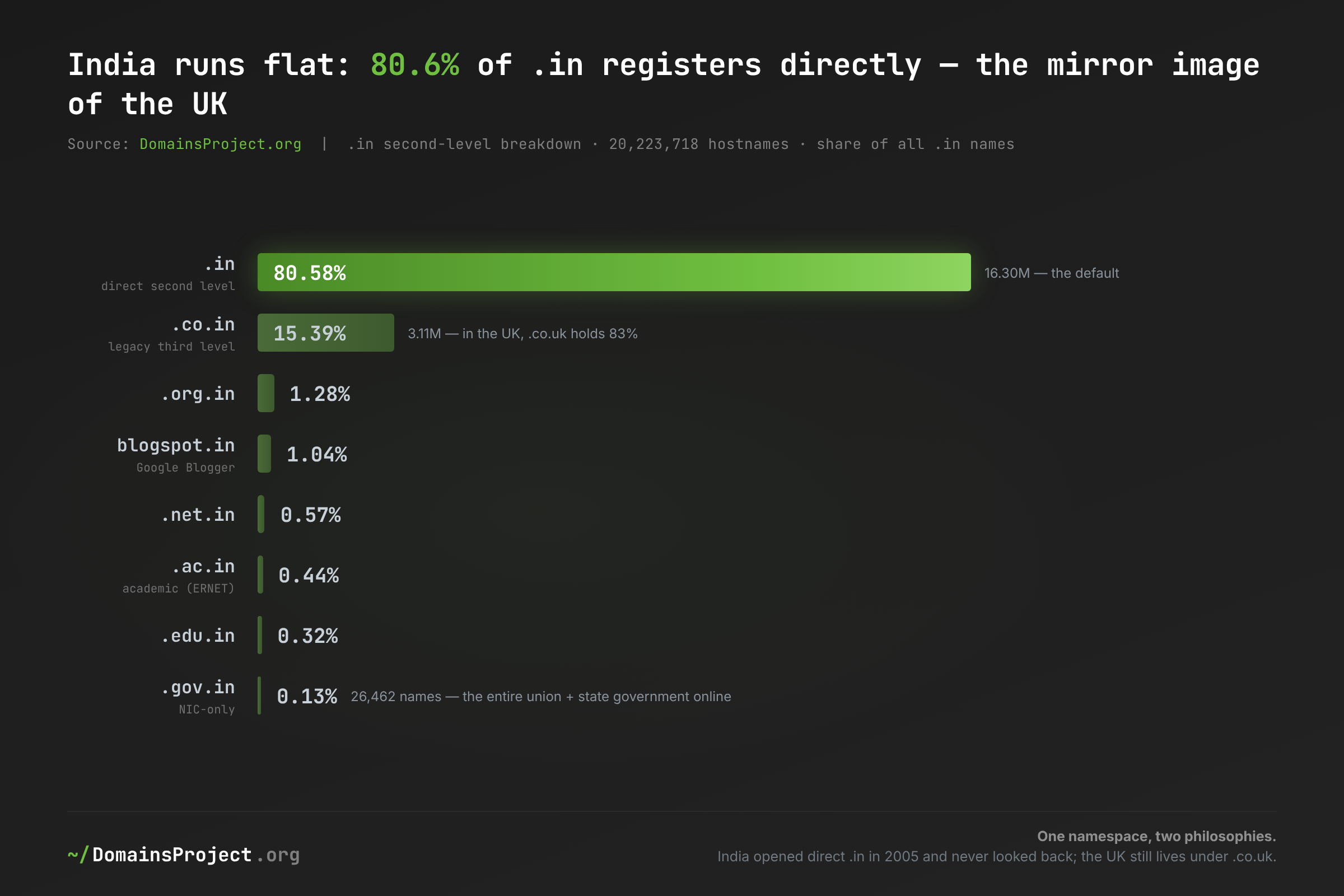
India's names are also long and alphabetic. Only 0.61% of registrable .in apexes are all-numeric — a rounding error next to China's 5.1%, where numerology drives a numeric-domain aftermarket. And 35% of .in apex labels run 13 characters or longer, with another 34.5% in the 9–12 band: Indian registrants favor full, descriptive, English-language strings over the compressed brandable names that dominate .com and .cn. The namespace reads like the search queries it is built to capture.
Where the Indian Web Actually Lives
If the namespace is unmistakably Indian, the infrastructure underneath it is not. We resolved 10,208,576 .in hostnames and geolocated each by the country of its serving IP address. This is the central finding of the analysis.
Hosting country of resolving .in domains
| Hosting location | Hostnames | Share |
|---|---|---|
| United States | 4,358,139 | 42.69% |
| India | 2,067,268 | 20.25% |
| Canada | 867,215 | 8.49% |
| Germany | 835,772 | 8.19% |
| Cloudflare (anycast, origin hidden) | 742,614 | 7.27% |
| Singapore | 316,997 | 3.11% |
| United Kingdom | 206,222 | 2.02% |
| Unknown / other anycast | 174,813 | 1.71% |
| Rest of world | ~639,000 | ~6.27% |
Only one in five .in domains is hosted on Indian soil. The United States alone hosts more than twice as much .in content (42.7%) as India does (20.3%). This is the inverse of what the eyeball Internet would predict: India has 954 million internet users and a domestic data-centre build-out approaching 1.1 GW of operational capacity, yet four out of five domains in its own national namespace resolve to servers in another country.
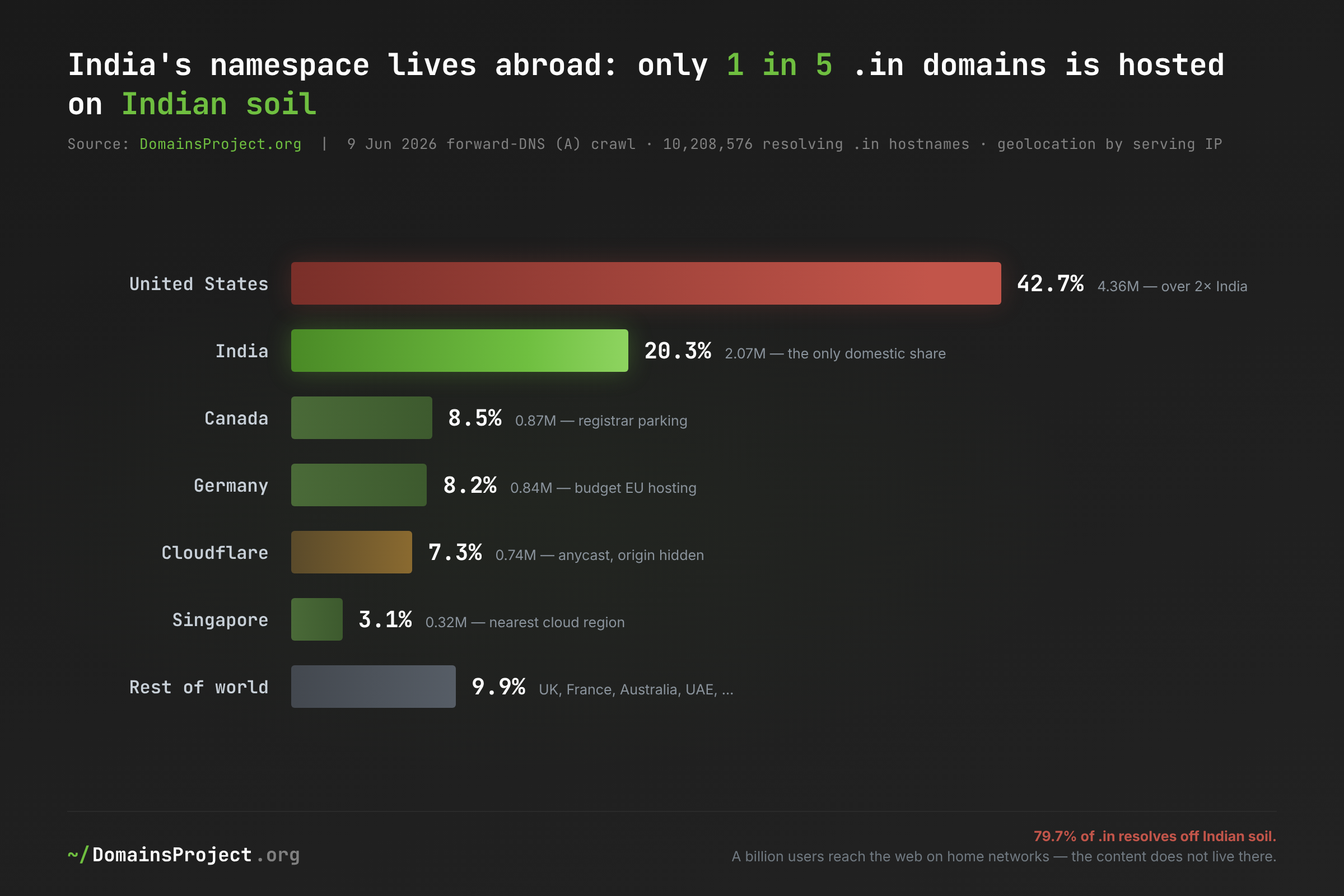
The offshore footprint is spread across the cheap-hosting and domain-monetization economy of the global north. The 8.5% in Canada and 8.2% in Germany, together with much of the Cloudflare and anycast share, are dominated by registrar parking estates and budget hosts — a pattern the IP-to-ASN data confirms in the next section. The data → inference chain is direct: when an Indian registrant points mybusiness.in at the path of least resistance, that path leads to a US or EU shared-hosting IP, and the content follows the hosting contract, not the flag. Singapore — the nearest hyperscaler region with deep capacity — accounts for just 3.1%, less than Germany, which suggests proximity is not the deciding factor; price and default registrar bundling are.
The Landlords of the Indian Web
Country-level geolocation answers where; the IP-to-ASN mapping answers who. We resolved 9,789,768 .in domains to their hosting networks across 6,691 distinct autonomous systems. The top 45 networks account for 90% of them, and the ranking is blunt.
Top networks hosting .in domains
| Rank | Network | Operator (country) | Share of .in |
|---|---|---|---|
| 1 | AS16509 Amazon AWS | Amazon (US) | ~24.0% |
| 2 | AS47583 Hostinger | Hostinger (LT, global) | 11.6% |
| 3 | AS13335 Cloudflare | Cloudflare (US) | 8.3% |
| 4 | Team Internet (AS206834 + AS61969) | Team Internet / parking (DE) | 9.1% |
| 5 | Google (AS15169 + AS396982) | Google (US) | 5.3% |
| 6 | AS46606 Unified Layer | Newfold / EIG (US) | 4.8% |
| 7 | AS394695 PDR / PublicDomainRegistry | Directi (India-origin) | 3.7% |
| 8 | AS47846 Sedo | Sedo / parking (DE) | 2.7% |
| 9 | GoDaddy (AS26496 + AS398101) | GoDaddy (US) | 2.4% |
| 10 | AS24940 Hetzner | Hetzner (DE) | 2.0% |
| 11 | AS133618 Trellian | Trellian / parking (AU) | 2.0% |
| 12 | AS199404 WHG Hosting | WHG (UK) | 1.6% |
| — | Indian-operated (CtrlS, NTT Netmagic, E2E) | India | ~1.7% |
Amazon Web Services alone hosts roughly 24% of all .in domains — more than the entire India-geolocated share (20.3%). The single largest operator of the Indian web is an American company. AWS, Cloudflare, Google, GoDaddy and Newfold — all US-headquartered — together carry well over 40% of the namespace. Hostinger, registered in Lithuania, adds another 11.6% as the dominant budget host. The combined share of clearly Indian-operated networks in the top ranks — Directi's PDR (India-origin, though much of its infrastructure sits abroad), CtrlS, NTT Netmagic and E2E Networks — is roughly 5–6%.
The "India" in the 20% geolocated share is itself substantially foreign. AWS's Mumbai region (ap-south-1, live since June 2016), Google Cloud's Mumbai and Delhi regions, Microsoft Azure's three Indian geographies, and Cloudflare's Indian edges all geolocate to India while being owned and operated by US firms. Strip them out and the share of .in hosted on Indian-owned infrastructure falls well below 10%. India's national web does not merely live abroad — even the part that lives at home is mostly a tenant in foreign-owned data centres.
A seventh of .in is parked on foreign monetization farms. Team Internet (Germany), Sedo (Germany) and Trellian (Australia) — all domain-parking and ad-monetization networks — together hold roughly 14% of resolving .in domains. This reconciles the country view: the Canadian, German and Australian shares in the geolocation table are not Indian businesses choosing European hosting for its own sake but speculative or lapsed registrations pointed at parking infrastructure that happens to live there. It is consistent with the namespace data, too — .in apexes are cheap, English, and descriptive, exactly the profile that attracts speculative registration.
The IPv6 Paradox: World-Class Access, a Content Layer That Ignores It
Here the two Indias collide most sharply. We queried 11,056,770 .in names for AAAA records and found that 2,240,858 — 20.3% — offer IPv6 at all. Strip the names whose only IPv6 address is a Cloudflare anycast edge, and operator-native IPv6 falls to about 14.8%.
IPv6: who can use it vs. who serves it
| Layer | IPv6 | Source |
|---|---|---|
| Reliance Jio subscribers | ~95% capable | APNIC Labs (AS55836) |
| All Indian users | 78.2% capable | APNIC Labs, Apr 2025 (#2 worldwide) |
.in domains with any AAAA |
20.3% | this study, 11.06M names |
.in origin-native (minus Cloudflare) |
14.8% | this study |
78% of India's users can reach IPv6, but only 20% of India's domains answer on it — a 3.9× gap between demand and supply. The access network is genuinely world-class: Jio deployed IPv6 from launch in 2016 as an all-IP network and dragged the national figure to #2 in the world. The content layer never followed. India's 20.3% server-side IPv6 is, strikingly, almost identical to the global average of ~20.4% — meaning India's domains are merely typical of the world even though its users are exceptional. The country that leads the planet in IPv6 access publishes content with the IPv6 posture of an average nation.
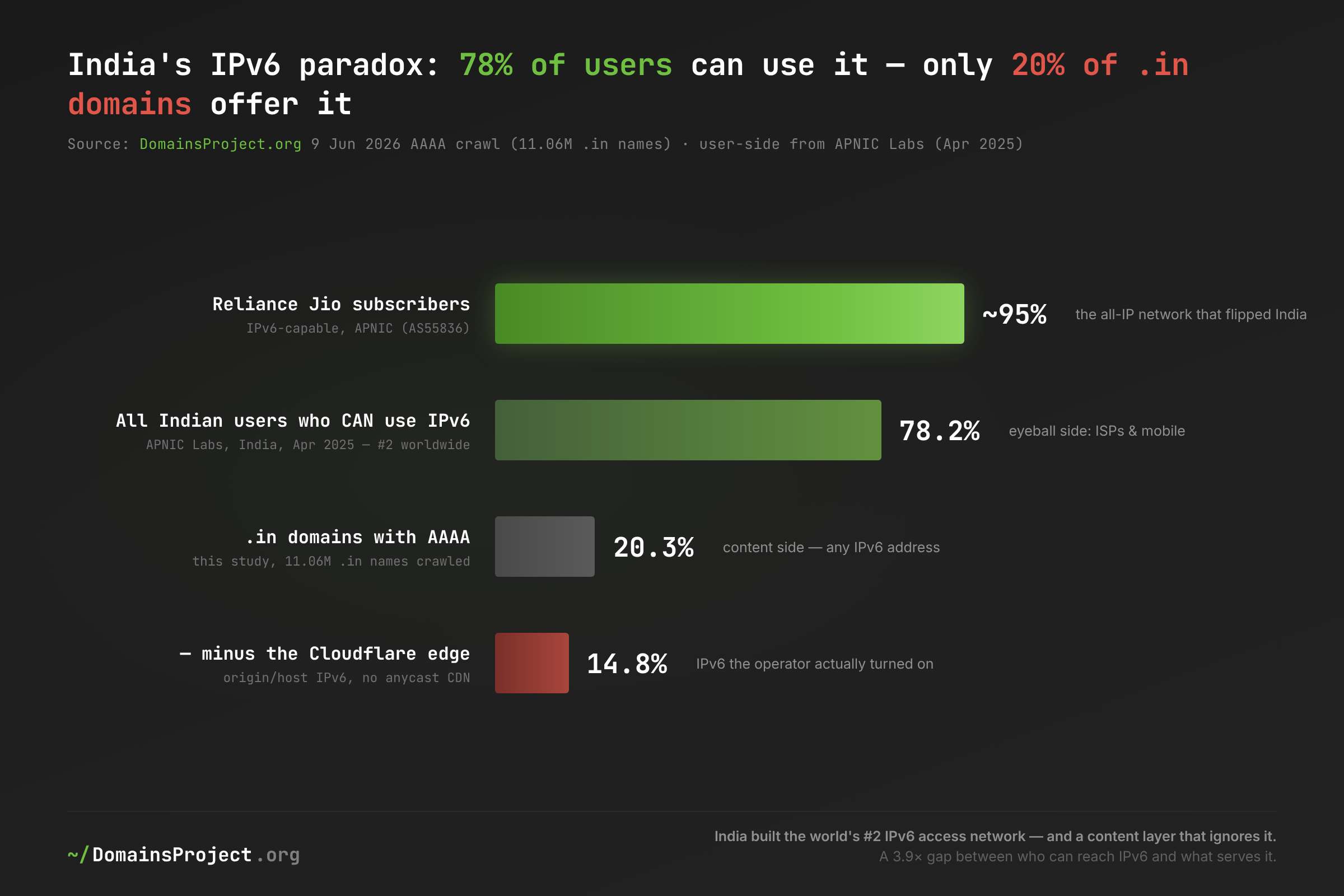
The data → inference chain is the same one we saw in the hosting tables. Server-side IPv6 is set by the host, not the registrant, and India's domains overwhelmingly sit on foreign budget hosts and parking networks whose default configurations are IPv4-only. The eyeball achievement was driven top-down by one operator with a clean-sheet network; the content layer is bottom-up, fragmented across millions of registrants on whatever hosting was cheapest, and no single actor has the leverage to flip it. The gap is not a measurement artifact — it is the structural signature of an Internet whose access and content layers were built by different people, in different decades, with different incentives.
Where India's Email Lives
Email exposes the platform shift underneath the namespace. Of 11,005,579 .in names queried for MX, only 28.0% — 3,081,150 — can receive mail at all. Nearly three-quarters of the namespace has no mail exchanger.
That 72% silence is the WhatsApp story in DNS. India has roughly 500 million WhatsApp users, and WhatsApp Business has become the default customer channel for Indian SMBs the way Mini Programs did in China — a chat thread and a phone number replace a mailbox and a website. A domain registered to capture a search result or hold a brand does not need an MX record, and most .in domains do not have one.
MX provider among mail-enabled .in domains
| Provider | Share | Notes |
|---|---|---|
| Long-tail / regional hosts | 43.1% | thousands of small Indian web hosts |
| Hostinger | 15.7% | budget host — the #1 named provider |
| Google Workspace | 11.4% | 3.5× Microsoft's share |
| Self-hosted MX | 10.8% | own mail server on the domain |
| GoDaddy / Secureserver | 9.7% | bundled registrar mailboxes |
| Zoho (Chennai, India) | 5.3% | homegrown — beats Microsoft 365 |
| Microsoft 365 | 3.2% | a distant fifth |
| Titan, Rediff (India), others | ~0.8% |
India's email does not run on the Google–Microsoft duopoly that dominates the rest of the corporate world — the two together hold barely 15% of mail-enabled .in domains. What dominates instead is bundled budget hosting: Hostinger (15.7%) and GoDaddy (9.7%) ship mailboxes with the hosting plan, and a 43% long tail of small Indian web hosts does the same. The duopoly that leads almost every other ccTLD we have measured is, in India, an afterthought.
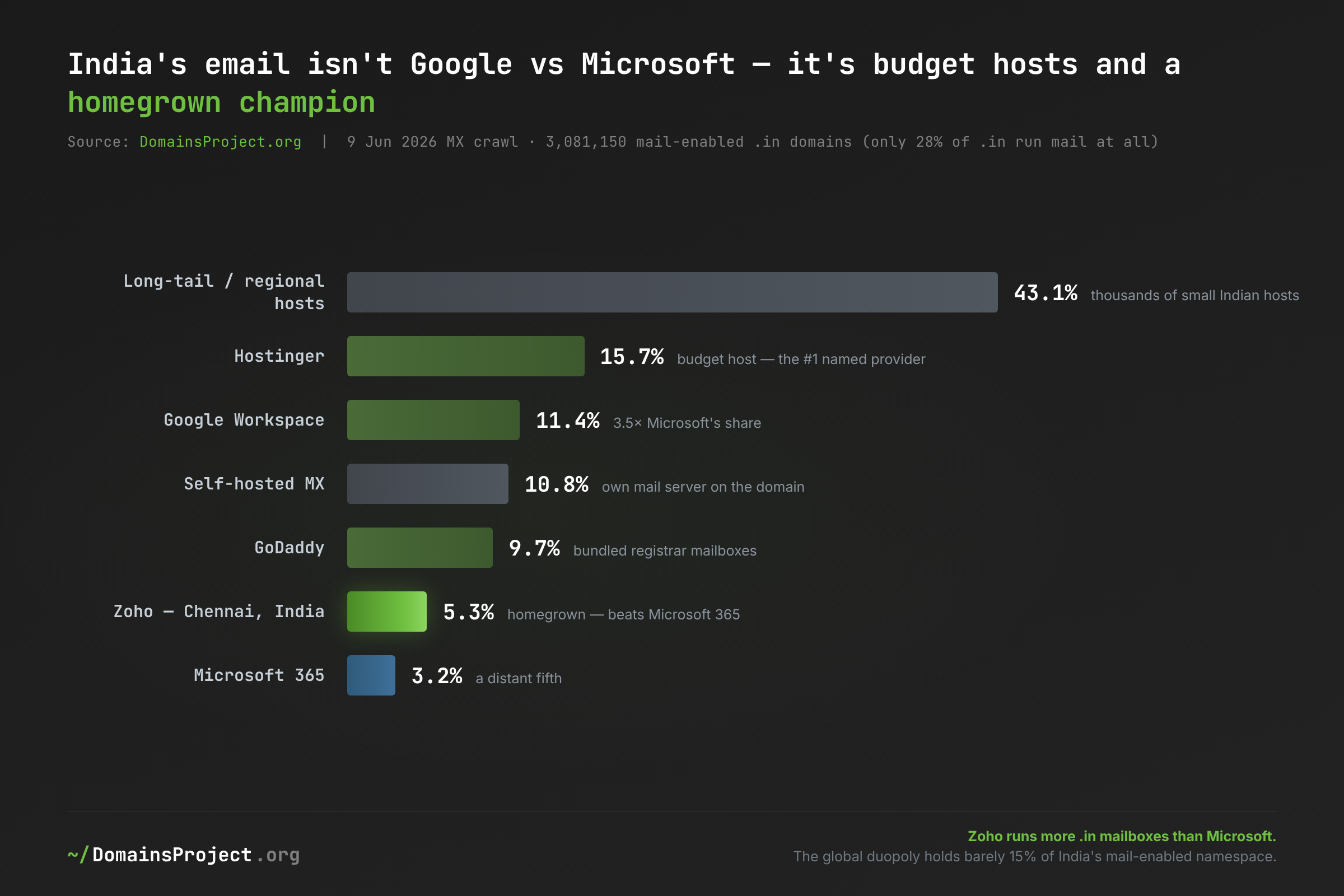
The standout is Zoho. Zoho Corporation — headquartered in Chennai, with engineering offices in rural Tamil Nadu and over 100 million users worldwide — runs the mail for 5.3% of mail-enabled .in domains, more than Microsoft 365's 3.2%. In its home market, a homegrown Indian provider outranks the global enterprise incumbent. The signal got stronger in 2023, when Zoho Mail won the Indian government's central email tender and migrated roughly 1.2 million government accounts off the legacy NIC system. Email is the one layer of the Indian Internet where a domestic operator competes at the top — and notably, it is the layer most tied to identity and data sovereignty rather than raw infrastructure cost.
Email authentication: a quiet competence
| Control | .in domains checked |
Adopted | Rate |
|---|---|---|---|
DMARC (v=DMARC1) |
4,232,548 | 950,936 | 22.5% |
— enforcing (quarantine/reject) |
— | 564,715 | 59.4% of DMARC |
| MTA-STS | 3,299,738 | 832 | 0.025% |
| BIMI | 3,311,309 | 1,457 | 0.044% |
22.5% of .in domains publish DMARC, and of those, 59.4% enforce — a posture roughly in line with the global average, and better than the budget-hosting story would suggest. Of domains with DMARC, 40.6% sit at p=none (monitoring only), 37.8% at p=quarantine, and 21.6% at the strictest p=reject. Some of the enforcement is a side effect rather than a security program: registrars and parking services increasingly set p=reject by default on non-sending domains, which is correct hygiene and inflates the enforcing share among India's many parked names. The newer controls remain vestigial — MTA-STS and BIMI are present on under 1 in 2,000 domains, consistent with their near-zero adoption everywhere. The takeaway is narrow but real: the authentication layer, which costs a DNS record rather than a hosting contract, is the one place India's content side performs to global standard.
What's at Stake
-
India's national web is hosted abroad: only 20.3% of
.inresolves on Indian soil, and under 10% on Indian-owned infrastructure — the United States hosts 42.7% and Amazon AWS alone hosts ~24%, more than the entire share geolocated to India. Sovereignty conversations under the Digital Personal Data Protection Act, 2023 are about data that, for the public web, already largely lives in Virginia, Frankfurt and Singapore. -
The IPv6 access–content gap is the widest of any major economy: 78% of users capable, 20% of domains serving — a 3.9× ratio. India proved a national IPv6 access network can be built top-down in a few years; it is the live demonstration that the content layer does not follow automatically, and that eyeball statistics overstate how "IPv6-ready" a national Internet really is.
-
A seventh of
.inis parked on foreign monetization networks — Team Internet, Sedo and Trellian (Germany and Australia) hold ~14% of resolving domains. Cheap, English, descriptive.inapexes attract speculative registration the way.xyzand.iodo, and the revenue from that parking flows out of the country. -
72% of
.indomains have no email — the namespace is increasingly a search-and-brand artifact, not a communications endpoint, as WhatsApp Business absorbs the SMB conversation. This mirrors the platform substitution we documented in China, arriving in India through chat rather than super-apps. -
One domestic champion competes at the top, and it is in email, not hosting — Zoho outranks Microsoft 365 in
.inand now carries central-government mail. The contrast with the hosting and DNS layers, where Indian operators barely register, suggests domestic providers win where the moat is identity, language and trust rather than commodity infrastructure price.
What Would Help
1. Policymakers: treat hosting location and IPv6 as distinct sovereignty metrics from connectivity. India's headline connectivity numbers are world-leading and its content-hosting numbers are not; conflating them obscures where actual dependency lies. A national dashboard tracking the share of .gov.in and critical-sector domains hosted on Indian-owned infrastructure — measurable from data like ours — would make the gap visible. Compare ccTLD hosting profiles on our country statistics page.
2. NIXI and Indian registrars: bundle domestic, IPv6-native hosting with .in registration. The data shows registrants follow the default path — and today that path leads to AWS, Hostinger and foreign parking. The single highest-leverage intervention on both the hosting-location and IPv6 gaps is changing what a new .in domain points at by default. The eyeball side was won by one operator setting a good default; the content side can be moved the same way.
3. Indian cloud and hosting providers: the 80% offshore share is the addressable market. CtrlS, E2E Networks, NTT Netmagic and the hyperscalers' Indian regions split well under a fifth of the namespace today. Latency, rupee billing, and DPDP-aligned data residency are real differentiators against US shared hosting; the gap between 20% domestic and 78% domestic eyeballs is the size of the opportunity.
4. Security teams: do not assume .in infrastructure is in India. Roughly 80% of .in resolves to foreign IP space, much of it shared budget hosting and parking. Threat models, takedown workflows, and jurisdiction assumptions built on the TLD will be wrong four times in five. Use IP-to-ASN and hosting-country data, not the TLD, to locate infrastructure — the full picture is in our dataset.
5. Researchers: India is the cleanest natural experiment in access–content decoupling. The combination of a world-#2 eyeball IPv6 network and a globally-average content IPv6 layer isolates the variable: when users are ready and content is not, the bottleneck is host defaults and registrant incentives, not user capability. Longitudinal AAAA and hosting crawls of .in would quantify whether — and how slowly — the content layer converges on the access layer.
This analysis is based on the DomainsProject dataset (20,223,718 .in hostnames parsed; 22,565,110 canonical .in entries), typed DNS crawls from the bigone collection (forward-DNS A, AAAA, MX and NS records from 9 June 2026; DMARC, MTA-STS and BIMI from 5 May 2026), and an IP-to-ASN mapping covering 9,789,768 resolving .in domains across 6,691 networks. External figures are drawn from APNIC Labs IPv6 capability statistics (April 2025), TRAI subscriber data (2024), NIXI and Verisign registry counts, and operator and registry public sources, each linked inline. Domain counts reflect what resolves on the public Internet and include subdomains; registry counts reflect second-level registrations only. Hosting geolocation reflects serving IP, not corporate ownership. Explore the full .in data on our TLD statistics page and country statistics for India, or download the complete dataset.