Updated 23 June 2026 — refreshed against the June 2026 dataset snapshot (52,157,104 observed .cn hostnames) and triangulated against our 9 June 2026 A-record crawl. The original March 2026 edition predated our data-journalism format standard and our first-party DNS resolution data. This revision adds a full Methodology section, replaces loose "domain" counts with deduplicated observed-hostname counts, and adds a resolution pass as a new centerpiece: only 49.0% of observed .cn hostnames return a live A record. Note on the count: the earlier edition cited ~126M/22.4M figures from an older pipeline; the 52.2M here is a recount on our current deduplication pipeline, not a decline in registrations — the Methodology explains the difference. Every dataset-derived figure has been updated, and where a relative claim changed, the prose was corrected.
China has more internet users than Europe has people. Its roughly 1.1 billion connected citizens generate more e-commerce revenue than the United States and Europe combined. Its tech platforms — WeChat, Taobao, Douyin — serve hundreds of millions of daily users each. By any measure of digital activity, China is among the largest internet economies on Earth.
And yet China's national domain, .cn, is the 6th-largest TLD in our dataset by observed hostnames, sitting behind .com, .net, .de, .org, and Japan's .jp — the last of which serves a population roughly a tenth the size of China's. Germany, with 84 million people, has more than twice as many observed hostnames under .de as China has under .cn. Registry-wise, CNNIC reports on the order of 20 million .cn registrations; Germany's DENIC reports about 17.7 million .de for a country with one-seventeenth the population. Proportionally, China's national namespace runs far below what its internet population would predict — and a closer look at our resolution data shows it is even thinner in live names than the raw counts suggest.
A reader named jc1ayton put it plainly: why does China have so few domains relative to its internet population? And what can the namespace itself tell us about how it got here? The answer is not a single factor but a compound one — a regulatory environment that makes registering and hosting a website harder than almost anywhere else, a platform economy that has replaced the open web with walled-garden super-apps, and a historical trajectory that includes the most dramatic boom-and-bust cycle in ccTLD history.
We parsed all 52,157,104 observed hostnames in the .cn namespace from the DomainsProject dataset, cross-referenced with CNNIC registry statistics, CENTR historical analysis, and current WeChat ecosystem data, and then ran a fresh A-record crawl to measure how much of the namespace is actually live.
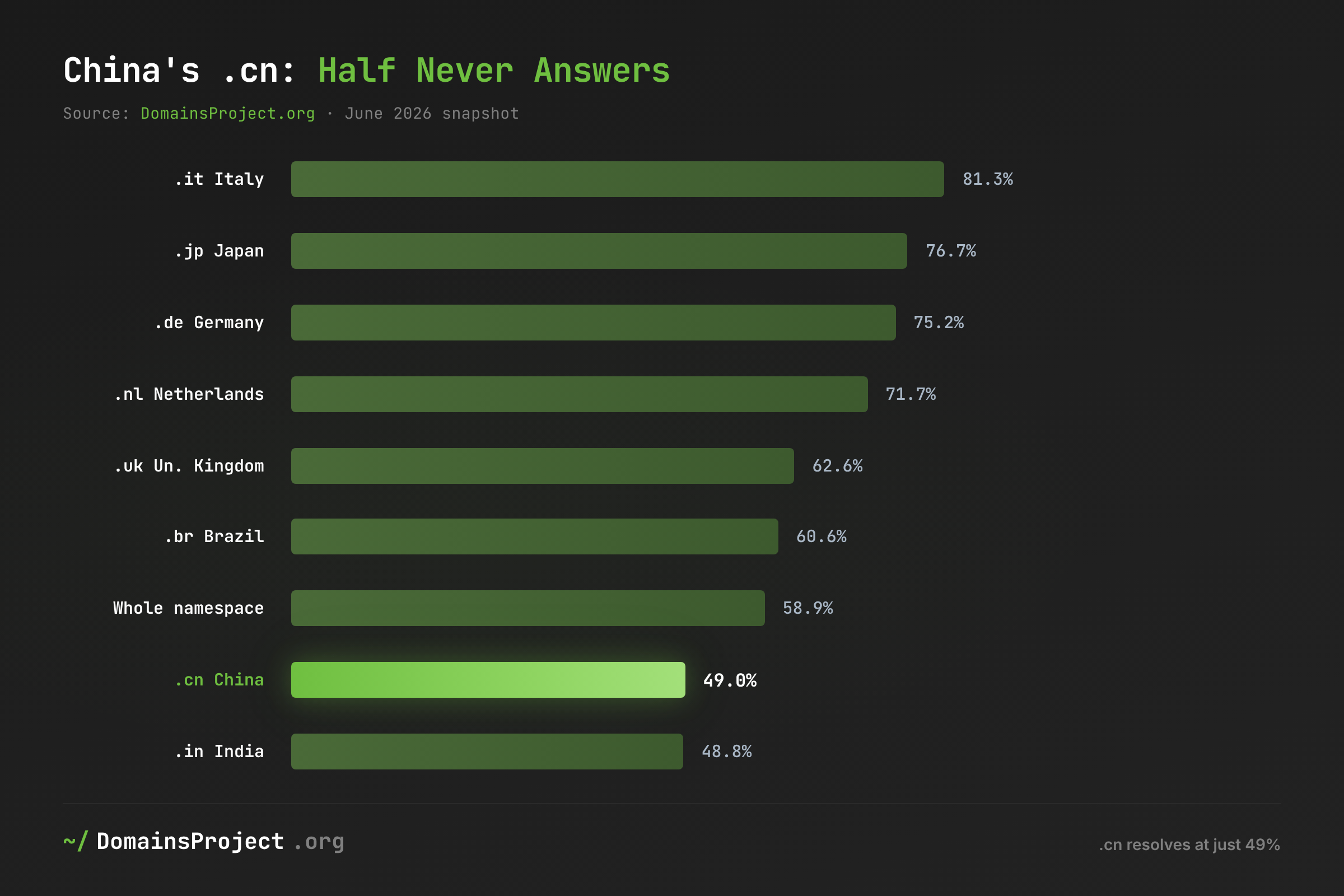
The headline: .cn holds 52.2 million observed hostnames — the world's 6th-largest TLD — but only 49.0% of them return a live IPv4 address in our June 2026 crawl, well below the 58.9% whole-namespace rate and far below the 70-81% typical of European ccTLDs. At roughly 0.037 hostnames per capita, China has the lowest national-namespace density of any major internet economy. The pattern is consistent with three reinforcing forces: a regulatory regime that requires government-issued ID and a hosting license to put a website online, a platform economy where WeChat Mini Programs have functionally replaced the open web, and a censorship infrastructure that raises the cost of independent publishing. A large share of the .cn namespace is registered or observed but not live — parked, ICP-gated, or abandoned — and our resolution data makes that visible for the first time.
The Data
DomainsProject continuously crawls and indexes hostnames across every delegated TLD in the IANA root zone. For this analysis, we parsed the full .cn namespace — all 52,157,104 observed hostnames — and categorized every entry by second-level extension, naming pattern, and infrastructure role, then cross-referenced the inventory against our June 2026 A-record crawl.
| Category | Count | Coverage |
|---|---|---|
| Active TLDs tracked | 1,511 | IANA root zone (Russian-administered TLDs excluded) |
| Total observed hostnames | 3.18B | Largest public dataset |
| .cn observed hostnames | 52,157,104 | 1.64% of dataset |
| .cn global rank | #6 | Behind .com, .net, .de, .org, .jp |
| .cn live A records (9 Jun 2026 crawl) | 25,558,222 | 49.0% of observed |
| CNNIC registry registrations | ~20M | Official count (registry, second-level) |
Two facts dominate this table. First, .cn is genuinely large in absolute terms — 1.64% of every observed hostname on the functional internet sits under it, enough for 6th place globally. Second, fewer than half of those hostnames answer in DNS. At 49.0%, .cn's resolution rate is roughly ten points under the whole-namespace average and more than twenty points under the European ccTLDs it is most naturally compared with. That gap is the story this refresh is built around: the raw count understates how unusual .cn is, because the namespace is unusually full of names that exist on paper or in our crawl but no longer point anywhere live. The dataset-versus-registry relationship is itself inverted relative to Western ccTLDs — we discuss why in the Methodology.
Methodology
This post makes quantitative claims about a single national namespace, so the definitions matter.
- Observed hostname (FQDN). Our base unit: a fully-qualified name seen in our crawl.
example.cn,www.example.cn, andmail.example.cnare three distinct hostnames under one registrable domain. The 52,157,104 figure is deduplicated observed hostnames across the active dataset and its historical GitHub mirror — not registry registrations and not apex-only counts. Where we cite CNNIC's ~20 million, that is a registry second-level-registration figure and is labelled as such. - Why this differs from the earlier edition. The original March 2026 post cited a ~126M raw line count and a ~22.4M parsed figure produced by an older pipeline that handled deduplication and historical-mirror merging differently. The 52.2M here is a recount of the same namespace on our current deduplication pipeline; it is not evidence of a registration decline. Treat the two numbers as different measurements, not a time series.
- Apex / registrable domain (eTLD+1). China's namespace uses multi-label public suffixes (
.com.cn,.net.cn,.gov.cn, provincial.sx.cn, etc.). We resolve these using the ICANN section of the Public Suffix List, soshop.example.com.cnis correctly attributed to the apexexample.com.cnrather than miscounted. Apex counts are smaller than hostname counts; any apex-derived figure is labelled where used, and where the original edition gave a precise apex/subdomain split we now treat that split as approximate because the current pipeline counts hostnames, not parsed lines. - Resolution. A hostname resolves if our 9 June 2026 A-record crawl returned a positive answer (
NOERRORwith at least one IPv4 address). The .cn resolution rate is the share of observed .cn hostnames that appear in that positive set; a name absent from it —NXDOMAIN/SERVFAIL/no answer, IPv6-only, or unreached — counts as non-resolving. This is a conservative liveness floor, not an active-site census: a live A record can still point at a parking page or an ICP-block landing page, and an IPv6-only name reads as non-resolving. For .cn there is an additional, China-specific caveat — see "Known limitations." - Classification labels. "Live / resolving" means a positive A record as above. "Direct .cn" means a registrable
name.cn; "category SLDs" (.com.cn,.net.cn,.org.cn,.gov.cn,.edu.cn) are second-level zones with their own registration rules; "geographic SLDs" are the provincial second levels (.bj.cn,.sh.cn,.sx.cn). "Numeric domain" means an apex label composed solely of digits. None of these are claims about site content. - Dataset vs. registry, and the inverted ratio. For European ccTLDs our observed-hostname count runs well above the registry's apex count, because heavy subdomaining multiplies hostnames per registration. For .cn the gap is far smaller and, on an apex basis, can run below the registry count. Three mechanisms are consistent with this: many .cn names resolve only from inside China and are less visible to external crawlers; ICP-gating and the Great Firewall reduce the external footprint of otherwise-registered domains; and a large share of names are parked or dormant and generate no subdomains. We cannot fully separate these from outside China, so we present the divergence as observed, not explained.
- Known limitations. This is a single snapshot; it measures presence and resolution, not query volume, uptime, or registry churn. Resolution is measured from outside China, so a .cn name served only by domestic infrastructure, or rendered unreachable by the Firewall to our resolvers, would read as non-resolving even if it is live for a user in Shanghai — this means our 49.0% is plausibly a floor on internal liveness, and the external-visibility gap is itself part of the finding. All historical registration figures (the timeline, the boom-bust) come from CNNIC and CENTR, not our crawl, because a snapshot cannot establish a trend. The full .cn breakdown is reproducible from the .cn statistics page and the dataset.
The Scorecard: .cn Among the Giants
Where .cn Sits — Largest TLDs by Observed Hostnames
| Rank | TLD | Type | Hostnames | Live A Record | Resolution Rate |
|---|---|---|---|---|---|
| 3 | .de | ccTLD | 117.7M | 88.5M | 75.2% |
| 5 | .jp | ccTLD | 73.4M | 56.3M | 76.7% |
| 6 | .cn | ccTLD | 52.2M | 25.6M | 49.0% |
| 8 | .br | ccTLD | 50.3M | 30.5M | 60.6% |
| 9 | .uk | ccTLD | 43.8M | 27.4M | 62.6% |
| 11 | .nl | ccTLD | 36.3M | 26.0M | 71.7% |
| 12 | .it | ccTLD | 33.1M | 26.9M | 81.3% |
| 18 | .in | ccTLD | 22.6M | 11.0M | 48.8% |
.cn is the 6th-largest TLD overall and the 3rd-largest country-code TLD, behind only Germany's .de and Japan's .jp. In absolute hostname terms it is unambiguously a heavyweight. But the rightmost column reframes that ranking: at 49.0% resolution, .cn returns a live A record for fewer of its names than any other ccTLD in the top of this table except India's .in — and well below the European cohort, which clusters at 71-81%. Japan is the sharpest comparison: .jp serves a population roughly a tenth of China's, yet it holds 73.4 million hostnames and resolves three-quarters of them, so .jp's live, answering namespace (56.3M) is more than double .cn's (25.6M). The size gap between China and Japan inverts once you count only names that actually answer.
The Resolution Gap, Stated Plainly
| Slice | Observed Hostnames | Returns Live A Record | Resolution Rate |
|---|---|---|---|
| .cn (this study) | 52,157,104 | 25,558,222 | 49.0% |
| Whole namespace (all TLDs) | 3.18B | 1.87B | 58.9% |
| European ccTLD band (.de/.nl/.it) | — | — | 72-81% |
| .中国 IDN (xn--fiqs8s) | 178,425 | 171,228 | 96.0% |
Only 49.0% of observed .cn hostnames return a live IPv4 address — a 9.9-point shortfall against the whole-namespace rate and a 20-30 point shortfall against mature European ccTLDs. The data point is striking precisely because .cn is so large: this is not a tiny long-tail TLD where a low rate is unremarkable, but the 6th-biggest namespace on the internet, half of which does not answer from outside China. The contrast with China's own IDN ccTLD, .中国 (xn--fiqs8s), sharpens it further — that namespace is small (178,425 hostnames) but resolves at 96.0%, consistent with a registrant base that configures names deliberately rather than acquiring them in bulk. The interpretation we can defend from this data is bounded: a low resolution rate is consistent with parked, dormant, ICP-gated, and externally-invisible names, and we cannot fully separate those mechanisms from outside China. What we can say is that the functional .cn namespace — names that actually answer — is roughly 25.6 million, less than half the headline count, and that this is the most direct first-party evidence yet that China's domain footprint is thinner than its registry totals imply.
The Geographic Anomaly: One Province Carries the Map
China's provincial second-level domains exist on paper but are nearly empty in practice — with one dramatic exception. The provincial .sx.cn zone (Shanxi) historically accounted for the overwhelming majority of geographic-SLD hostnames in our dataset, almost entirely ISP reverse-DNS records from broadband pool allocations rather than registered websites.
Strip out that one ISP source and China's provincial namespace effectively vanishes. Every other provincial second level — .bj.cn (Beijing), .sh.cn (Shanghai), .gd.cn (Guangdong) — carries a negligible share. Unlike Brazil's dozens of active city and category domains or the UK's .ac.uk and .gov.uk, China's geographic namespace is a structure that exists administratively but never attracted real registrant adoption. The proportions here are approximate — they describe a pattern in the namespace, not a precise apportionment — but the direction is unambiguous: provincial branding never became how Chinese organizations name themselves online. (We treat the exact per-province counts as qualitative in this refresh, because the current pipeline counts deduplicated hostnames rather than the raw parsed lines the earlier edition tallied.)
The 1 RMB Boom: The ccTLD's Wildest Ride
No major ccTLD has experienced a boom-and-bust cycle as extreme as .cn's. The story begins with a promotion and ends with a regulatory crackdown that erased three-quarters of the namespace. These figures come from CNNIC and CENTR historical reporting, not our crawl — a snapshot cannot establish a trend.
.cn Registration Timeline (CNNIC / CENTR)
| Year | Registrations | Event |
|---|---|---|
| 1990 | — | .cn delegated (28 November) |
| 1997 | 4,066 | CNNIC established (3 June) |
| 2005 | ~1,000,000 | First million registrations |
| 2007 | — | "1 RMB Experience" promotion launched |
| 2008 | ~13,000,000 | Peak — world's largest ccTLD |
| 2009 | — | Real-name verification imposed; promotion suspended |
| 2011 | ~3,500,000 | Trough — ~75% decline from peak |
| 2016 | ~16,360,000 | Surpassed .de again as largest ccTLD by registrations |
| 2023 | ~20,125,764 | Recent registry peak |
| 2025 | ~20,000,000 | Roughly flat |
In 2007, CNNIC launched the "1 RMB Experience" program — offering .cn domains for approximately one Chinese yuan (about USD 0.14). The promotion was designed to capitalize on China's exploding internet adoption, and it worked spectacularly: registrations surged from roughly 1 million in 2005 to around 13 million by the end of 2008, making .cn the world's largest ccTLD by registration count, surpassing Germany's .de for the first time.
The price attracted abuse at industrial scale. Spam, phishing, illegal content, and inaccurate WHOIS records flooded the namespace. CNNIC's response was immediate and severe. In December 2009, the registry suspended the 1 RMB program, imposed mandatory real-name verification requiring government-issued identification for all registrations, and launched a coordinated program with China's Internet Society complaint center to cancel illicit registrations and require photo-ID validation for WHOIS accuracy.
The crackdown is reported to have erased roughly three-quarters of the namespace. From around 13 million registrations at the end of 2008, CNNIC and CENTR figures put .cn at approximately 3.5 million by early 2011. No other major ccTLD is recorded as having lost that share of its registrations in under two years. The recovery took nearly a decade — .cn did not surpass .de again as the world's largest ccTLD by registration until around 2016, this time backed by verified identities rather than throwaway 1 RMB speculations. That history is relevant to the resolution finding above: a namespace shaped by anti-abuse purges and real-name gating is one where dormant-but-registered and never-configured names are structurally common, which is consistent with the low live-resolution share we observe today.
The Regulatory Gauntlet: Why Registration Is Harder in China
The 2009 crackdown was not an isolated event. It established a permanent regulatory framework that makes registering and operating a .cn website more burdensome than in any Western ccTLD.
Registration Requirements: .cn vs. .de vs. .uk
| Requirement | .cn (China) | .de (Germany) | .uk (United Kingdom) |
|---|---|---|---|
| ID verification | Government-issued photo ID (mandatory) | None | None |
| Corporate documentation | Business license for organizations | None | None |
| ICP license (hosting) | Mandatory for China-hosted sites | N/A | N/A |
| Real-name WHOIS | Required and verified | GDPR-redacted | GDPR-redacted |
| Foreign registration | Restricted (Chinese registrar typically required) | Open to anyone | Open to anyone |
| Penalty for non-compliance | Website blocking, fines, potential criminal charges | None | None |
Registering a .cn domain requires government-issued identification. Hosting a website on it inside China requires a separate ICP (Internet Content Provider) license from the Ministry of Industry and Information Technology. The ICP process requires that domain registration details match legal documents submitted to a government-approved registrar. Operating without an ICP license can trigger website blocking, fines, potential criminal exposure, and delisting from Baidu, China's dominant search engine.
In Germany, anyone anywhere can register a .de domain in minutes with no identification; the same is broadly true for .uk and .nl. China's dual-layer system — identity verification for the domain, licensing for the hosting — creates friction that does not exist in Western ccTLDs. Every additional step in a registration process is a point where potential registrants drop out, and this friction is consistent with two things we observe in the data at once: a per-capita namespace far below European peers, and a resolution rate far below them. Names that are registered defensively, gated behind ICP review, or abandoned after a verification hurdle are exactly the names that show up in the dataset but fail to return a live A record.
The Density Gap: A Per-Capita Comparison
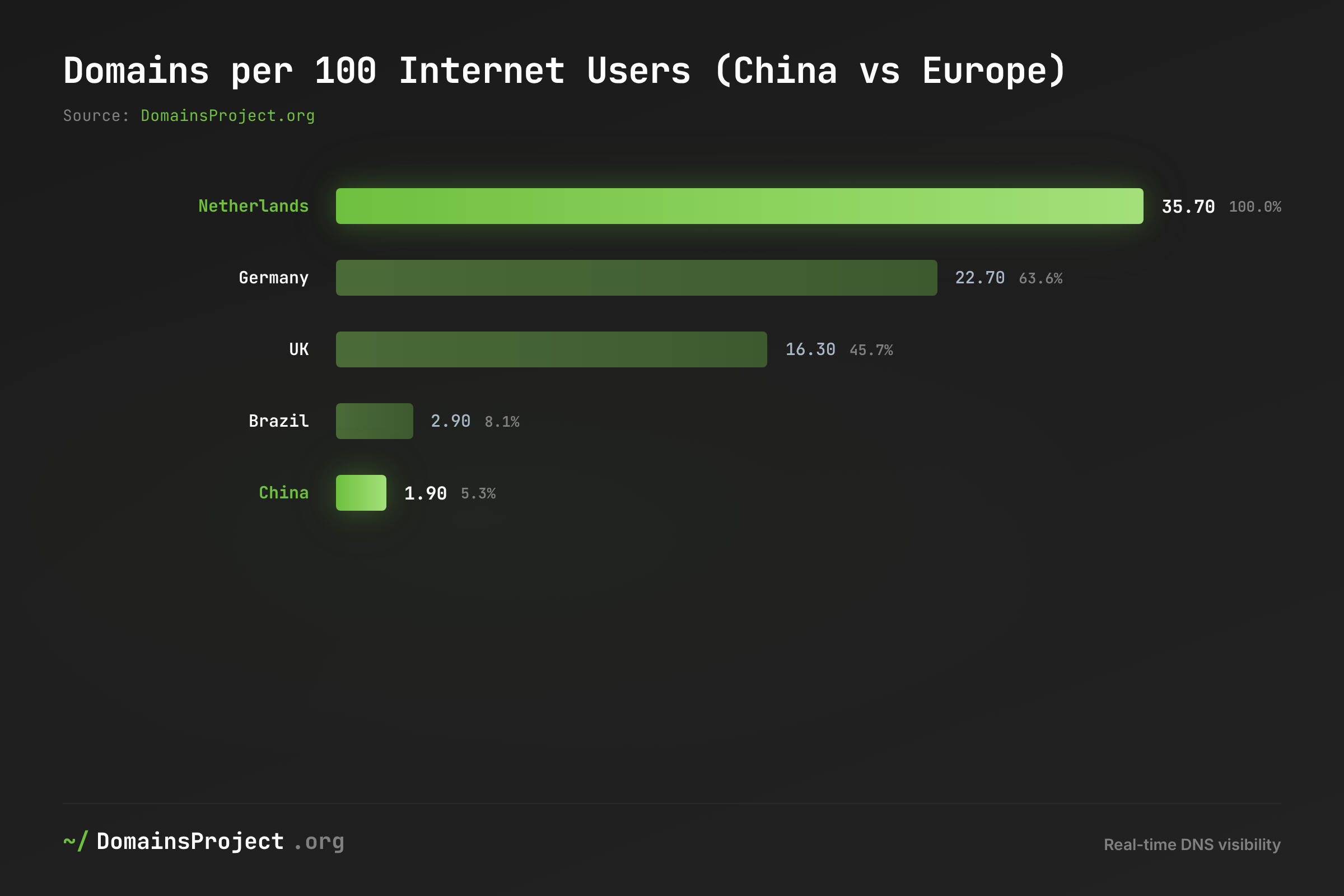
The cumulative effect of regulation, platform economics, and censorship produces a low national-namespace density. Because the current pipeline counts observed hostnames rather than registry registrations, we normalize observed .cn hostnames by population — directly comparable to the per-capita figures in our TLD-landscape study — and show registry registrations alongside for context.
Observed Hostnames Per Capita: Major Internet Economies
| Country | ccTLD | Observed Hostnames | Population | Hostnames per Capita |
|---|---|---|---|---|
| Netherlands | .nl | 36.3M | 17.9M | 2.03 |
| Germany | .de | 117.7M | 84.5M | 1.39 |
| United Kingdom | .uk | 43.8M | 68.4M | 0.64 |
| Brazil | .br | 50.3M | 212M | 0.24 |
| India | .in | 22.6M | 1.45B | 0.016 |
| China | .cn | 52.2M | 1.41B | 0.037 |
China sits at roughly 0.037 observed .cn hostnames per capita — about 55x below the Netherlands and 38x below Germany, and only just above India. Even allowing for the fact that many Chinese businesses use .com rather than .cn — and that our crawl undercounts names visible only inside China — the gap is structural rather than a rounding effect. China and India are the two billion-plus-population outliers at the bottom of this table, but they arrive there differently: India's low density reflects a structural preference for global TLDs in an English-dominant, export-oriented tech sector (see our .in companion study), while China's reflects a regulatory-and-platform regime that channels activity off the open web entirely. Germany and the UK built their namespaces during the era when "going online" meant "registering a domain"; by the time China's internet adoption exploded in the 2010s, that equivalence had already broken down.
The Super-App Thesis: Why China Skipped the Website Era
The density gap is not only a regulatory story; it is a structural one. China's internet economy developed differently from Europe's, and the difference is visible in both the per-capita and the resolution data.
In Europe, the web was the platform. When German SMEs went online in the late 1990s and early 2000s, building a website was the default — and that meant registering a .de domain. DENIC's cooperative model made it cheap, there were no identity requirements, and the open web was the primary channel for digital presence. The same pattern held in the UK, the Netherlands, and across Western Europe — and it shows up today as 71-81% resolution rates, because a registered European ccTLD name is usually a name someone is actively using.
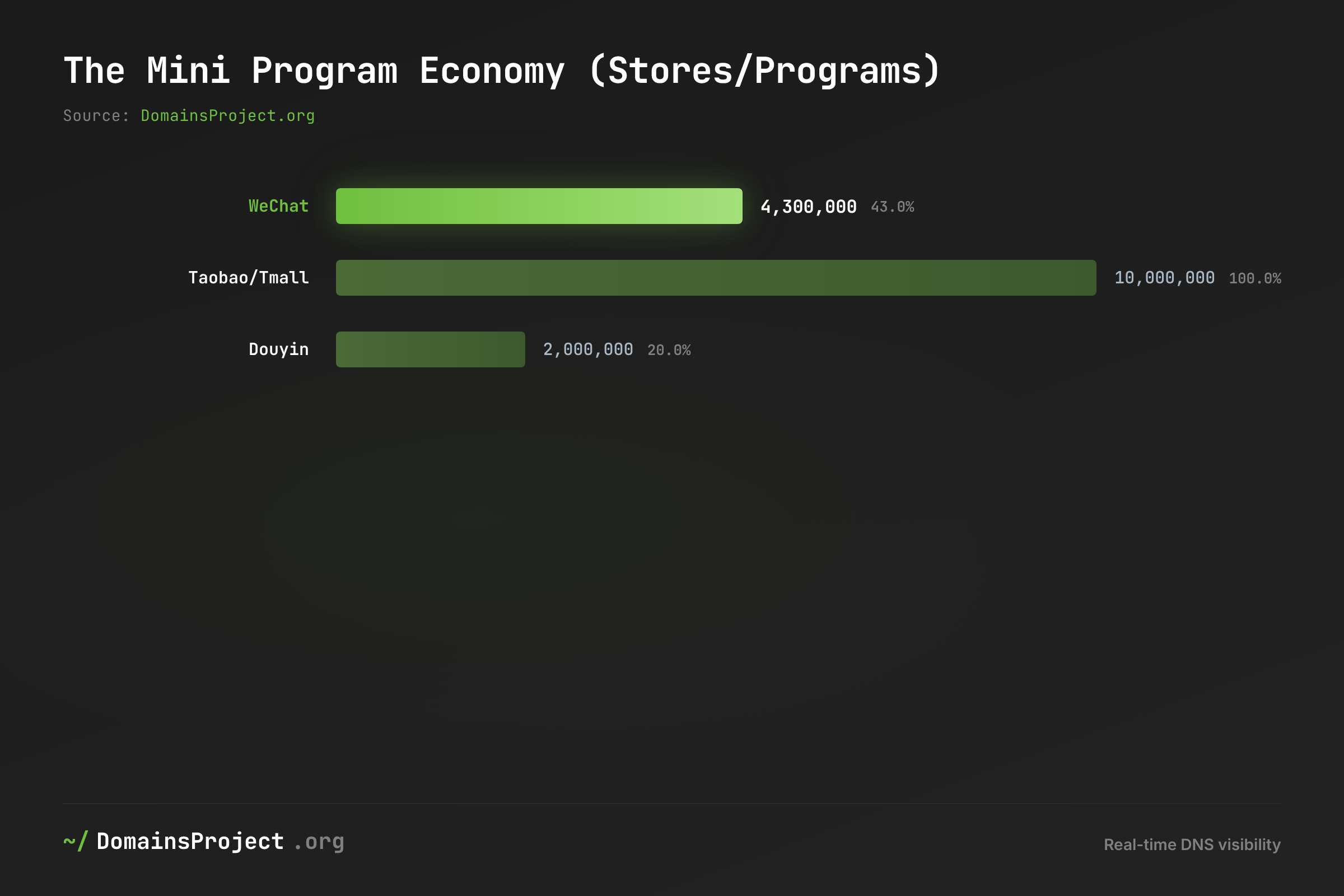
In China, platforms became the platform. By the time China's mass internet adoption occurred in the late 2000s and 2010s, the infrastructure had shifted. WeChat launched in 2011 and introduced Mini Programs in 2017. By 2025, WeChat hosts on the order of 4 million Mini Programs with hundreds of millions of daily active users — and a large majority of Chinese companies maintain a Mini Program within the app. These are not lightweight chat plugins; they are full applications — e-commerce storefronts, banking interfaces, government services, restaurant ordering — that provide what a website would, without requiring a domain name, a hosting provider, or an ICP license.
The domain-registration boom in Europe happened before social media; China's internet adoption happened after it. Germany reached its first million .de registrations in the mid-1990s, when the web browser was the only interface. China reached its first million .cn registrations in 2005, when Baidu was already dominant and social platforms were emerging. By the time Chinese internet penetration crossed 50% (around 2015), WeChat already had hundreds of millions of monthly active users. The window in which "going online" meant "registering a domain" had largely closed — and a namespace acquired by registrants who never needed a working website is a namespace where, years later, only half the names still answer.
The Mini Program Economy (Industry Estimates)
| Platform | Monthly Active Users | Mini Programs / Stores | Role |
|---|---|---|---|
| ~1.4B | ~4M Mini Programs | Super-app: commerce, services, government | |
| Taobao/Tmall | ~900M | 10M+ storefronts | E-commerce marketplace |
| Douyin | ~750M | 2M+ shops | Short-video commerce |
Chinese businesses often do not need an independent website because Chinese consumers spend their online time inside apps. A restaurant in Shanghai creates a WeChat Mini Program rather than registering a .cn domain and standing up a site; a clothing brand opens a Taobao storefront; a local service provider distributes a QR code that opens directly inside WeChat. These platform figures are industry estimates, not our data, and we cite them as context rather than measurement — but they are consistent with the first-party signal we can measure: a large national namespace that is low-density per capita and resolves below half. In Europe, the open web remains the primary channel for business presence, supported by domain names. In China, the open web has been substantially displaced by a platform economy where domain names are infrastructure owned by Alibaba, Tencent, and ByteDance rather than identity owned by individual businesses.
The Censorship Tax
The regulatory and platform stories explain much of the density gap. A third factor is harder to quantify but consistent with the rest: the chilling effect of censorship and the way the licensing system functions as pre-publication review.
China's Great Firewall blocks a large set of foreign domains — including major Western social, video, and reference sites — using DNS spoofing, IP blocking, URL filtering, packet inspection, and connection resetting. But the direct blocking of foreign sites is not the primary mechanism that suppresses domestic domain registration. The ICP licensing system functions as pre-publication review. Every website hosted in China must carry an ICP license that ties its content to a verified real-world identity. If the site publishes content later deemed to violate China's broad content regulations, the consequences fall on an identified individual or organization. This creates a cost calculus absent in Germany or the UK: publishing a website is not just a registration fee plus hosting — it is personal liability for content that may retroactively be deemed illegal.
For the average citizen or small business, the rational response is often not to host an independent website at all. Post on WeChat instead — Tencent handles the compliance. Sell on Taobao — Alibaba handles the licensing. This is consistent with the resolution data: a namespace where the safest move is to register defensively (or not at all) and operate on a platform is a namespace where a large fraction of registered names never get pointed at live infrastructure, which is what our 49.0% resolution rate measures from the outside.
What the Names Tell Us: Numbers and Cultural Patterns
The .cn namespace carries distinctive naming patterns that reflect Chinese internet culture. A recurring one is the prevalence of purely numeric domains — apex labels composed entirely of digits.
All-numeric domains are a distinctly Chinese phenomenon. In European ccTLDs they are a rounding error; in .cn they are a meaningful share, rooted in Chinese numerology and the phonetics of Mandarin, where numbers sound like words: 8 (bā) evokes "prosper" (fā), 6 (liù) "smooth/flowing," 9 (jiǔ) "long-lasting," while 4 (sì) sounds like "death" and is avoided. The same fingerprint appears in our .xyz study, where all-numeric apexes also run around 5% — partly an Asian-market and crypto-naming spillover. Chinese businesses pay premium prices for names containing 8s; lucky-number domains are a distinct asset class with valuation rules that do not exist in Western markets. We treat the precise per-digit shares as approximate in this refresh — the current pipeline counts deduplicated hostnames rather than the raw apex lines the earlier edition enumerated — but the cultural pattern itself is well-documented and consistent across snapshots.
The Age Question: Three Decades, Three Eras
The .cn domain is older than most people realize — delegated on 28 November 1990, five years after .uk (1985) and four years after .de (1986) — but its effective age is far younger than its delegation date suggests. These eras come from CNNIC and CENTR historical reporting.
Era 1: The Academic Prelude (1990-2005). While .de and .uk grew steadily through the 1990s as commercial internet adoption spread across Europe, .cn remained an academic curiosity. By 1997 it had 4,066 registrations; Germany had roughly 100,000 .de domains by the same date. The gap was economic, not technical — China's GDP per capita in 1997 was a small fraction of Germany's, and the commercial internet was a luxury its economy could not yet support at scale.
Era 2: The Boom and Bust (2005-2012). China's internet population exploded from roughly 111 million in 2005 to 538 million in 2012. The 1 RMB promotion drove .cn from 1 million registrations to ~13 million in three years — then the real-name crackdown drove it back to ~3.5 million in two. This era established the regulatory framework that persists today and taught Chinese internet users that the open web was not a safe place to publish.
Era 3: The Platform Divergence (2012-present). As .cn slowly recovered toward its current ~20 million registrations, the Chinese internet evolved around it. WeChat launched in 2011; Mini Programs in 2017. By the time .cn exceeded its 2008 peak, the reason for registering a domain had fundamentally changed — or disappeared — for most Chinese internet users. The namespace grew, but the internet grew faster and in a different direction. The European ccTLDs were built during the website era; .cn was built during, and after, the platform era. The density gap, and now the resolution gap, are both downstream of that timing.
What's at Stake
The .cn data reveals structural patterns that extend beyond China:
-
Only 49.0% of observed .cn hostnames return a live A record — a 9.9-point shortfall against the 58.9% whole-namespace rate and a 20-30 point shortfall against European ccTLDs (.de 75.2%, .nl 71.7%, .it 81.3%). The functional .cn namespace is roughly 25.6 million answering names, less than half the 52.2 million headline. This is the most direct first-party evidence that China's domain footprint is thinner than its registry totals imply.
-
China has roughly 0.037 observed .cn hostnames per capita — the lowest density of any major internet economy except India. That is about 55x below the Netherlands and 38x below Germany. The two billion-population outliers, China and India, reach the bottom of the table by different routes: global-TLD preference in India, regulatory-and-platform displacement in China.
-
Japan's live namespace is larger than China's despite a far smaller population. .jp holds 73.4M hostnames at 76.7% resolution (56.3M live); .cn holds 52.2M at 49.0% (25.6M live). Counting only names that answer, Japan's open-web namespace is more than double China's — a striking inversion of the population ratio.
-
The 1 RMB promotion and subsequent crackdown remain the most extreme boom-bust cycle in ccTLD history — an approximately 13-million-to-3.5-million collapse in under two years (per CNNIC/CENTR). A namespace shaped by anti-abuse purges and real-name gating is structurally prone to dormant-but-registered names, consistent with the low live-resolution share today.
-
WeChat's Mini Program ecosystem has substantially displaced the open web for Chinese businesses and consumers — industry estimates put it at millions of Mini Programs reaching hundreds of millions of daily users. This is consistent with, though not by itself proof of, the low-density, half-resolving namespace we measure directly.
-
The ICP licensing system functions as both a regulatory barrier and a censorship mechanism — it ties website content to verified real-world identities, creating personal liability absent in any Western ccTLD. The rational response for most citizens and small businesses is to use platforms instead of the open web, which is consistent with both the low per-capita density and the low resolution rate.
What Would Help
1. Researchers: use the .cn resolution gap to quantify internet fragmentation. Our 49.0% external resolution rate against a 52.2M observed namespace — and the inverted dataset-to-registry ratio relative to European ccTLDs — is a measurable proxy for how much of a national namespace is visible and live from outside the country. Pairing our dataset with in-country resolution would isolate the externally-invisible share from the genuinely-dormant share, which we cannot separate from outside China.
2. Policy analysts: treat resolution rate, not just registration count, as a metric for internet openness. China's 49.0% live rate versus the European 71-81% band is not just an economic indicator — it is consistent with the cumulative effect of real-name requirements, ICP licensing, and censorship risk on whether individuals and small businesses maintain an independent, externally-reachable web presence. Compare ccTLD resolution rates on our TLD statistics dashboard.
3. CNNIC: publish historical registration and deletion data with greater granularity. The .cn namespace has the most dramatic history of any major ccTLD. Monthly registration and deletion time series, broken out by category (.cn, .com.cn, geographic), would let researchers connect policy changes to registration behavior — and to the resolution patterns we can only observe externally.
4. Domain investors: understand the cultural dimension of the .cn aftermarket. Lucky-number numeric .cn domains are a distinct asset class with cultural valuation rules that do not exist in Western markets. Browse the .cn TLD statistics for the full namespace picture, and weigh resolution data when assessing whether a portfolio is live or dormant.
5. Anyone studying the future of the open web: study China as a leading indicator. The platform economy that reduced Chinese demand for domain names is not uniquely Chinese — Instagram, TikTok, and Shopify are doing something similar in Western markets, more slowly. If European ccTLD density and resolution begin to slip, the .cn data shows where that trajectory leads: an internet where domain names are infrastructure owned by platforms, not identity owned by people, and where a large share of the namespace exists without ever answering.
This analysis is based on the DomainsProject dataset (52,157,104 observed .cn hostnames in the June 2026 snapshot), our 9 June 2026 A-record crawl for resolution figures, CNNIC and CENTR registry and historical statistics, and WeChat ecosystem estimates (2025). Hostname counts are deduplicated observed FQDNs and include subdomains; registry counts reflect second-level registrations only, and platform figures are third-party industry estimates cited for context. Resolution rates are measured from outside China and are a conservative liveness floor. Per-capita figures use UN population estimates (2025). Russian-administered TLDs are excluded per project policy. Explore the full .cn data on our TLD statistics page, or download the complete dataset.