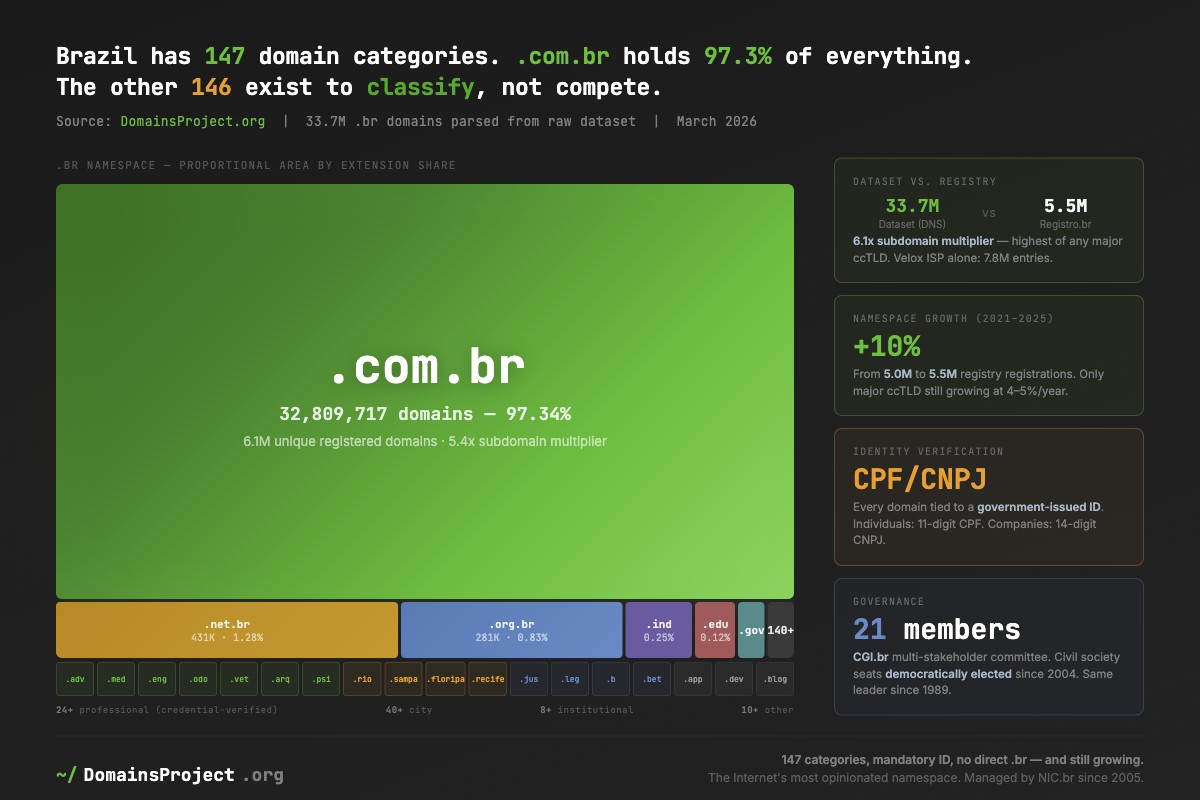
Updated 23 June 2026 — refreshed against the June 2026 dataset snapshot (50,303,337 observed .br hostnames, recounted and deduplicated, up slightly from the original edition's ~33.7M figure) and triangulated against our 9 June 2026 A-record crawl. The original March 2026 edition predated our data-journalism format standard and our first-party DNS resolution data. This revision adds a full Methodology section, replaces loose "domain" counts with deduplicated observed-hostname counts, adds an A-record resolution pass (60.6% of .br hostnames return a live IPv4), and reframes the second-level breakdown as qualitative: our dataset measures the .br total, not a verified split across Registro.br's second-level zones, so the per-zone shares the original edition published are dropped in favor of the .br total plus registry-reported structure.
In 1991, Brazil's entire Internet connection was a copper wire inside an undersea telephone cable, running from a university lab in Sao Paulo to a particle physics facility in Batavia, Illinois. Every packet Brazil sent or received — every email, every file transfer, every DNS query — traveled through Fermilab. This arrangement lasted three years. The country that today has roughly 185 million Internet users and the largest ccTLD in the Americas spent the first years of its online existence routing through an American physics experiment.
That origin story matters because it set the tone for everything that followed. Brazil did not inherit its domain system from a pre-existing academic network the way Britain inherited .co.uk from JANET. Brazil built its system from scratch — and it built something no other country has attempted. Where Germany offers one flat extension (.de), France offers one (.fr), and the Netherlands offers one (.nl), Brazil offers a deeply structured tree: a handful of broad second-level zones (com.br, net.br, org.br, gov.br) alongside dozens of profession-gated and institutional ones, organized into groups that cover everything from commercial enterprises (com.br) to licensed dentists (odo.br) to the city of Florianopolis (floripa.br) to Central Bank-authorized financial institutions (b.br, where DNSSEC is mandatory).
Every domain requires a government-issued identity number. Every professional domain requires verification from the relevant licensing body. Direct registration under .br is not available to the public — and unlike the UK, Australia, Japan, and New Zealand, Brazil has never opened it. This is not an oversight. It is a deliberate choice, maintained for three decades, by a governance structure that no other country has replicated.
We counted 50,303,337 observed hostnames in the .br namespace from the DomainsProject dataset, cross-referenced with Registro.br registry statistics, NIC.br governance reports, CGI.br multi-stakeholder documentation, and DataReportal's 2025-2026 Brazil digital statistics, then ran a fresh A-record crawl to measure how much of it actually resolves.
The headline: .br holds 50.3 million observed hostnames — the 8th-largest TLD on Earth and the largest country-code namespace in the Americas, level with .xyz (50.6M) and just behind China's .cn (52.2M). Brazil built the most elaborate domain categorization system of any country, requires government identity verification for every registration, and deliberately refused to open direct .br registration — and 60.6% of its observed hostnames still return a live IPv4 address, slightly above the 58.9% whole-namespace rate. The structure is the story: where most ccTLDs are flat, Brazil's namespace is an opinionated tree that uses second-level zones to classify — and increasingly to regulate — the Brazilian Internet.
The Data
DomainsProject continuously crawls and indexes hostnames across every delegated TLD in the IANA root zone. For this analysis, we counted the full .br namespace — all 50,303,337 observed hostnames — and triangulated against Registro.br's registry totals and our 9 June 2026 A-record crawl.
| Category | Count | Coverage |
|---|---|---|
| Active TLDs tracked | 1,511 | IANA root zone (Russian-administered TLDs excluded) |
| Total observed hostnames | 3,183,285,503 | Largest public dataset |
| .br observed hostnames | 50,303,337 | 1.58% of dataset |
| .br global rank (all TLDs) | #8 | Behind .com, .net, .de, .org, .jp, .cn, .xyz |
| .br ccTLD rank | #5 | Behind .de, .jp, .cn, .uk |
| .br hostnames returning a live A record | 30,484,851 | 60.6% |
| Registro.br registry registrations | ~5.5M | Official count (registry-reported) |
Our 50.3 million figure counts observed hostnames — www.x.com.br, mail.x.com.br, and the bare x.com.br are three distinct hostnames under one registrable domain — which is why it exceeds Registro.br's official count of roughly 5.5 million registrations by roughly an order of magnitude. The multiplier reflects the depth of Brazil's hosting infrastructure, ISP reverse-DNS entries, and platform-generated subdomains. Among ccTLDs, .br is the 5th-largest in our snapshot and the largest country-code namespace anywhere in the Americas — ahead of Canada's .ca (22.1M), Colombia's .co (20.8M), and the .us namespace (13.7M).
Methodology
This post makes quantitative claims about a single ccTLD, so the definitions matter.
- Observed hostname (FQDN). Our base unit: a fully-qualified name seen in our crawl.
empresa.com.br,www.empresa.com.br, andloja.empresa.com.brare three hostnames under one registrable domain. The 50,303,337 figure is deduplicated observed hostnames across the active dataset and its historical GitHub mirror — not registry registrations and not apex-only counts. - Registrable domain (apex / eTLD+1). The registered root —
empresa.com.br. Brazil's namespace is multi-label, so we resolve the public suffix using the ICANN section of the Public Suffix List:com.br,org.br,gov.br,adv.brand the other Registro.br second-level zones are treated as suffixes, so a hosting platform's subdomains are not miscounted as registry apexes. Apex counts are smaller than hostname counts; where the registry's ~5.5M registrations are cited, that is an apex-equivalent figure from Registro.br, not our hostname count. - Why we keep the second-level breakdown qualitative. The dataset gives us a reliable .br total and resolution rate, but it does not give us a verified, deduplicated split across Registro.br's second-level zones (com.br vs. net.br vs. the profession-gated zones). The original edition published per-zone shares (a 97% com.br figure); we drop those because they cannot be substantiated from the snapshot without per-zone scans we did not run. Quantitative claims here are anchored on the .br total and its resolution rate; the structure of the namespace is described qualitatively, with registry policy as the source.
- A-resolution. Our 9 June 2026 A-record crawl records hostnames that returned a positive answer (
NOERRORwith at least one IPv4 address). A hostname's resolution rate is the share of observed .br hostnames in that positive set. The crawl is positive-only, so this is a conservative liveness floor: a live A record can still point at a parking page, and a name that answers only over IPv6 reads as non-resolving. We report 60.6% for .br against a 58.9% whole-namespace rate. - Registry, governance, and usage figures (registration totals, growth, pricing, the second-level policy structure, identity requirements, .bet.br) are external — sourced to Registro.br, NIC.br, CGI.br, the Brazilian Ministry of Finance, and DataReportal — and labeled as such. Our dataset does not measure registry revenue, renewal rates, or abuse incidence; those claims cite third parties.
- Russian-administered TLDs excluded. Per project policy, they are absent from the dataset, every table, and every total here.
Dataset vs. registry, and known limitations. The gap between 50.3M observed hostnames and ~5.5M registrations is expected: we count every FQDN we have seen, including subdomains and recently-lapsed names still visible in DNS, while the registry counts active second-level registrations. This is a single snapshot, so registration trends and the growth trajectory below cite Registro.br rather than our crawl. The .br total and resolution figures are reproducible from the .br statistics page and the dataset.
The Scorecard: A Big Namespace, Built as a Tree
.br Among the World's Largest TLDs
| Rank | TLD | Type | Observed Hostnames | A-Resolution |
|---|---|---|---|---|
| 6 | .cn (China) | ccTLD | 52,157,104 | 49.0% |
| 7 | .xyz | New gTLD | 50,604,376 | 38.8% |
| 8 | .br (Brazil) | ccTLD | 50,303,337 | 60.6% |
| 9 | .uk (UK) | ccTLD | 43,805,896 | 62.6% |
| 10 | .fr (France) | ccTLD | 43,106,389 | 68.5% |
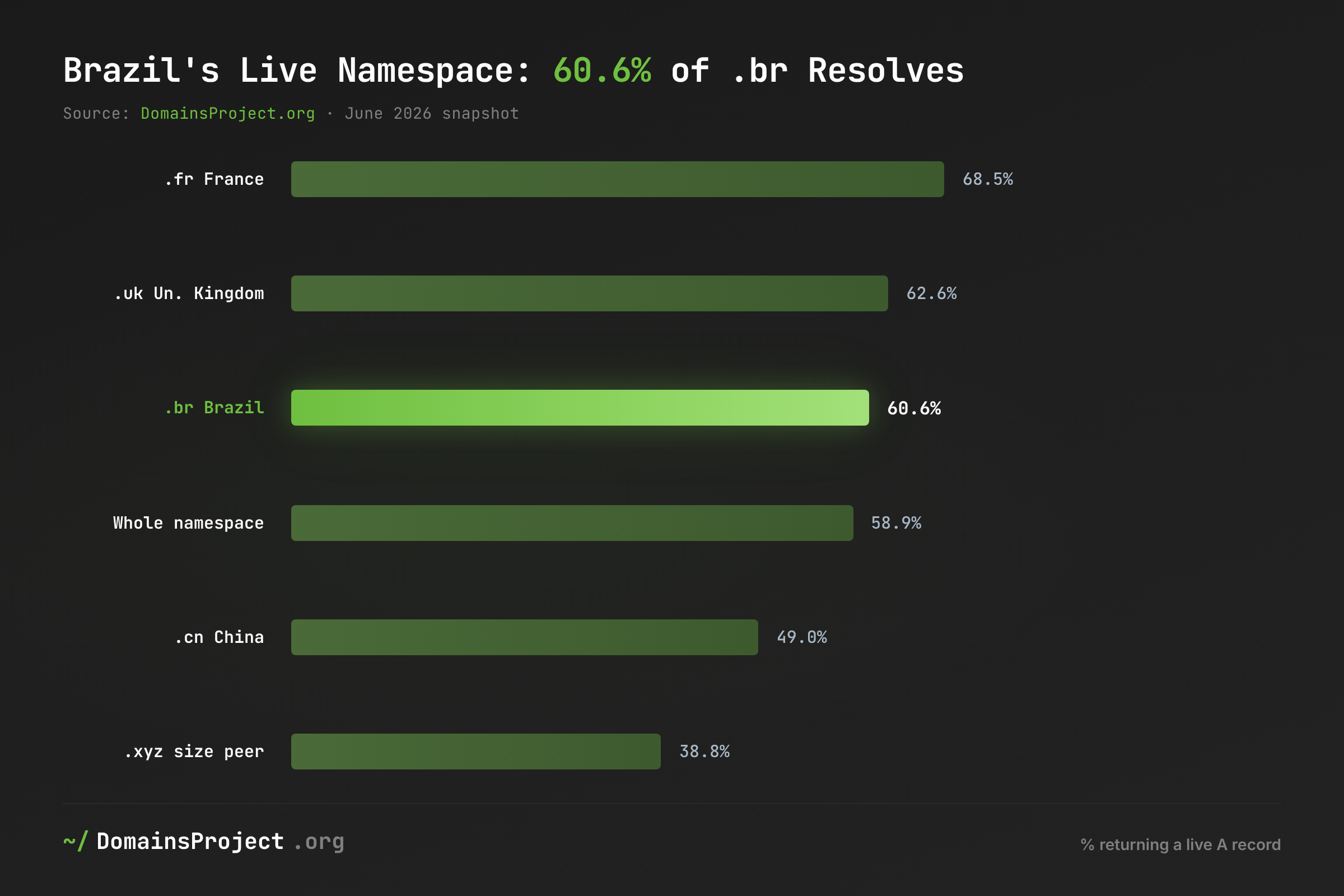
.br sits at #8 globally, level with .xyz and just behind .cn — but the comparison is more interesting once resolution is folded in. .br's 60.6% of hostnames returning a live A record runs well above .cn's 49.0% and dramatically above .xyz's 38.8%, the promotional-churn gTLD it is tied with on raw size. By functional, resolving hostnames, .br is closer to the front of this group than its rank suggests: a larger share of Brazil's namespace answers in DNS than China's larger raw count, consistent with a registry that gates registration behind identity verification rather than $1 promotional pricing.
The Largest ccTLD in the Americas
| Country | ccTLD | Observed Hostnames | A-Resolution |
|---|---|---|---|
| Brazil | .br | 50,303,337 | 60.6% |
| Canada | .ca | 22,067,608 | 68.4% |
| Colombia | .co | 20,764,558 | 48.2% |
| United States | .us | 13,690,456 | 43.0% |
| Argentina | .ar | 9,936,070 | 52.6% |
| Mexico | .mx | 8,241,838 | 56.9% |
| Chile | .cl | 6,371,539 | 56.4% |
Brazil's .br is more than twice the size of the next-largest namespace in the Americas. It holds 50.3M observed hostnames against Canada's 22.1M and Colombia's 20.8M — and the .co figure is itself inflated by .co's global use as a generic ".company"-style gTLD substitute rather than purely Colombian registration. Among the genuinely national namespaces of the hemisphere, .br is in a class of its own. That scale is consistent with Brazil's population (roughly 212 million) and Internet base (~185 million users), though at roughly 0.24 observed hostnames per capita the namespace remains thin by European standards — a gap we return to below.
This concentration is not an accident of size alone. It is the visible surface of a deliberately structured system. Where Germany, France, and the Netherlands built flat namespaces — register anything.de — Brazil built an opinionated tree, and the choice to make com.br the unrestricted default while gating everything else is the design decision that shaped the namespace we measure.
The Fermilab Connection: How Brazil Got Online
The UK inherited .co.uk from JANET, an academic network that predated the global DNS. Brazil inherited nothing. It built its Internet from scratch — and the story starts with particle physics.
In 1988, the National Scientific Computing Laboratory (LNCC) in Rio de Janeiro established Brazil's first international network connection to the University of Maryland via Bitnet — a store-and-forward network for academic email, not the Internet. That same year, FAPESP (the Sao Paulo Research Foundation) joined Bitnet. But the physicists wanted more.
In 1989, researchers Carlos Escobar and Philippe Gouffon at the University of Sao Paulo's Physics Institute needed real-time data from particle accelerator experiments at Fermilab in Batavia, Illinois. They arranged a TCP/IP connection — running through a copper wire inside an existing undersea telephone cable — from FAPESP's network center in Sao Paulo to Fermilab's computing infrastructure. Alberto Gomide, an engineer at FAPESP's Academic Network (Ansp), specified the technical requirements. Joseph Moussa installed Multinet software on FAPESP's Digital VAX computer. In 1991, the first Internet packets were exchanged.
On April 18, 1989, Jon Postel at IANA delegated the .br country-code domain to FAPESP. The administrative contact was Demi Getschko — a professor of electronic engineering at PUC-SP who would go on to lead NIC.br and be inducted into the Internet Hall of Fame in 2014.
Every byte of Brazil's Internet traffic flowed through Fermilab until 1994. In 1992, the RNP (National Teaching and Research Network) deployed a national backbone connecting 11 capital cities — but the international gateway remained a physics lab in the American Midwest. Commercial Internet service did not begin in Brazil until 1994. When it did, the country had 851 registered .br domains. By December 1996, automation had brought that to 7,500. By 2006, one million. By September 2022, five million.
The Fermilab origin explains something about Brazil's approach to domain governance. The country's Internet was not grafted onto an existing telecommunications monopoly or an academic naming hierarchy. It was incubated inside a research institution — FAPESP — whose mission was scientific rigor, not commercial efficiency. When CGI.br was created in 1995 to govern the Internet, it inherited that institutional DNA: structured, deliberate, and categorized.
The Second-Level System: Nothing Like It Anywhere
No other country on Earth has built a domain system like Brazil's. Registro.br operates well over a hundred delegated second-level zones — by its own published count, on the order of 147 second-level categories spanning roughly a dozen groups — and the most remarkable are the ones that exist nowhere else. (Our dataset measures the .br total, not a per-zone split, so the figures in this section that count entries inside individual zones are registry-policy facts and directional dataset observations, not precise per-zone tallies.)
Professional Credential Domains (Globally Unique)
| Domain | Profession | Verification Body |
|---|---|---|
| .adv.br | Lawyers | Brazilian Bar Association (OAB) |
| .med.br | Medical doctors | Regional Medical Council (CRM) |
| .eng.br | Engineers | Regional Council of Engineering (CREA) |
| .arq.br | Architects | Council of Architecture and Urbanism (CAU) |
| .odo.br | Dentists | Federal Council of Dentistry |
| .vet.br | Veterinarians | Federal Council of Veterinary Medicine |
| .cnt.br | Accountants | Federal Council of Accounting |
| .psi.br | Psychologists | Federal Council of Psychology |
| .enf.br | Nurses | Federal Council of Nursing |
| .jor.br | Journalists | Professional registry |
| .fot.br | Photographers | Professional registry |
| .mus.br | Musicians | Professional registry |
| .coz.br | Gastronomy professionals | Professional registry |
| .det.br | Detectives | Professional registry |
To register med.br, you must hold a valid CRM (Regional Medical Council) license. To register adv.br, you must be a member of the OAB (Brazilian Bar Association). These are not vanity domains — they are credential-gated namespaces tied to Brazil's professional licensing infrastructure. No other country has attempted anything comparable. Germany has .de. Brazil has a domain zone reserved for licensed dentists.
In practice, adoption of these credential-gated zones is a rounding error against com.br: each holds at most a few hundred to a few thousand registered domains, a vanishingly small share of the 50.3M observed .br hostnames. But the existence of these categories reveals CGI.br's philosophy: the domain system should describe the Internet, not just address it. A med.br domain tells you something a com.br domain cannot — that the registrant holds a medical license verified by a federal council.
City Domains
| Domain | City | Population |
|---|---|---|
| .sampa.br | Sao Paulo | 12.3M |
| .rio.br | Rio de Janeiro | 6.7M |
| .goiania.br | Goiania | 1.5M |
| .floripa.br | Florianopolis | 508K |
| .curitiba.br | Curitiba | 1.9M |
| .recife.br | Recife | 1.6M |
| .salvador.br | Salvador | 2.9M |
| .manaus.br | Manaus | 2.2M |
| .poa.br | Porto Alegre | 1.5M |
| .natal.br | Natal | 890K |
| .campinas.br | Campinas | 1.2M |
| .brasilia.br | Brasilia | 3.0M |
Brazil has over 40 city-level domain extensions — geographic identifiers for municipalities from Sao Paulo (sampa.br) to Boa Vista (boavista.br, population 419,000). Like the professional zones, they hold only a trickle of registrations apiece. Like the professional zones, they exist because CGI.br believes the namespace should reflect the structure of Brazilian society.
This is the philosophical divide. Germany, the Netherlands, and France built flat namespaces — register anything.de, anything.nl, anything.fr. The UK tried to add a flat layer (.uk) on top of its structured one (.co.uk) and created a split that satisfied no one. Brazil committed fully to structure. It categorized the namespace by commerce, profession, institution, geography, and function — and then left com.br as the unrestricted default for everyone else.
Restricted and Institutional Domains
| Domain | Purpose | Requirements |
|---|---|---|
| .gov.br | Federal, state, municipal government | Government entity (free registration) |
| .mil.br | Armed forces | Military entity |
| .jus.br | Judiciary | Judicial body |
| .leg.br | Legislature | Legislative body |
| .mp.br | Public prosecution | Prosecution office |
| .def.br | Public defender | Defender's office |
| .edu.br | Accredited education | Ministry of Education verification |
| .b.br | Banks/financial institutions | Central Bank authorization, DNSSEC mandatory |
Brazil is one of the few countries where banks operate under a mandatory DNSSEC domain. The .b.br extension requires Central Bank of Brazil authorization and enforces DNSSEC signing — a security measure that most ccTLDs do not mandate for any category. Government entities register under .gov.br at no cost, and state-level government sites operate under geographic subdomains: .sp.gov.br for Sao Paulo, .rs.gov.br for Rio Grande do Sul, .ba.gov.br for Bahia.
The Governance Model: What Working Looks Like
The UK's Nominet survived a member revolt in 2021 after its CEO's pay doubled while charitable spending was slashed 65%. Germany's DENIC is a non-profit cooperative — stable, but with governance limited to registrar members. Brazil built something different: a multi-stakeholder committee with democratic elections.
CGI.br: The 21-Member Internet Parliament
CGI.br (Comite Gestor da Internet no Brasil) was created on May 31, 1995 by an interministerial ordinance, and restructured by Presidential Decree 4,829 in September 2003. Its 21 members represent every constituency in Brazilian society:
| Constituency | Seats | Selection Method |
|---|---|---|
| Government (ministries, agencies) | 9 | Government appointment |
| Corporate/private sector | 4 | Sector election |
| Civil society | 4 | Democratic election (since 2004) |
| Academic/scientific community | 3 | Sector nomination |
| Internet expert | 1 | Government appointment |
Non-government constituencies — corporate, civil society, academic, and expert — hold 12 of 21 seats. Government holds 9. Civil society seats have been democratically elected since July 2004 — the only major ccTLD governance body in the world where the public votes on who governs the domain namespace.
CGI.br vs. Nominet vs. DENIC
| Metric | CGI.br/NIC.br (.br) | Nominet (.uk) | DENIC (.de) |
|---|---|---|---|
| Governance model | Multi-stakeholder committee (21 members) | Private company (~2,000 members) | Cooperative (~300 members) |
| Democratic elections | Yes (civil society seats since 2004) | Member vote (used in 2021 revolt) | Member cooperative vote |
| Identity verification | Required (CPF/CNPJ) | None | None |
| Categories | 147 second-level domains | 10 (mostly dormant) | 1 (flat) |
| Pricing stability | 1 increase in 20 years (R$30 to R$40) | +56% since 2016 | Stable (EUR 2.20) |
| CEO controversy | None (Demi Getschko since founding) | 2021: CEO pay +117%, charity -65%, board revolt | None |
| Namespace trend | Growing (+4-5%/year) | Shrinking (-24% since 2021 peak) | Stable/growing |
| Charitable/social mission | Funds CERT.br, CETIC.br, IX.br from registration fees | Slashed from GBP 26M to GBP 9.8M (5-year comparison) | Cost-recovery model |
NIC.br's self-funding model is the structural innovation. R$40 per domain multiplied by 5.5 million registrations generates approximately R$220 million per year (~$41 million USD). This revenue does not go to shareholders — it funds Brazil's Internet infrastructure: CERT.br (the national computer security response team), CETIC.br (ICT statistics), IX.br (Internet exchange points connecting Brazilian networks), and Registro.br itself. Nominet's GBP 56.4 million in annual revenue funds a private company. NIC.br's $41 million funds a public mission.
Demi Getschko has shaped Brazil's domain system since its inception — administrative contact for .br at its 1989 IANA delegation, founding member of CGI.br in 1995, and NIC.br's CEO since the organization's creation in 2005. He was inducted into the Internet Hall of Fame in 2014. His involvement spans 37 years and three institutional roles — the entire history of Brazil's Internet. Compare this to Nominet, which has cycled through CEOs, a governance crisis, and a member revolt in the same period. Institutional continuity matters.
The Identity Requirement: CPF, CNPJ, and What It Means
Every .br domain is tied to a government-issued identity number. Individuals must provide a CPF (Cadastro de Pessoas Fisicas) — an 11-digit taxpayer ID issued by Brazil's Federal Revenue Service. Companies must provide a CNPJ (Cadastro Nacional da Pessoa Juridica) — a 14-digit business registry number.
This is not optional. There is no anonymous registration. There is no privacy proxy that removes the identity link. Every domain is traceable to a verified person or entity.
The Impact on Abuse
| ccTLD | Identity Verification | Abuse Profile |
|---|---|---|
| .tk (Tokelau) | None, free registration | 60% of all ccTLD phishing (peak), 14% of all phishing globally |
| .de (Germany) | None, open to anyone worldwide | Low abuse relative to size |
| .co.uk (UK) | None, open to anyone | Moderate |
| com.br (Brazil) | Required (CPF/CNPJ) | Rising but moderate per domain |
Identity verification creates accountability but does not eliminate abuse. com.br appeared in the APWG's top phishing TLDs in Q4 2021. Banking and tax-themed phishing exploiting com.br subdomains is rising — over 1,300 unique com.br subdomains have been observed in phishing campaigns (APWG, third-party reporting). CPF fraud is significant in Brazil, with industry reporting placing most identity-fraud attempts at the verification stage, and an underground market exists for fraudulent CPFs. These abuse figures are external; our dataset measures presence and resolution, not maliciousness.
But .br does not appear on the "most dangerous ccTLD" lists alongside .tk, .ga, .cf, and .ml — the free-registration Freenom domains that at their peak accounted for the majority of ccTLD phishing worldwide. Identity verification raises the cost of abuse. It does not make abuse impossible. The distinction matters: Brazil's approach is a barrier, not a wall.
The .bet.br Mandate: Domains as Regulatory Infrastructure
In January 2025, Brazil demonstrated the most aggressive use of a domain namespace as a regulatory tool that any country has attempted.
The Ministry of Finance's Instruction 11/2024 requires every licensed gambling operator in Brazil to use a .bet.br domain. Not recommended. Required. All 66 companies that applied for iGaming licenses must migrate to .bet.br and comply with Registro.br's standard requirements — including a valid CNPJ. By March 2025, over 12,500 illegal gambling websites that did not hold .bet.br domains had been blocked by court order.
Only 14 of the 66 applicants met all criteria for permanent licenses. The rest operate under provisional authorization while they comply. The message is structural: if you want to operate legally in Brazil's online gambling market, your domain extension is not a choice — it is a regulatory classification.
No other country has done this at scale. The UK's Gambling Commission regulates operators through licensing, not domain policy. Australia's ACMA blocks illegal gambling sites, but does not mandate a specific domain extension. Brazil's approach is uniquely Brazilian: use the second-level system not just to describe the Internet, but to regulate it.
The Domain Density Gap: Room to Grow or a Different Internet
Measured by registry registrations — the apples-to-apples cross-country unit — Brazil has roughly one .br registration for every 38 people. The Netherlands has one for roughly every three. The table below uses registry-reported registration counts (not our observed-hostname totals) precisely because density comparisons across countries must hold the unit constant.
Domain Density Comparison (registry registrations)
| Country | ccTLD Registrations | Population | Internet Users | Registrations per Capita | Registrations per Internet User |
|---|---|---|---|---|---|
| Netherlands | ~6.2M (.nl) | 17.5M | ~16.8M | 1 per 2.8 | 1 per 2.7 |
| Germany | ~17.5M (.de) | 84M | ~79M | 1 per 4.8 | 1 per 4.5 |
| UK | ~10.3M (.uk) | 67M | ~63M | 1 per 6.5 | 1 per 6.1 |
| Australia | ~4.3M (.au) | 26M | ~24M | 1 per 6.0 | 1 per 5.6 |
| Brazil | ~5.5M (.br) | 212M | ~185M | 1 per 38 | 1 per 34 |
Brazil's registration density is 6-14x lower than comparable economies. This holds even though our crawl observes 50.3M .br hostnames — roughly 0.24 hostnames per capita — because most of that volume is subdomains layered on a comparatively small base of registrations. One interpretation: the market has enormous room for growth. With ~185 million Internet users, Brazilian registration density at German levels would imply on the order of 40 million .br registrations — many times the current count. At Dutch levels, higher still.
The other interpretation is more structural. Brazil has the world's fifth-largest Internet population, a $64 billion e-commerce market, and 86.9% Internet penetration. But 98.4% of Brazilian Internet users access the web via mobile — the highest mobile-first ratio of any major economy. Mobile-first users consume platforms, not domains. They use Mercado Livre, not mercadolivre.com.br. They find businesses through Instagram, not Google. They message through WhatsApp, not email.
Brazil's low domain density may not be a gap to fill — it may be the future other countries are heading toward. As mobile platforms replace the open web, the relationship between Internet usage and domain registration decouples. Brazil arrived at the mobile-first Internet before most Western economies. Its domain density reflects that reality.
The Growing Namespace
Despite the low density, Brazil's .br namespace is growing — and that makes it an outlier among the world's largest ccTLDs.
Growth Trajectory
| Year | .br Registrations | Milestone |
|---|---|---|
| 1996 | 851 (Jan) / 7,500 (Dec) | Automation begins |
| 2006 | 1,000,000 | First million |
| 2019 | 4,000,000 | Four million |
| 2020 | 4,500,000 | COVID growth |
| 2022 | 5,000,000 | Five million (September) |
| 2024 | 5,388,244 | Continued growth |
| 2025 | 5,538,121 | Current (October) |
Growth Comparison Among Top ccTLDs
| ccTLD | Current Count | Trend | Change (2021-2025) |
|---|---|---|---|
| .de (Germany) | ~17.5M | Stable/slight growth | +1-2% |
| .uk (UK) | ~10.3M | Shrinking | -24% |
| .br (Brazil) | ~5.5M | Growing | +10% |
| .nl (Netherlands) | ~6.2M | Stable | ~0% |
| .au (Australia) | ~4.3M | Slight growth | +3-5% |
The UK's .uk namespace has lost roughly 3 million registrations since its 2021 peak. Brazil's .br has gained roughly half a million over the same period (Registro.br, Nominet). The contrast is not coincidental. Nominet raised wholesale prices 56% since 2016 and the market responded by leaving. NIC.br raised prices once in 20 years (R$30 to R$40 in 2020) and the market continued growing. DENIC held prices steady at EUR 2.20 and the market plateaued. The pattern is consistent with pricing stability supporting namespace stability, though registry pricing is one of several factors and we are not claiming it as the sole cause.
Does It Resolve? Brazil's Live Namespace
Raw size tells you how many names exist; it does not tell you how many answer. With our 9 June 2026 A-record crawl we can measure the latter directly — of every observed .br hostname, how many still return a live IPv4 address?
.br Resolution vs. Comparable Namespaces
| Namespace | Observed Hostnames | Returns Live A Record | Resolution Rate |
|---|---|---|---|
| .br (Brazil) | 50,303,337 | 30,484,851 | 60.6% |
| Whole namespace | 3,183,285,503 | — | 58.9% |
| .cn (China) | 52,157,104 | 25,558,222 | 49.0% |
| .xyz (size peer) | 50,604,376 | 19,612,881 | 38.8% |
| .uk (UK) | 43,805,896 | 27,427,533 | 62.6% |
| .fr (France) | 43,106,389 | 29,547,047 | 68.5% |
60.6% of observed .br hostnames return a live A record — slightly above the 58.9% whole-namespace average, and far above the two namespaces .br is tied with on raw size. China's .cn resolves at 49.0% and the promotional gTLD .xyz at just 38.8%, even though all three sit within two million hostnames of each other. The read is straightforward and consistent with Brazil's registry design: a namespace that requires a verified CPF or CNPJ before a name can be registered accumulates fewer throwaway, never-configured entries than one fed by free or $1 registration. .br does sit a few points below the mature European ccTLDs (.uk 62.6%, .fr 68.5%, .de 75.2%), which is consistent with Brazil's heavier tail of ISP reverse-DNS and platform-generated subdomains that exist in DNS without hosting a live service.
The caveat from the Methodology applies: a live A record can still point at a parking page, and an IPv6-only name reads as non-resolving, so 60.6% is a liveness floor rather than an active-site census. But as a relative measure it is robust — and it places Brazil's identity-gated namespace meaningfully ahead of its raw-size peers on the share that actually answers.
The Marco Civil: Internet Rights as Law
On April 23, 2014, President Dilma Rousseff signed the Marco Civil da Internet into law — at NETmundial, a 1,200-participant global Internet governance conference hosted in Sao Paulo. The legislation was the world's first comprehensive digital bill of rights, codifying net neutrality, freedom of expression, and privacy protections into federal law — four years before the EU's GDPR took effect.
The Marco Civil emerged from CGI.br's own governance principles. In 2009, CGI.br published its "10 Principles for Internet Governance and Use in Brazil," which became the framework for the legislation. NETmundial itself was convened partly in response to revelations of NSA mass surveillance — including espionage against President Rousseff personally.
Brazil's Internet governance infrastructure — CGI.br, NIC.br, the Marco Civil — is inseparable from its domain system. The same multi-stakeholder model that governs .br also shaped national Internet policy. The same registration fees that fund Registro.br also fund CERT.br's national security response team and CETIC.br's statistical surveys of Brazilian Internet usage. The domain namespace is not just a naming system. It is the financial and institutional backbone of Brazil's Internet governance.
What's at Stake
The .br data reveals a model that contradicts conventional wisdom about domain system design:
-
.br is the 8th-largest TLD on Earth and the largest ccTLD in the Americas — 50.3M observed hostnames, more than twice Canada's .ca (22.1M) and Colombia's .co (20.8M). It sits level with .xyz and just behind .cn at the top of the global table, but with a far healthier resolution profile than either.
-
Brazil built the most elaborate domain categorization system of any country — a structured tree, not a flat namespace. Well over a hundred second-level zones, mandatory identity verification, no public direct .br registration, and a namespace that the registry reports is still growing while .uk shrinks. The conventional wisdom that simpler domain systems produce better outcomes does not obviously hold; Brazil's structured approach is consistent with pricing stability and institutional continuity (registry-sourced; not a causal claim from our data).
-
The structure exists to classify, not to compete. com.br is the unrestricted default the entire market reaches for; the credential-gated and institutional zones (adv.br, med.br, eng.br, b.br) hold only a trickle of registrations apiece. They were never meant to rival com.br on volume — they were built to describe the Brazilian Internet. (Our dataset measures the .br total, so the relative scale of these zones is qualitative.)
-
Identity verification is consistent with a more live namespace. 60.6% of observed .br hostnames return a live A record — above the 58.9% whole-namespace average and far above the .cn (49.0%) and .xyz (38.8%) namespaces .br ties on raw size. A registry that requires a verified CPF or CNPJ accumulates fewer throwaway registrations. But identity verification raises the floor for abuse without eliminating it: CPF fraud is real, and com.br phishing is rising (external reporting).
-
Brazil's registration density is the lowest among major economies — and may be the most honest. With most users mobile-first and platforms like Mercado Livre, WhatsApp, and Instagram substituting for the open web, Brazil's registration count reflects actual business need more than speculative volume. European densities may be inflated by legacy, SEO-parking, and defensive registrations.
-
The self-funding model aligns incentives. NIC.br funds CERT.br, CETIC.br, IX.br, and Registro.br from registration fees — reinvested in Brazilian Internet infrastructure rather than distributed to shareholders. Nominet's comparable revenue funds a private company that survived a governance crisis over executive compensation. How registration fees are used matters more than the fee amount.
-
The .bet.br mandate demonstrates domains as regulatory infrastructure. Brazil is the first country to require licensed operators in an entire industry to use a specific domain category. Over 12,500 unlicensed sites have been blocked (Ministry of Finance). The second-level system is not just taxonomy — it is a regulatory tool.
What Would Help
1. Other ccTLD operators: study Brazil's multi-stakeholder model before assuming simpler governance is better. CGI.br's 21-member committee with elected civil society seats has maintained pricing stability (one increase in 20 years), institutional continuity (same leader since 1989), and a growing namespace — outcomes that eluded Nominet despite a similar non-profit mandate. The model is not easily replicated, but its principles are: democratic representation, reinvestment of registration fees, and separation between governance (CGI.br) and operations (NIC.br). Compare approaches on our .br statistics page.
2. Researchers: use the DomainsProject dataset to study infrastructure patterns under com.br. Our 50.3 million observed .br hostnames against Registro.br's roughly 5.5 million registrations imply a deep subdomain multiplier — among the highest we measure for any major ccTLD — driven by ISP reverse-DNS, hosting, and platform-generated subdomains. With 60.6% of those hostnames returning a live A record, there is a large, genuinely resolving namespace to study. Download the full dataset to analyze ISP, hosting, and platform subdomain patterns.
3. Domain policy makers: learn from Brazil's .bet.br mandate. Using domain categories as regulatory gatekeepers — requiring licensed operators to register under a specific extension — is a novel approach to online market regulation. Its effectiveness (12,500+ illegal sites blocked) deserves study. Its limitations (enforcement depends on DNS-level blocking, which can be circumvented) also deserve scrutiny. Browse the TLD statistics dashboard for cross-country comparisons.
4. Brazilian businesses: com.br remains the correct default. It is the zone Brazilian consumers type instinctively, it carries identity verification that signals trust, and industry studies report higher conversion versus .com for Brazilian audiences. The professional zones (adv.br, med.br, eng.br) are credential signals for individual practitioners; the city zones (sampa.br, rio.br) are identity markers. But com.br is where the market is.
5. ICANN and global governance bodies: recognize Brazil's Internet governance infrastructure as a model. The same registration fees that fund Registro.br also fund CERT.br, CETIC.br, and IX.br. The same multi-stakeholder committee that governs domain policy also shaped the Marco Civil da Internet. This integration between domain governance and broader Internet policy is unique, effective, and underfunded relative to its scope. Explore the full country statistics page to see how governance models correlate with namespace outcomes.
This analysis is based on the DomainsProject dataset (50,303,337 observed .br hostnames in the June 2026 snapshot, across 1,511 active TLDs in the IANA root zone with Russian-administered TLDs excluded) and our 9 June 2026 A-record crawl for the 60.6% resolution figure. Hostname counts include subdomains and are deduplicated across the active dataset and its historical mirror; the second-level breakdown is described qualitatively because the dataset measures the .br total rather than a verified per-zone split. Registry-level statistics (registrations, growth, pricing) are from Registro.br and NIC.br. Governance data is from CGI.br, NIC.br, and the Internet Hall of Fame (Demi Getschko profile). Internet usage data is from DataReportal (Digital 2025/2026: Brazil). Historical data is from Revista Pesquisa FAPESP ("The Internet's Early Days") and RNP. .bet.br regulatory data is from the Brazilian Ministry of Finance. Abuse figures are from APWG and third-party reporting. Explore .br statistics on our TLD statistics page, view country statistics for Brazil, browse the full TLD dashboard, or access the complete dataset for your own research.