Updated 23 June 2026 — this post has been rebuilt on the June 2026 dataset snapshot (43,805,896 observed .uk hostnames) and triangulated against our 9 June 2026 A-record crawl. The original March 2026 edition predated our data-journalism format standard and our first-party DNS resolution data. This revision adds a full Methodology section, replaces loose "domain" counts with deduplicated observed-hostname counts, and adds an A-record resolution pass that tests how much of the namespace is actually live. One correction matters most: the original reported ~96M and then ~36M ".uk domains" and framed the namespace as "shrinking year over year." Those figures came from earlier, differently-deduplicated passes of our crawl; the June 2026 count of 43.8M is a clean recount on our current pipeline, not evidence of decline. We do not have a like-for-like time series of observed hostnames, so this edition makes no growth or contraction claim from our own data and cites registry trends to Nominet directly.
The United Kingdom is one of the few large economies where a business choosing its own web address must first choose between two versions of its national country code. Germany has .de. France has .fr. The Netherlands has .nl. Britain has .co.uk and .uk — and after twelve years of coexistence, the market has delivered a verdict that satisfies almost no one.
A reader named ConsciousStop put it plainly: "Regarding the UK, we're split between .uk, .co.uk and .org.uk. Wondering if the figure includes all 3 combined or just .uk." The short answer: yes — our 43.8 million figure counts the whole .uk tree, including every hostname under .co.uk, .org.uk, .me.uk, .ac.uk and direct second-level .uk. But the aggregate hides the more interesting question. In 2014 Nominet opened direct registration under .uk as a deliberate modernization, hoping to retire the awkward second-level structure that Britain had inherited from a 1980s academic network. Twelve years later, the legacy .co.uk format still dominates by every available measure — registry counts, our hostname counts, and consumer recognition alike.
The split is not just cosmetic. British businesses routinely pay twice — once for .co.uk, once for the matching .uk — to defend a single brand identity. And the registry that runs the namespace, Nominet, survived a member revolt in 2021 after its CEO's pay more than doubled while charitable spending was cut and its signature charitable trust was wound down. Britain's corner of the Internet is structurally fragmented and institutionally bruised, even though, on our numbers, it is also one of the largest and most heavily-used country-code namespaces on Earth.
We analyzed 3,183,285,503 observed hostnames across 1,511 TLDs in the DomainsProject dataset, with a focus on the 43.8 million observed hostnames in the .uk namespace, then cross-referenced our findings against Nominet registry statistics, JPRS registration reports, auDA domain statistics, and the PublicBenefit.uk governance analysis to keep every claim anchored to more than our own crawl.
The headline: .uk is the 9th-largest TLD in the world with 43.8 million observed hostnames — roughly level with France's .fr (43.1M) and ahead of the Netherlands' .nl (36.3M) and Italy's .it (33.1M). But 62.6% of those hostnames return a live IPv4 address in our June 2026 crawl, below the German (.de) and Dutch (.nl) figures, and the namespace remains split across two competing forms of the country code. Twelve years after Nominet opened direct .uk registration to replace .co.uk, registry figures still show .co.uk holding roughly four out of five .uk registrations. The reform did not fail outright — but it did not unify Britain's namespace either.
The Data
DomainsProject continuously crawls and indexes hostnames across every delegated TLD in the IANA root zone. For this analysis we isolated the entire .uk subtree — every hostname whose registrable domain sits under .uk, including the second-level public suffixes .co.uk, .org.uk, .me.uk, .ac.uk, .gov.uk and direct .uk.
| Category | Count | Coverage |
|---|---|---|
| Active TLDs tracked | 1,511 | IANA root zone (Russian-administered TLDs excluded) |
| Total observed hostnames | 3,183,285,503 | Largest public dataset |
| .uk observed hostnames (all second levels) | 43,805,896 | 1.38% of dataset |
| .uk global rank | #9 | Behind .com, .net, .de, .org, .jp, .cn, .xyz, .br |
| .uk hostnames returning a live A record | 27,427,533 | 62.6% resolution rate |
| Nominet registry registrations | ~10.3M | Official count (Nominet, latest published) |
Our 43.8 million figure counts observed hostnames, not registry registrations, which is why it sits far above Nominet's published count of roughly 10.3 million registered domains. The two numbers measure different things and are both correct: ours counts every fully-qualified name our crawl has seen resolve under .uk (www.example.co.uk, mail.example.co.uk and bare example.co.uk are three hostnames under one registration), while Nominet's counts what is registered at the registry. The gap — a little over 4x — is the depth of subdomain usage under .uk, dominated by .co.uk. We define every term precisely below.
Methodology
This post makes quantitative claims about a single national namespace, so the definitions matter.
- Observed hostname (FQDN). Our base unit: a fully-qualified name our crawl has seen in DNS.
example.co.uk,www.example.co.uk, andshop.example.co.ukare three distinct hostnames under one registrable domain. The 43,805,896 figure is deduplicated observed hostnames across the active dataset and its historical GitHub mirror — not registry registrations and not apex-only counts. - Registrable domain (apex / eTLD+1) and the second-level structure. Under .uk the public suffix is often two labels deep —
example.co.uk,example.org.uk— so the registrable domain is the third label, not the second. We resolve the suffix using the ICANN section of the Public Suffix List, which lists.co.uk,.org.uk,.me.uk,.ac.uk,.gov.ukand the other delegated second levels. This matters here more than for any flat TLD: a naive "last two labels" rule would treat every.co.ukregistration as a subdomain of a nonexistentco.ukregistration. Where this post discusses the split between .co.uk and direct .uk we rely on Nominet's registry figures, not our hostname counts, because the two formats are not separable in a way that is meaningful at the hostname level (a single business often runs both); our own data establishes the .uk total, the resolution rate, and the international rank. - Registry registrations. Counts of registered domains published by the relevant registry operator (Nominet for .uk, JPRS for .jp, auDA for .au, DENIC for .de). These are apex-level and authoritative for registration questions; we cite them as such and never blend them into our hostname totals.
- Resolution / A-resolution rate. Our 9 June 2026 A-record crawl records every hostname that returned a positive answer (
NOERRORwith at least one IPv4 address). A TLD's resolution rate is the share of its observed hostnames in that positive set. We report 62.6% for .uk (27,427,533 of 43,805,896). Treat this as a conservative liveness floor: a live A record can still point at a parking page, and a name reachable only over IPv6 reads as non-resolving, so the true "in use" share could be somewhat higher or lower. The whole-namespace rate across all 1,511 TLDs is 58.9%, which is the benchmark we compare against. - Dataset vs. registry counts. Our 43.8M observed-hostname figure runs far above Nominet's ~10.3M registration count because we count subdomains; it can also run below a zone-file total because we count only names our crawl has actually seen resolve, not every registration ever sold. Treat our number as a measure of the observed, functional .uk namespace, not of registry revenue.
- Known limitations. This is a single snapshot. It measures presence and IPv4 resolution, not query volume, uptime, or per-format share. We have no like-for-like prior observed-hostname series for .uk on the current deduplication pipeline, so we make no growth or decline claim from our own data; every registration-trend statement below is sourced to Nominet. Hostname-weighted counting gives a one-page .co.uk site the same weight as a thousand-subdomain platform. Russian-administered TLDs are excluded per project policy and appear in no table or total here. The full per-TLD breakdown is reproducible from the .uk statistics page and the dataset.
The Scorecard: Where .uk Sits Among the Country Codes
.uk Against Its European Peers
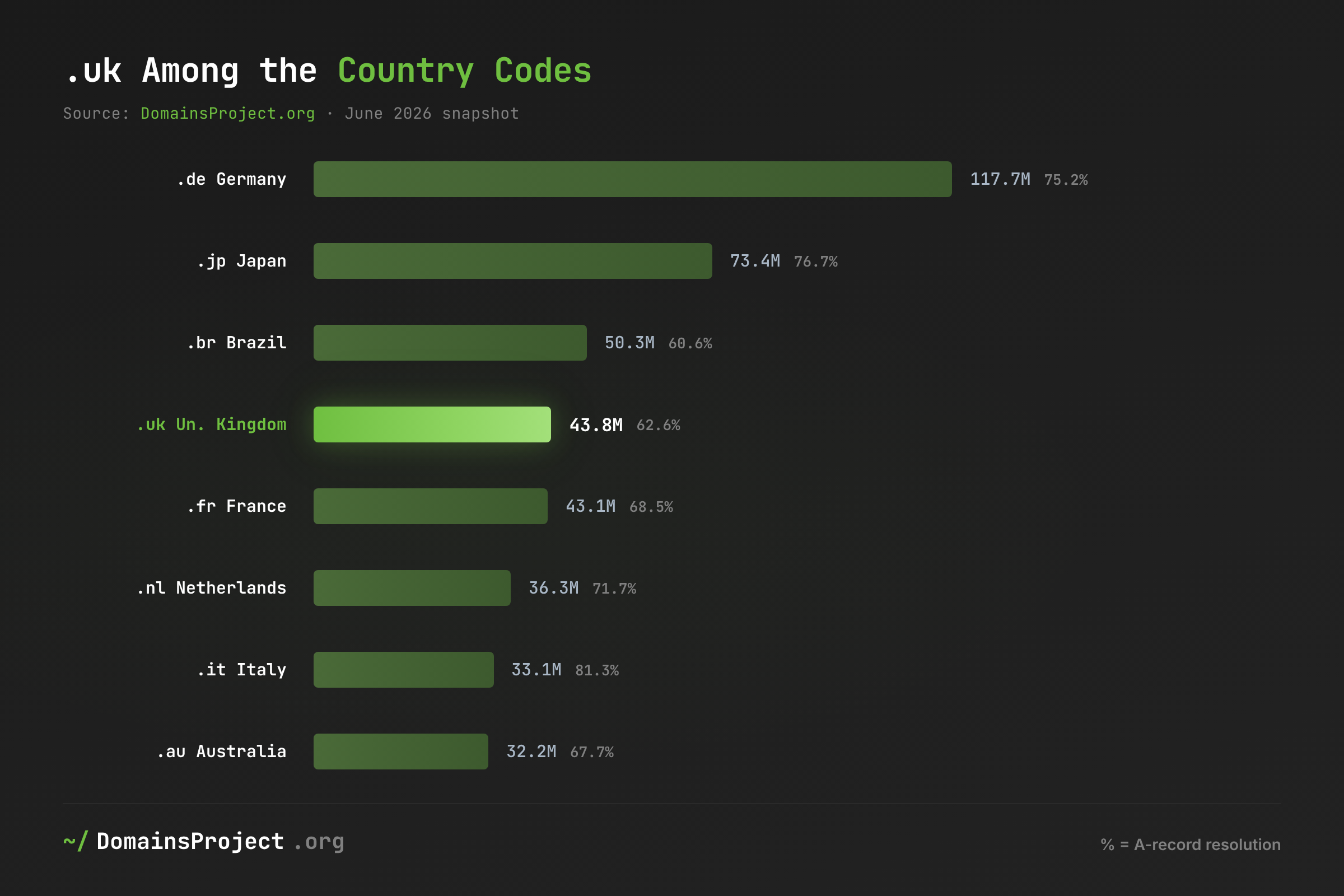
| Rank | TLD | Country | Observed Hostnames | A-Resolution Rate |
|---|---|---|---|---|
| 3 | .de | Germany | 117,679,029 | 75.2% |
| 5 | .jp | Japan | 73,446,024 | 76.7% |
| 8 | .br | Brazil | 50,303,337 | 60.6% |
| 9 | .uk | United Kingdom | 43,805,896 | 62.6% |
| 10 | .fr | France | 43,106,389 | 68.5% |
| 11 | .nl | Netherlands | 36,326,261 | 71.7% |
| 12 | .it | Italy | 33,130,745 | 81.3% |
| 13 | .au | Australia | 32,189,304 | 67.7% |
.uk is the largest national namespace outside Germany and Japan in raw hostname terms, but it punches below its size on liveness. At 43.8 million observed hostnames it sits just ahead of France's 43.1 million and comfortably above the Netherlands and Italy. Yet its 62.6% A-resolution rate trails .de (75.2%), .nl (71.7%) and .it (81.3%) — and only just clears the 58.9% whole-namespace benchmark. Germany resolves a higher share of a namespace nearly three times larger. The data → inference chain is narrow but worth stating: a lower resolution rate at this scale is consistent with a larger fraction of registered-but-dormant or parked names under .uk, which is exactly what a heavily-subdomained, defensively-registered namespace would look like. It is not, on its own, proof of decline.
Normalized for population, the picture sharpens. With a UK population of roughly 68.4 million, 43.8 million observed .uk hostnames works out to about 0.64 hostnames per person — a density that reflects heavy commercial and hosting use, not one address per citizen. Density comparisons across ccTLDs are sensitive to how much each namespace is used for subdomain-heavy hosting, so we treat this as an order-of-magnitude figure rather than a precise rank.
The Split: .co.uk vs Direct .uk (Nominet Registry Figures)
Because the two formats cannot be cleanly separated at the hostname level, the breakdown below comes from Nominet's published registry statistics, not our crawl. Treat the shares as registry-level and approximate.
| Format | Approx. Registry Share | Role |
|---|---|---|
| .co.uk (legacy second level) | ~80% | Commercial / general — inherited from 1980s JANET naming |
| .uk (direct, since June 2014) | ~14% | General-purpose modern registration |
| .org.uk | ~3-4% | Non-profit organizations |
| .me.uk, .ac.uk, .gov.uk, other | remainder | Personal, academic, government, specialist |
Twelve years after launch, registry data still shows .co.uk holding roughly four times the share of direct .uk. The reform Nominet intended — direct .uk replacing the clunky second-level format — has not happened at the registry level. Direct .uk grew into a meaningful minority but never displaced the incumbent. Our own data cannot confirm the per-format split (a business frequently runs example.co.uk and example.uk together), which is precisely why we anchor this section on Nominet and anchor the headline on the .uk total instead.
The JANET Legacy: Why Britain Has .co.uk at All
The reason Britain uses .co.uk rather than just .uk is not a design decision made for the Internet age. It is an inheritance from academic networking history.
.uk was delegated on 24 July 1985 — seven months after .com became the first commercial domain. Andrew McDowall at University College London received the delegation, and management later passed to UKERNA (the UK Education and Research Networking Association). But before the global DNS existed as a standard, the UK academic community had already built its own naming hierarchy on JANET — the Joint Academic Network.
JANET used reversed, domain-like names: UK.AC for academic institutions, UK.CO for commercial entities, UK.MOD for the Ministry of Defence. When the global DNS was adopted, these were simply flipped: .ac.uk, .co.uk, .gov.uk. The second-level structure was inherited, not designed. There is no technical requirement for it — DNS works identically whether you register example.uk or example.co.uk. Germany's .de, France's .fr, and the Netherlands' .nl all allow direct registration under the country code. Britain's structure persists because of path dependency from a 1980s academic network that predated the commercial Internet.
Countries With Second-Level Structures
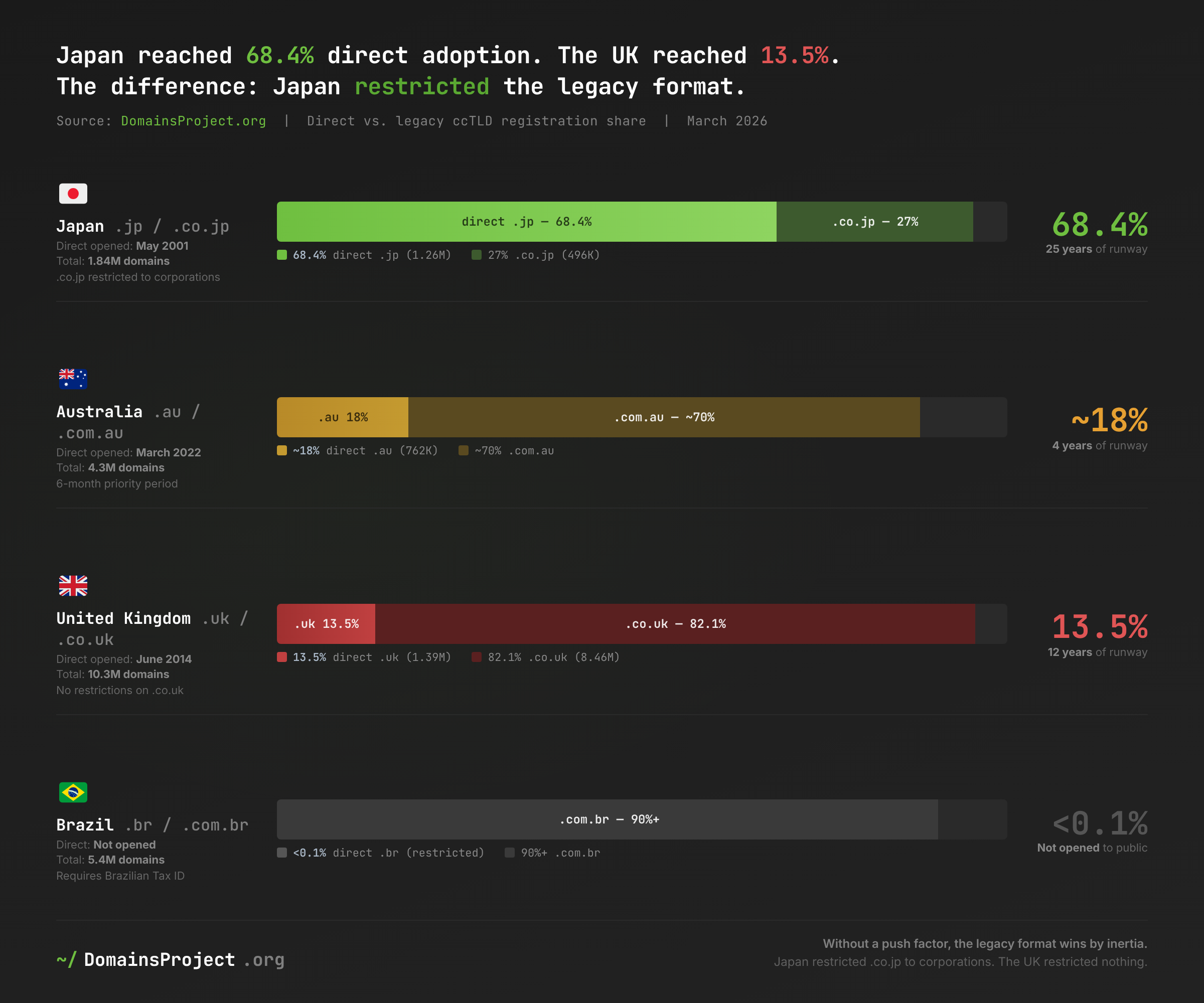
| Country | Legacy Format | Direct Opened | Approx. Direct Share | Registry Registrations |
|---|---|---|---|---|
| Japan | .co.jp | May 2001 | ~68% | ~1.8M |
| Australia | .com.au | March 2022 | ~18% | ~4.3M |
| United Kingdom | .co.uk | June 2014 | ~14% | ~10.3M |
| Brazil | .com.br | Not opened | <1% | ~5.4M |
Direct-share figures are from each registry's published statistics (JPRS, auDA, Nominet, NIC.br) and are approximate; registry registration totals likewise.
The international comparison suggests the UK's outcome is structural, not accidental — and that the design of the reform matters more than its timing. Japan opened direct .jp in 2001 and is the only country here where direct registration genuinely overtook the legacy structure, with roughly two-thirds of registrations now direct. The critical difference: Japan kept .co.jp restricted to legally registered Japanese corporations, which gave individuals and small businesses a real reason to choose .jp. The UK placed no such restriction on .co.uk, so there was no push factor away from the legacy format. Australia opened direct .au in March 2022 — eight years after the UK — and has already reached roughly 18%, ahead of the UK's ~14% despite a third of the runway, with a more aggressive priority-window rollout. Brazil never opened direct registration at all and remains effectively all-legacy. The pattern that emerges is consistent with a simple rule: without a restriction or incentive that makes the legacy format less attractive, the legacy format wins by inertia.
Nominet: A Non-Profit That Lost Its Way, Then Found It Again
Nominet was founded on 14 May 1996 as a private, not-for-profit company limited by guarantee — replacing the volunteer "Naming Committee" that could no longer handle growing registration volume. Headquartered at the Oxford Science Park, it manages roughly 10.3 million .uk registrations through approximately 2,500 member registrars and answers billions of DNS queries.
Nominet vs DENIC vs Verisign: Three Models, Three Outcomes
| Metric | Nominet (.uk) | DENIC (.de) | Verisign (.com) |
|---|---|---|---|
| Legal structure | Not-for-profit company | Non-profit cooperative | For-profit corporation |
| Registry registrations | ~10.3M | ~17.7M | ~161M |
| Our observed hostnames | 43.8M | 117.7M | 1.36B |
| Hostnames per registration | ~4.3x | ~6.6x | ~8.5x |
| A-resolution rate (our crawl) | 62.6% | 75.2% | 57.2% |
| Wholesale price (approx.) | ~GBP 3.90/yr | ~EUR 2.20/yr | ~$10.26/yr |
| Governance model | Board + member vote | Member cooperative | Shareholders |
Of the three large registries, .de resolves the highest share of the largest national namespace — and does it at the lowest wholesale price. DENIC's ~EUR 2.20 cost-recovery price accompanies 117.7M observed hostnames at a 75.2% resolution rate. Nominet's ~GBP 3.90 — roughly double DENIC's — accompanies a smaller namespace resolving at 62.6%. We are careful here: pricing is one of many differences between these registries (market size, hosting ecosystems, and the .co.uk/.uk split all differ), so this is a comparison of outcomes, not a causal claim that price explains the resolution gap. The hostnames-per-registration column is also instructive: .com's 8.5x reflects its role as the default zone for global hosting and CDN infrastructure, while .uk's 4.3x reflects a more domestically-scoped, business-heavy subdomain pattern.
The 2021 Governance Crisis
Nominet's price increases were the spark; its governance choices were the accelerant. Under CEO Russell Haworth (appointed 2015), the organization shifted resources toward commercial diversification. According to the PublicBenefit.uk campaign analysis and contemporaneous reporting by The Register, charitable donations fell sharply over 2016–2020, CEO compensation more than doubled relative to the predecessor, and the Nominet Trust — which had distributed tens of millions of pounds to social-good projects since 2008 — was wound down in 2018.
In January 2021, Simon Blackler, CEO of hosting company Krystal, launched the PublicBenefit.uk campaign, backed by roughly 40 registrars and supported by Tucows and LINX (the London Internet Exchange). They demanded an extraordinary general meeting to remove the board. The EGM took place on 22 March 2021: a majority of voting members backed removing five of eleven board members, including the chairman, and CEO Russell Haworth resigned ahead of the vote. Paul Fletcher was appointed CEO later that year and the focus nominally returned to public benefit — though campaigners argued the promised reforms were slow to materialize.
The episode is a documented case study in how a non-profit registry structure does not, by itself, guarantee alignment with the public interest. A non-profit legal form coexisted with doubling executive pay and a collapsing charitable program until members forced a change. That is a governance lesson, not a verdict on the .uk namespace itself — which remained one of the largest in the world throughout.
Does It Resolve? The 62.6% Reality
The most useful first-party measurement we can add to the .uk story is not how many names exist, but how many answer. With our 9 June 2026 A-record crawl we can test exactly that.
| Slice | Observed Hostnames | Returns Live A Record | Resolution Rate |
|---|---|---|---|
| All .uk hostnames | 43,805,896 | 27,427,533 | 62.6% |
| Whole-namespace benchmark | 3,183,285,503 | — | 58.9% |
| .de (Germany) | 117,679,029 | 88,456,659 | 75.2% |
| .nl (Netherlands) | 36,326,261 | 26,030,414 | 71.7% |
| .fr (France) | 43,106,389 | 29,547,047 | 68.5% |
62.6% of observed .uk hostnames return a live IPv4 address — above the 58.9% whole-namespace floor, but below every large Western-European peer except Brazil's. Roughly 16.4 million of the 43.8 million hostnames we have seen under .uk did not return an IPv4 answer in our June crawl. Some of that is genuine churn (lapsed registrations still visible in our historical mirror), some is parking, and some is IPv6-only infrastructure that an A-record crawl cannot see. The honest reading: the functional .uk namespace is closer to 27 million live hostnames than the 43.8 million headline, and it is comparatively less live than Germany's or the Netherlands'. (Caveat: a live A record can still point at a parking page, and IPv6-only names read as non-resolving, so 62.6% is a liveness proxy rather than an active-site census.)
This is also the cleanest way to interpret the split. A namespace where many businesses register both example.co.uk and example.uk defensively will, by construction, carry a larger tail of registered-but-unused names — and a lower resolution rate is exactly what defensive double-registration produces. The data does not let us isolate that effect from ordinary parking, so we frame it as consistent with, not caused by, the .co.uk/.uk split.
What's at Stake
The .uk data reveals structural patterns that extend beyond Britain:
-
.uk is one of the largest national namespaces on Earth — 43.8 million observed hostnames, 9th overall — yet it remains split between two forms of the same country code. Businesses face a choice no German, French, or Dutch competitor faces: register .co.uk, direct .uk, or both. Many register both defensively, paying twice for one identity, which inflates the namespace with names that may never be used.
-
Direct .uk has not displaced .co.uk at the registry level after twelve years. Nominet's figures still show .co.uk holding roughly four times the share of direct .uk. Japan's restricted-legacy model produced a majority direct share; the UK restricted nothing, so the legacy format held by inertia. This is a design outcome, not an inevitability.
-
The .uk namespace is comparatively less live than its peers. At 62.6% A-resolution it clears the whole-namespace benchmark but trails .de, .nl, .it and .fr. The functional namespace is closer to 27 million live hostnames than the 43.8 million total — consistent with a larger defensive-registration and parking tail under .uk.
-
Nominet's 2021 governance crisis is a documented case study in non-profit registry failure modes. A doubling of executive pay, a sharp cut to charitable spending, and the wind-down of a long-standing charitable trust all occurred under a structure designed to serve the public benefit, until members forced a change. The legal form alone did not guarantee alignment; member oversight and compensation transparency did the corrective work.
-
Registry-level trends are Nominet's to report, not ours. We deliberately make no growth-or-decline claim from our own crawl because we lack a like-for-like historical hostname series. The earlier editions of this post that read contraction into changing crawl totals were measuring our pipeline, not the British namespace.
What Would Help
1. Nominet: treat the .co.uk/.uk split as durable and grow the total namespace rather than cannibalizing within it. Registry data shows direct .uk holding roughly a seventh of registrations after twelve years. Japan's success required restricting the legacy format — politically difficult in the UK. The more productive goal is total-namespace health and resolution quality, not internal migration. Explore the .uk statistics page and country statistics for the United Kingdom for the full picture.
2. UK businesses: register both .co.uk and .uk defensively, but pick one primary and point it somewhere real. Consumer recognition of .co.uk is entrenched; registering the matching .uk prevents squatting. But our 62.6% resolution rate suggests a large share of .uk registrations resolve to nothing — a parked defensive domain is a cost, not an asset. If you hold both, configure the primary properly and redirect the other.
3. ICANN and policymakers: study Nominet's 2021 crisis as a non-profit governance case. The DENIC cooperative and the Nominet non-profit both claim to serve the public interest yet produced different outcomes — DENIC with stable cost-recovery pricing and a 75.2% resolving namespace, Nominet with a price roughly double and a documented governance failure that members had to reverse. Legal structure alone does not guarantee alignment; governance mechanisms do. Compare the two registries on our .uk statistics page and .de statistics page.
4. Researchers: use the DomainsProject dataset to study subdomain depth and resolution under .uk. Our 43.8 million observed hostnames against Nominet's ~10.3 million registrations implies a ~4.3x subdomain multiplier, and our 9 June 2026 A-crawl lets you separate the ~27 million live hostnames from the ~16 million that did not answer. That separation — live infrastructure versus defensive or parked inventory — is invisible at the registry level. Download the full dataset to analyze the distribution.
5. Other countries considering direct registration: copy Japan's restriction, not just its timing. Japan opened direct .jp in 2001 and reached a majority direct share by keeping .co.jp restricted to corporations. The UK opened direct .uk in 2014 with no restriction on .co.uk and reached roughly a seventh. Australia opened .au in 2022 and is already ahead of the UK at ~18%. The lesson is consistent: without a push factor that makes the legacy format less attractive, the legacy format wins by inertia. Browse the full TLD dashboard to compare ccTLD structures across countries.
This analysis is based on the DomainsProject dataset (43,805,896 observed .uk hostnames in the June 2026 snapshot, deduplicated across the active dataset and its historical GitHub mirror), and our 9 June 2026 A-record crawl for resolution figures (27,427,533 .uk hostnames returning a live IPv4 address, a 62.6% rate against a 58.9% whole-namespace benchmark). Registry-level statistics and the .co.uk/.uk split are from Nominet's published reports; international comparison data is from JPRS, auDA, and NIC.br; governance data is from the PublicBenefit.uk campaign analysis and The Register's reporting. Russian-administered TLDs are excluded per project policy. Explore .uk statistics on our TLD statistics page, view country statistics for the United Kingdom, browse the full TLD dashboard, or access the complete dataset for your own research.