Updated 23 June 2026 — refreshed against the June 2026 dataset snapshot (29,314,881 observed .pl hostnames, recounted from 22.25M on our current NASK 2LD-aware apex pipeline) and triangulated against our 9 June 2026 A-record crawl, which adds first-party DNS-resolution data the original lacked. The most important correction is to the coverage narrative: the original framed our crawl as observing about 74% of registered .pl domains. Our deduplicated dataset now resolves 3,319,758 distinct apexes — more than the 2.61 million currently registered — because deduplicating over time unions domains that were seen while live and have since lapsed. This edition reframes that figure as an all-time observed footprint that exceeds the live registry (a churn-and-lapse signal), not a sub-100% coverage ratio. The refresh also recounts the subdomain multiplier (8.83×), the operator-rDNS aggregate (35.9% of the namespace), and every per-zone table, and notes that the top of the apex distribution is no longer pure ISP reverse-DNS — Polish shared-hosting providers now sit alongside the carriers.
On 30 July 1990, with the COCOM technology embargo on post-communist states relaxing into a thaw, IANA delegated .pl to a coordination team at Warsaw University. The first registration was pwr.edu.pl — the Wrocław University of Technology, the institution that had operated Poland's first IP-based connection and that had pulled three of Poland's first six academic apex domains into the DNS by the end of 1991. Day-to-day administration passed to NASK (Naukowa i Akademicka Sieć Komputerowa — Research and Academic Computer Network) when its coordination team took over in January 1992, and NASK was formally constituted as a state research unit in December 1993. Registration was paper-based, fee-paying began in 1996 with a single-payment model, electronic registration came online in December 2000, and an EPP partner-registrar system plus IDN support — the first IDN deployment by any European ccTLD operator — went live in March 2003.
Poland's .pl then did something distinctive among European ccTLDs: rather than collapsing into a single direct-registration zone, NASK operated, and continues to operate, a parallel architecture of functional second-level domains (.com.pl, .net.pl, .org.pl, .edu.pl, .gov.pl, .biz.pl, .info.pl, .art.pl, .media.pl, .ngo.pl) and regional second-level domains for twenty-three cities and voivodeships (.waw.pl and .warszawa.pl for Warsaw, .wroc.pl and .wroclaw.pl for Wrocław, .gda.pl and .gdansk.pl for Gdańsk, plus .krakow.pl, .poznan.pl, .lodz.pl, .szczecin.pl, .katowice.pl, .lublin.pl, .bialystok.pl, .bydgoszcz.pl, .olsztyn.pl, .opole.pl, .rzeszow.pl, .torun.pl, .gliwice.pl, .kalisz.pl, .koszalin.pl, .slupsk.pl, .suwalki.pl, .zgora.pl, .czest.pl, .elblag.pl, .gorzow.pl, .pila.pl and the regional zones .malopolska.pl, .mazowsze.pl, .mazury.pl, .slask.pl, .podlaska.pl). Direct second-level registration (e.g., example.pl) opened gradually through the 2000s; by 2008 the registry had passed one million names; in June 2015 NASK discontinued direct end-user registration and made all new .pl registrations flow through accredited partner registrars.
By the end of Q1 2026 the registry counted 2,614,293 active .pl domain names at the dns.pl statistics page. We crawled and indexed 29,314,881 .pl hostnames in our June 2026 snapshot, cross-referenced against NASK's quarterly market reports, the dns.pl historical timeline and pricing tables, Polish national telecommunications regulator UKE filings, Statistics Poland (GUS) household-internet figures for 2025, and Eurostat's broadband penetration series, then ran a 9 June 2026 A-record crawl to measure how much of the namespace actually resolves. The dataset reveals a namespace whose registered count is mid-table among European ccTLDs and whose observed hostname count is dominated by infrastructure to an extent unusual even by ISP-rDNS-heavy ccTLD standards.
The headline: Poland's .pl is structurally a backbone in DNS. Twenty-eight operator reverse-DNS and dynamic-IP zones generate over ten million of the 29.3 million observable .pl hostnames — roughly a third of the namespace, the single largest category. A single carrier, Orange Polska, contributes 4.70 million hostnames across its three rDNS zones (tpnet.pl, orange.pl, centertel.pl), or 16.0 percent of every observable .pl hostname — the highest single-operator concentration we have measured in a major continental-European ccTLD outside the Netherlands' Ziggo case. But the very top of the apex distribution is no longer pure reverse-DNS: Polish shared-hosting platforms (home.pl, nazwa.pl, kylos.pl) and the software-download portal softonic.pl now sit among the largest apexes alongside the carriers. Beneath the infrastructure layer sits a frozen ecosystem of mid-2000s Polish-language Web 2.0 platforms — pinger.pl (100k hostnames), digart.pl (86k), beep.pl (84k), prv.pl (48k), fora.pl (47k) — that still resolve in 2026 even as their commercial moments are long past, and a twenty-three-zone regional second-level architecture launched in the 1990s that, three decades on, accounts for under 1.5 percent of all .pl apex domains.
The Data
DomainsProject continuously crawls and indexes hostnames across every delegated TLD in the IANA root zone. For .pl, the snapshot used in this post breaks down as follows.
| Category | Count | Coverage |
|---|---|---|
| Active TLDs tracked | 1,511 | 100% of IANA root zone |
| Total hostnames indexed | 3.18B+ | Largest public dataset |
.pl hostnames observed |
29,314,881 | 0.92% of dataset |
.pl distinct apex domains (NASK 2LD-aware) |
3,319,758 | Subdomain multiplier 8.83× |
.pl registered domains (Q1 2026, NASK) |
2,614,293 | Official registry |
.pl hostnames returning a live A record |
21,660,146 | 73.9% (9 Jun 2026 crawl) |
.pl rank among ccTLDs |
~10th globally | per regional ccTLD comparisons |
| Snapshot date | June 2026 | Active crawl |
The 29.3M observed-hostname figure exceeds the 2.61M registry figure because we count distinct hostnames — every <id>.internetdsl.tpnet.pl reverse-DNS entry, every <login>.republika.pl user page, every www.example.pl and example.pl pair when both resolve, every <board>.fora.pl Polish-forum subdomain. The registry counts only currently registered second-level (and a small set of registered third-level) domains. The two numbers describe the same namespace from different angles — and, notably, even our apex count (3.32M) now runs ahead of the live registry (2.61M), a point we return to in the Methodology section below.
Methodology
What we count. A hostname appears in our dataset when our crawler observed it resolving in the DNS over the rolling crawl window. We deduplicate exact strings; we do not deduplicate by IP, certificate, or content. www.example.pl and example.pl count as two hostnames if both resolve.
Apex extraction. For each hostname we identify the apex by walking from the right. Direct .pl apex is the rightmost two labels (e.g., example.pl). For NASK's administered second-level zones — the ten functional zones (.com.pl, .net.pl, .org.pl, .info.pl, .biz.pl, .gov.pl, .edu.pl, .mil.pl, .art.pl, .media.pl, plus rarer ones such as .ngo.pl, .nom.pl, .priv.pl, .aid.pl, .shop.pl, .sklep.pl, .sex.pl, .targi.pl, .tm.pl, .travel.pl, .turystyka.pl, .realestate.pl, .gmina.pl, .powiat.pl, .miasta.pl, .nieruchomosci.pl, .sos.pl, .atm.pl, .auto.pl, .agro.pl, .pc.pl, .rel.pl) and the regional zones enumerated above — the apex is the rightmost three labels (e.g., example.gov.pl). All other strings to the left of the apex are treated as subdomains.
Classification labels used in this post.
- "Direct
.pl": an apex registered directly under.pl(example.pl). - "Functional SLD apex": an apex registered under a NASK functional second-level zone (
example.com.pl). - "Regional SLD apex": an apex registered under a NASK regional second-level zone (
example.waw.pl). - "ISP reverse-DNS apex": an apex whose hostname pattern matches operator-allocated PTR-record naming conventions (e.g.,
<id>.<infra>.tpnet.pl,<ip-pattern>.chello.pl,<account>.dynamic.t-mobile.pl). We classify based on hostname structure (rDNS-style labels and per-apex hostname density), not on inspection of hosted content. The 28 apexes summed in the rDNS analysis are:tpnet.pl,orange.pl,chello.pl,centertel.pl,t-mobile.pl,play-internet.pl,inetia.pl,vectranet.pl,plus.pl,tktelekom.pl,icpnet.pl,dolsat.pl,cyfrowypolsat.pl,multimo.pl,gtsenergis.pl,serv-net.pl,gawex.pl,euro-net.pl,netia.com.pl,internetia.net.pl,dialog.net.pl,toya.net.pl,asta-net.com.pl,telpol.net.pl,tkb.net.pl,sileman.net.pl,itsa.net.pl,satfilm.com.pl. - "Web 2.0 platform apex": an apex hosting third-party user content (free hosting, blogging, forums, photo sharing) whose subdomains expand to user accounts. Includes
digart.pl,fora.pl,pinger.pl,beep.pl,republika.pl,prv.pl,blog.pl,pun.pl,flog.pl,bloog.pl,cba.pl,blip.pl. - "Bare-apex domain": an apex domain whose only observed hostname in our crawl is the apex itself, or the apex plus a single canonical
www.form.
A-resolution method. On 9 June 2026 we ran a positive-only IPv4 (A-record) crawl across the dataset and recorded which observed .pl hostnames returned at least one live A record. The resulting rate — 73.9% of observed .pl hostnames (21,660,146 of 29,314,881) — is a liveness floor, not a measure of live websites: a name can return an A record and still serve a parked, placeholder, or "account no longer exists" page, and an IPv6-only name reads as non-resolving because the crawl is IPv4-only. We use the rate only to compare the .pl namespace against the whole-dataset baseline of 58.9%, not to assert that any given hostname hosts active content.
Known limitations. Our crawler under-observes domains that never resolve outside the registrant's country, are not linked from the wider web, or are parked at registrar nameservers we do not probe. We therefore systematically under-count dark portfolios and over-count portfolios with heavy subdomain scaffolding (CDN edge nodes, blogging platforms, ISP rDNS). The 8.83× subdomain multiplier reported here is itself a partly artefactual figure: it reflects what is observable in the public DNS, not what is registered, and the gap between the two is concentrated in two domains — operator infrastructure and frozen-platform user content. (The figure was 11.54× in the original April 2026 edition; the change is a recount on our current deduplication and 2LD-aware apex pipeline, in which distinct apexes grew faster than hostnames, not a real-world shift over fourteen months.)
Dataset vs. registry counts. Our deduplicated crawl resolves 3,319,758 distinct .pl apexes — about 27% more than NASK's 2,614,293 currently registered domains. This is not a coverage ratio above 100%; it is a consequence of deduplicating over time. Our apex set is a union of every registrable domain we have observed resolving across the rolling crawl window, so it includes domains that were live when we saw them but have since lapsed, been deleted, or been re-registered to a different holder. The registry counter, by contrast, is a point-in-time count of names active today. The gap is therefore best read as an all-time observed .pl footprint that exceeds the live registry — a churn-and-lapse signal, consistent with NASK's published quarterly delete/create flow, rather than evidence that we observe a fraction of the registry. It also means there is no per-zone "observable-vs-registered" sub-100% ratio to report from our side; the honest framing is an accumulated footprint, and the live registry is the smaller, more volatile subset within it.
Reproducibility. The full dataset is available at domainsproject.org/dataset. The aggregations in this post can be reconstructed with a single GNU awk pass over the country file, applying the NASK second-level-zone list above when extracting apexes. Explore the DomainsProject statistics dashboard and the full dataset.
The Scorecard
.pl Among Top European ccTLDs
| Rank | ccTLD | Country | Domains (registry, latest) | Per capita |
|---|---|---|---|---|
| 1 | .de |
Germany | 17.7M | 1 per 4.7 |
| 2 | .uk |
United Kingdom | 10.3M | 1 per 6.6 |
| 3 | .nl |
Netherlands | 6.06M | 1 per 2.97 |
| 4 | .fr |
France | 4.32M | 1 per 15.7 |
| — | .pl |
Poland | 2.61M | 1 per 14.6 |
| 5 | .es |
Spain | 2.13M | 1 per 17.6 |
| 6 | .it |
Italy | 3.40M | 1 per 17.4 |
Poland registers one .pl domain per 14.6 inhabitants — sitting in the same density tier as France (1 per 15.7) and Italy (1 per 17.4). Polish household internet access reached 96.2% in 2025 (Statistics Poland, Information Society 2025) with mobile-broadband penetration at 78.2% and fixed broadband at 70.3%; the per-capita gap to Germany or the Netherlands is structural, not infrastructural.
.pl Subdomain Multiplier vs. Peers
| ccTLD | Hostnames observed | Distinct apexes | Multiplier |
|---|---|---|---|
.net |
400.8M | ~13M (registry) | ~30× |
.pl |
29.31M | 3.32M | 8.83× |
.es |
14.75M | 2.16M | 6.83× |
.nl |
36.33M | 5.91M | 6.15× |
.com.br |
40.26M | 6.72M | 5.99× |
.fr |
43.11M | 9.47M | 4.55× |
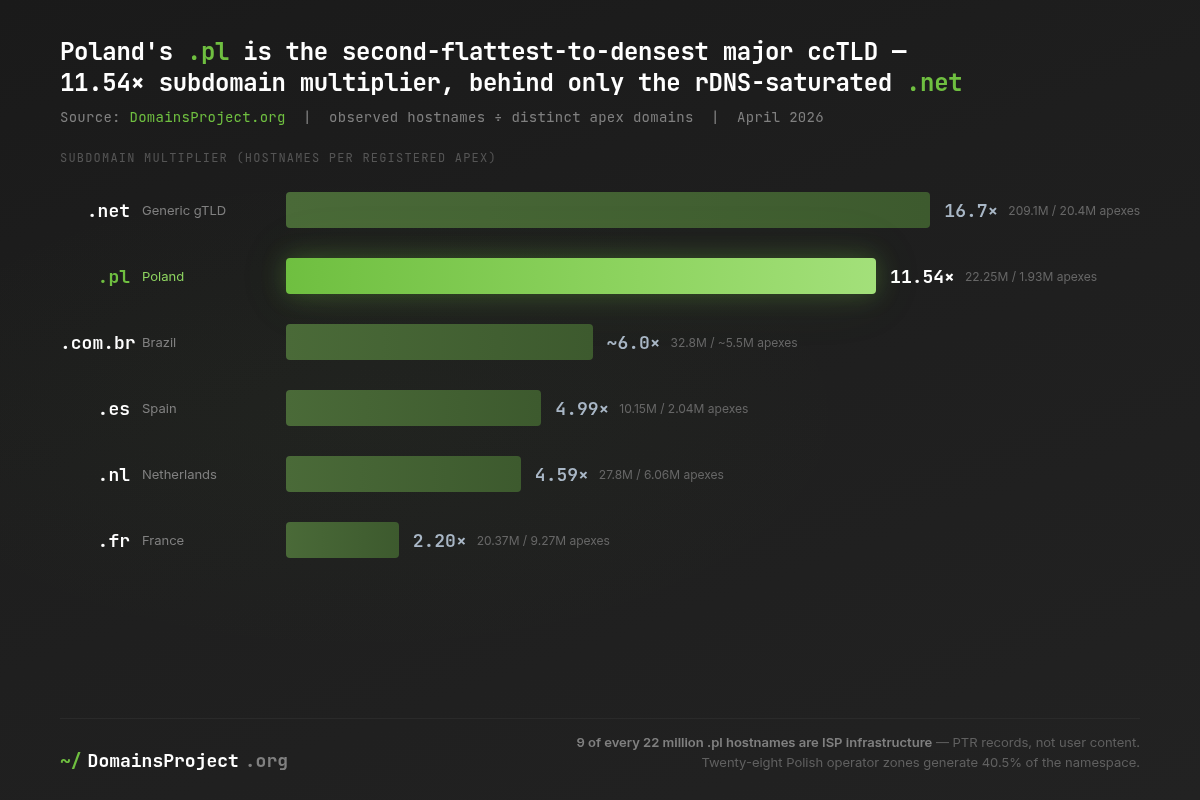
.pl is the second-highest-multiplier ccTLD in our comparison set, behind only .net. The Polish multiplier of 8.83× sits above Spain's .es (6.83×), the Netherlands' .nl (6.15×), Brazil's .com.br (5.99×), and France's .fr (4.55×). Where the .net figure of ~30× is driven by global ISP and CDN reverse-DNS pollution distributed across many sponsoring organisations, the .pl figure of 8.83× is concentrated in a much smaller set of national operators — specifically twenty-eight Polish ISPs whose rDNS-style zones generate the bulk of the namespace's subdomain density. (The .net apex basis is its registry count rather than an observed apex extraction, so its multiplier is the least directly comparable in the table; the four ccTLDs below .pl are all computed on the same observed-apex method.)
How Much of .pl Actually Resolves
Our 9 June 2026 A-record crawl tested every observed .pl hostname for a live IPv4 address. The result is first-party evidence on how much of the namespace is reachable, not merely catalogued.
| Population | Hostnames | Returning a live A record | Rate |
|---|---|---|---|
All observed .pl hostnames |
29,314,881 | 21,660,146 | 73.9% |
| Whole dataset (1,511 TLDs) | 3.18B | — | 58.9% |
.pl resolves at 73.9% — fifteen points above the 58.9% whole-namespace baseline. That is a high reachability rate, and it is consistent with a namespace whose largest single category is ISP reverse-DNS: PTR-backed hostnames are, by construction, attached to allocated and routed IPv4 space, so they tend to return a live A record even when there is no website behind them. The rate is a liveness floor — a live A record can still front a parked page, and the crawl is IPv4-only, so the minority of IPv6-only names reads as non-resolving — but the gap above baseline is large enough to suggest that comparatively little of observed .pl is purely historical DNS detritus. The exception, as the Web 2.0 section below notes, is the frozen-platform tail, where many user-subdomain hostnames persist in the dataset whether or not they still resolve.
.pl Top-100 Apex Concentration
| Concentration metric | Value |
|---|---|
| Hostnames in top 100 apexes | ~13,335,000 |
Share of total .pl hostnames |
45.5% |
Hostnames in top 1 apex (tpnet.pl) |
2,887,673 (9.9%) |
| Hostnames in top 3 apexes | 4,908,796 (16.7%) |
| Hostnames in top 10 apexes | 9,132,400 (31.2%) |
The top one hundred apexes account for nearly half of every observable .pl hostname. This is roughly an order of magnitude more concentrated than .fr (top-100 share 2.34%) and comparable to .nl and .es levels of operator-driven concentration. The single largest apex, tpnet.pl, alone produces 2.89 million hostnames — more than the entire .es apex namespace. (The top-100 share was 51.7% in the original edition; the recounted, deduplicated apex base spreads the same operator mass across a larger denominator, so the concentration reads slightly lower without any underlying change in operator structure.)
The top of the apex distribution is no longer pure ISP reverse-DNS. Where the original edition described the largest apexes as almost entirely carrier rDNS, the recounted top-20 now interleaves Polish shared-hosting platforms with the operators: home.pl (235,347 hostnames), nazwa.pl (217,422), and kylos.pl (126,849) are among the largest non-carrier apexes, and the software-download portal softonic.pl (146,915) appears alongside them. The concentration is therefore better described as ISP reverse-DNS plus shared hosting: the carriers still supply the single largest blocks, but the platforms on which Polish small businesses and individuals actually publish — home.pl and nazwa.pl are the country's two dominant mass-market hosts and registrars — now register at top-apex scale through customer-subdomain and control-panel hostname expansion.
.pl and Single-Operator ISP Concentration
| ccTLD | Largest single operator's rDNS share | Hostname count |
|---|---|---|
.nl |
Ziggo | 22.3%* |
.es |
Jazztel | 21.4%* |
.pl |
Orange Polska (tpnet.pl + orange.pl + centertel.pl) |
16.0% (4.70M) |
.com.br |
(more fragmented, no single operator dominates) | <5%* |
.fr |
Free.fr | 1.24%* |
* .nl, .es, .com.br, and .fr operator shares are carried forward from the original cross-ccTLD analysis and are approximate; only the Orange .pl figure is recomputed on the June 2026 snapshot (4,695,814 / 29,314,881).
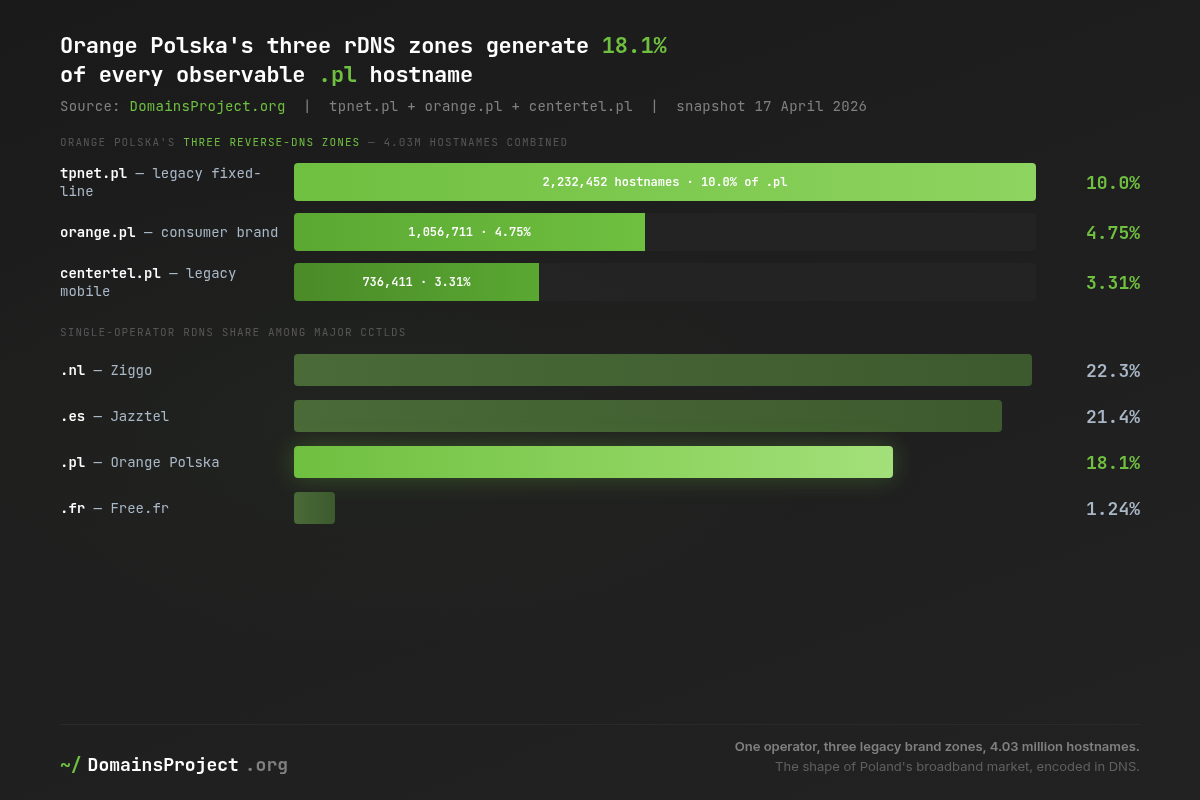
Orange Polska's three rDNS zones constitute roughly one out of every six observable .pl hostnames. TPnet was originally Telekomunikacja Polska — the state PSTN monopoly privatised in stages and acquired by France Telecom (now Orange S.A.) by 2002. Centertel was the legacy mobile arm before the 2005 unification under the Orange brand. Although Orange Polska has rebranded its consumer-facing products, the operator continues to assign reverse-DNS records under all three legacy zone names: residential ADSL/VDSL/FTTH connections under <id>.internetdsl.tpnet.pl and <account>.neoplus.adsl.tpnet.pl, mobile data under centertel.pl strings, and modern fibre and convergence under orange.pl. The combined 4.70M hostnames is a structural feature of Polish DNS that no policy decision since 2005 has touched.
The Reverse-DNS Backbone
Every nationally important Polish ISP whose customers use IPv4 with reverse-DNS records configured is visible in our crawl as one or more .pl apexes generating tens or hundreds of thousands of hostnames apiece. Together they constitute the largest single category of observable .pl hostnames.
Top operator reverse-DNS apexes
| Apex | Hostnames | Operator (current) | Notes |
|---|---|---|---|
tpnet.pl |
2,887,673 | Orange Polska | Legacy Telekomunikacja Polska — fixed-line ADSL/VDSL/FTTH residential pool |
orange.pl |
1,065,983 | Orange Polska | Consumer brand zone — fibre, mobile-broadband, convergence |
chello.pl |
955,140 | Liberty Global / UPC Polska / Play (post-2022) | Cable broadband — legacy "chello" branding retained in PTR records |
plus.pl |
952,972 | Plus / Polkomtel (Polsat Plus Group) | Mobile — jumped from 342,973 to #4 since the original edition |
centertel.pl |
742,158 | Orange Polska | Legacy mobile (Centertel — original Polish mobile operator) |
t-mobile.pl |
659,673 | T-Mobile Polska | Mobile and fixed-wireless |
play-internet.pl |
496,765 | Play (P4) | Mobile broadband and fixed-wireless |
inetia.pl |
485,441 | Netia | Alternative fixed-line carrier (Polsat Plus Group) |
vectranet.pl |
464,318 | Vectra | Cable operator |
netia.com.pl |
422,277 | Netia | Same operator, separate rDNS zone |
internetia.net.pl |
221,064 | Netia | Wholesale-customer ISP |
dialog.net.pl |
206,623 | Dialog (Polsat Plus Group, post-2014) | Legacy regional fixed |
tktelekom.pl |
202,169 | TK Telekom (PKP rail-track operator → Netia 2017) | Backbone provider |
toya.net.pl |
149,825 | Toya | Łódź-area cable |
icpnet.pl |
145,413 | ICP / Multimedia | Cable |
dolsat.pl |
61,640 | Dolsat | Bielsko-Biała regional ISP |
asta-net.com.pl |
57,698 | Asta-Net | Pomorze regional ISP |
multimo.pl |
43,719 | Multimo / Multimedia | Cable |
telpol.net.pl |
33,290 | Telpol | Voivodeship-level fixed |
sileman.net.pl |
32,064 | Sileman | Silesia regional ISP |
euro-net.pl |
32,048 | Euro-Net | Mazovia regional ISP |
cyfrowypolsat.pl |
31,413 | Cyfrowy Polsat | Satellite + mobile broadband |
serv-net.pl |
30,308 | Serv-Net | Local ISP |
itsa.net.pl |
29,385 | ITSA Telekom | Local |
gawex.pl |
28,022 | Gawex Media | Pomerania regional ISP |
tkb.net.pl |
27,752 | TKB | Local fixed |
satfilm.com.pl |
26,558 | SATfilm | Lublin-area cable |
gtsenergis.pl |
23,459 | GTS / Energis (T-Mobile Polska 2014) | Legacy backbone |
Sum across these twenty-eight operator zones: 10,514,850 hostnames — 35.9% of the entire observable .pl namespace. The shape of this aggregate matches the reality of Poland's broadband market: per UKE filings and Omdia's Poland Country Regulation Overview 2025, Orange Polska holds roughly 25% of fixed-broadband revenue, the Polsat Plus Group (Plus / Netia / Cyfrowy Polsat / Dialog) takes the high teens, Vectra and Multimedia together hold a similar share, and a long tail of regional cable, ISP, and wireless-internet providers — INEA, Toya, Asta-Net, Sileman, Telpol, Gawex, Euro-Net, Dolsat — hold roughly 36% of subscribers under the heading "other." The .pl namespace mirrors that fragmentation almost perfectly. The most notable mover since the original edition is plus.pl (Polsat Plus Group's mobile rDNS zone), which nearly tripled from 342,973 to 952,972 hostnames to become the fourth-largest apex in the entire namespace — consistent with Plus expanding PTR coverage across its mobile and fixed-wireless IP pools.
The operational consequence: any benchmark of .pl's "size" against another ccTLD that does not normalise for ISP rDNS produces a distorted comparison. The .pl registered base is 2.61M (mid-table for European ccTLDs); the .pl observed base of 29.3M ranks meaningfully higher, but more than 10M of those hostnames are infrastructure — automatically generated PTR records, not human-published web content.
NASK: State Research Institute With a Hybrid Mandate
The institution behind .pl is unlike both DENIC's pure-cooperative .de model and AFNIC's state-adjacent non-profit .fr model. NASK is a Państwowy Instytut Badawczy (PIB) — a State Research Institute under direct ministerial supervision, founded as a Warsaw University coordination team in 1991 and constituted as an autonomous research unit in December 1993. NASK is owned by the Government of Poland, currently supervised by the Ministry of Digital Affairs (split from the Ministry of Digitalization in 2023), and combines four functions in a single institutional body that has no exact analogue in the Western European ccTLD operator set:
| NASK function | Scope |
|---|---|
.pl registry operator |
2.61M domains, partner-registrar EPP model since 2003 |
| CERT Polska | National computer emergency response — active since 1996 |
| Research and development | EU-funded R&D in cybersecurity, AI, networking |
| Critical-infrastructure operator | Government data-centre and DNS operator under Polish cybersecurity law |
NASK runs the country's authoritative DNS, the country's CERT, and roughly ninety percent of the country's public-sector cybersecurity research within a single state-owned institute. Compared to AFNIC's institutional separation between registry function and the (separate) ANSSI/CERT-FR cybersecurity authority, or DENIC's strict commercial-cooperative model where the registry has no incident-response or research mandate, NASK's hybrid status is structurally distinct. It also means that any Polish national policy on registry operations, dispute resolution, takedown, or DNSSEC roll-out can be enacted within a single state institution rather than across a registry/regulator/CERT triangle.
The functional consequence is operational coherence on national-security incidents. The .gov.pl zone was transferred from the Polish Academy of Sciences to NASK in July 2013, consolidating central-state DNS under the same operator that runs CERT Polska. The Registry Lock service launched in March 2019 was deployed across the high-value .gov.pl, banking, and infrastructure spaces under a single operational team.
NASK pricing and registrar landscape
| Metric | NASK (.pl) |
AFNIC (.fr) |
DENIC (.de) |
SIDN (.nl) |
|---|---|---|---|---|
| Wholesale registration (1st year) | 14.90 PLN (~€3.50) | €5.07 | €2.20 | €4.38 |
| Wholesale renewal | 50.00 PLN direct / 30.00 PLN SLD-zone (~€11.70 / €7.00) | €5.07 | €2.20 | €4.38 |
| Registrations | 2.61M | 4.32M | 17.7M | 6.06M |
| Accredited registrars | 200+ | 400+ | ~300 | ~1,058 |
| Direct-from-registry registration | discontinued June 2015 | n/a | n/a | n/a |
| IDN support since | March 2003 (first European ccTLD) | May 2012 | 2004 | 2004 |
NASK's .pl is the only major European ccTLD we have analyzed where wholesale registration and wholesale renewal differ by a factor of more than three. A first-year direct .pl registration costs the registrar 14.90 PLN (€3.50) — meaningfully cheaper than €11.70) is 2.3× more than .fr's €5.07 or .nl's €4.38. The renewal price of 50.00 PLN (.fr's €5.07 and 5.3× more than .de's €2.20. The structural effect of this pricing curve is a heavy bias against domain stockpiling and speculative registration: a portfolio holder who buys ten thousand .pl names at 14.90 PLN apiece pays 150,000 PLN year one but 500,000 PLN year two, against zero corresponding lift on aftermarket valuations. Functional-zone (com.pl, net.pl, org.pl) and regional-zone (waw.pl, krakow.pl) renewals run at a discounted 30.00 PLN (~€7.00), which leaves the SLD zones cheaper to hold long-term but still far above peer-ccTLD rates.
NASK's Functional Second-Level Zones: Where the Polish Internet Actually Lives
Where .fr runs nine identity-verified profession TLDs that almost nobody uses, Polish second-level zones are a different design choice: broad functional categories with no identity-verification mechanism, opened to any registrant on the same partner-registrar EPP model as direct .pl. The result is the inverse of France's empty professional namespace — .com.pl and .edu.pl are large, active, and used.
Functional SLD zones in our crawl
| Zone | Hostnames observed | Distinct apexes | Hosts/apex |
|---|---|---|---|
.com.pl |
1,893,273 | 273,214 | 6.9× |
.net.pl |
1,141,048 | 28,067 | 40.7× |
.edu.pl |
223,600 | 27,276 | 8.2× |
.org.pl |
99,965 | 21,607 | 4.6× |
.gov.pl |
52,062 | 1,015 | 51.3× |
.biz.pl |
28,956 | 6,648 | 4.4× |
.media.pl |
26,673 | 336 | 79.4× |
.info.pl |
25,675 | 7,158 | 3.6× |
.sklep.pl |
7,939 | 2,560 | 3.1× |
.art.pl |
6,658 | 1,894 | 3.5× |
.nieruchomosci.pl |
2,777 | 966 | 2.9× |
.mil.pl |
1,611 | 36 | 44.8× |
.ngo.pl |
602 | 114 | 5.3× |
.priv.pl |
598 | 142 | 4.2× |
.tm.pl |
277 | 88 | 3.1× |
.com.pl and .net.pl together generate 3,034,321 hostnames against 301,281 distinct apexes — more than the entire registered .es namespace registered to date by Spain. These two zones are the functional core of Polish commercial and infrastructure DNS, and they dominate every operator-rDNS aggregation: of the 28 ISP zones above, 11 are registered as third-level under .com.pl or .net.pl (netia.com.pl, internetia.net.pl, dialog.net.pl, toya.net.pl, asta-net.com.pl, telpol.net.pl, tkb.net.pl, sileman.net.pl, itsa.net.pl, satfilm.com.pl). The high hosts-per-apex ratio in .net.pl (40.7×) is itself an rDNS artefact: the zone's modest apex count is dominated by a handful of operator reverse-DNS apexes (internetia.net.pl, dialog.net.pl, toya.net.pl, and others) that each expand into hundreds of thousands of PTR hostnames, whereas .com.pl carries a much broader base of ordinary commercial apexes at a 6.9× ratio.
.gov.pl: Functional but small
The Polish federal-state digital estate under .gov.pl carries 1,015 distinct apex domains generating 52,062 hostnames — a hosts-per-apex ratio of 51.3×, far higher than any other functional zone, indicating that the state's apexes publish substantial subdomain trees. But the zone is now dominated by a single backbone: mofnet.gov.pl, the Ministry of Finance's infrastructure apex, has expanded from 685 hostnames in the original edition to 31,344 — roughly 60% of every observed .gov.pl hostname. The remaining top apexes still paint a coherent map of Polish central-state web architecture:
mofnet.gov.pl(31,344) — Ministry of Finance backbone — now ~60% of all.gov.plhostnames, up from 685; a single ministry's infrastructure expansion that reshaped the entire zone's distributionsr.gov.pl(1,526) — sąd rejonowy (district courts) federationbip.gov.pl(1,511) — Biuletyn Informacji Publicznej, the unified public-information bulletin federation across all Polish government entitiespolicja.gov.pl(1,173) — Polish National Policelasy.gov.pl(983) — Lasy Państwowe (State Forests of Poland), the Treasury-owned forestry administration covering 7.6M hectarespionier.gov.pl(523) — PIONIER, the Polish national academic and research networkpraca.gov.pl(469) — National employment agencyuw.gov.pl(378) — urząd wojewódzki (voivodeship offices) federationso.gov.pl(326) — sąd okręgowy (regional courts) federationmsz.gov.pl(319) — Ministry of Foreign Affairsparp.gov.pl(257) — Polska Agencja Rozwoju Przedsiębiorczości (agency for enterprise development)mf.gov.pl(211) — Ministry of Finance, alternative apex
The Polish federal state's web estate is the unusual case among European ccTLDs of an institutional architecture that runs far deeper than the apex count would suggest — and that depth is now overwhelmingly concentrated in one ministry. Where Spain's .gob.es resolved at roughly 5% of registered apexes and France's .gouv.fr at roughly one hostname per apex, Poland's .gov.pl runs 1,015 apexes that publish 52,062 distinct hostnames between them — over fifty per apex. That ratio is inflated almost single-handedly by mofnet.gov.pl: strip out the Ministry of Finance backbone and the remaining 1,014 apexes average closer to twenty hostnames each, much nearer the original edition's reading. The standout finding of this refresh is therefore the mofnet.gov.pl expansion itself — a forty-five-fold growth in observed hostnames under one Ministry of Finance apex — which is consistent with a large internal-services or e-tax subdomain build-out rather than any change in the breadth of the Polish state's web presence. Beyond it, Polish ministries, courts, and agencies still tend to publish multiple sub-services per apex, and the unified BIP federation alone contributes 1,511 distinct hostnames under one organising apex.
The transfer of .gov.pl administration from the Polish Academy of Sciences to NASK in July 2013 unified the .gov.pl operational stack with the .pl registrar EPP system and CERT Polska's incident-response capability. The functional consequence is that any Polish central-government domain takedown, transfer, or DNS-level emergency action can be effected by NASK as registry operator and as CERT in the same operational team — without requiring inter-agency coordination of the kind France's DINUM-vs-AFNIC-vs-ANSSI architecture imposes.
.edu.pl: Substantial academic estate, concentrated in twenty institutions
Polish higher education runs 27,276 distinct apexes under .edu.pl, but the bulk of the namespace's observable density concentrates in twenty universities and research institutions:
| Apex | Hostnames | Institution |
|---|---|---|
us.edu.pl |
23,572 | University of Silesia in Katowice |
agh.edu.pl |
8,372 | AGH University of Science and Technology, Kraków |
pw.edu.pl |
6,933 | Warsaw University of Technology |
uwm.edu.pl |
6,186 | University of Warmia and Mazury, Olsztyn |
amu.edu.pl |
6,013 | Adam Mickiewicz University, Poznań |
uj.edu.pl |
5,233 | Jagiellonian University, Kraków |
zut.edu.pl |
5,052 | West Pomeranian University of Technology, Szczecin |
ukw.edu.pl |
4,432 | Kazimierz Wielki University, Bydgoszcz |
gumed.edu.pl |
4,155 | Medical University of Gdańsk |
pk.edu.pl |
3,793 | Cracow University of Technology |
uw.edu.pl |
3,595 | University of Warsaw |
icm.edu.pl |
3,212 | Interdisciplinary Centre for Mathematical and Computational Modelling |
prz.edu.pl |
2,980 | Rzeszów University of Technology |
The University of Silesia's us.edu.pl is, in our crawl, the largest single Polish academic apex by hostname count — 23,572 distinct hostnames against the Jagiellonian University's 5,233 and the University of Warsaw's 3,595. This ranking inverts the prestige ordering of Polish universities — Jagiellonian (founded 1364) and Warsaw are the two flagship research universities; the University of Silesia, founded in 1968, is mid-tier in international rankings. The hostname count here measures subdomain expansion of the institution's web infrastructure, not academic prestige; the Silesia number is dominated by its faculty-by-faculty and research-group-by-research-group subdomain conventions, where Warsaw and Jagiellonian use flatter, more centralised web architectures. Reading our .edu.pl table top-down is reading which Polish universities subdivide their web estate the most, not which are the most academically active.
The Twenty-Three-Zone Regional Architecture, Three Decades In
NASK launched a parallel set of geographic second-level zones in the 1990s — twenty-three city zones plus a handful of voivodeship-region zones — anticipating that Polish municipal life would follow Italian and German patterns of strong city-level web identity. Three decades later, the zones exist, are still open to registration, and account for under 1.5% of the namespace.
Top regional second-level zones in our crawl
| Zone | Hostnames | Distinct apexes | Notes |
|---|---|---|---|
.waw.pl (Warsaw, short form) |
61,719 | 12,241 | Largest regional zone by apex count |
.wroc.pl (Wrocław, short form) |
41,536 | 724 | Heavy subdomain expansion |
.poznan.pl |
29,359 | 1,792 | |
.gda.pl (Gdańsk, short form) |
25,182 | 998 | |
.lublin.pl |
21,413 | 1,534 | |
.lodz.pl |
20,300 | 553 | |
.szczecin.pl |
19,459 | 3,484 | Second-largest by apex |
.krakow.pl |
16,741 | 2,291 | |
.torun.pl |
14,809 | 469 | |
.wroclaw.pl (long form) |
13,043 | 3,559 | Long form has more apexes than the short-form .wroc.pl |
.rzeszow.pl |
11,010 | 2,098 | |
.olsztyn.pl |
9,601 | 1,937 | |
.katowice.pl |
9,227 | 1,762 | |
.bydgoszcz.pl |
8,844 | 1,842 | |
.opole.pl |
8,636 | 1,861 | |
.warszawa.pl (long form) |
8,036 | 2,337 | Short form .waw.pl has 5.2× more apexes |
.zgora.pl |
5,916 | 1,094 | Zielona Góra |
.bialystok.pl |
5,805 | 1,605 | |
.gliwice.pl |
4,715 | 344 | |
.czest.pl |
4,589 | 854 | Częstochowa |
| Twenty-three zones combined | 363,171 | 49,278 | 1.48% of .pl apex namespace |
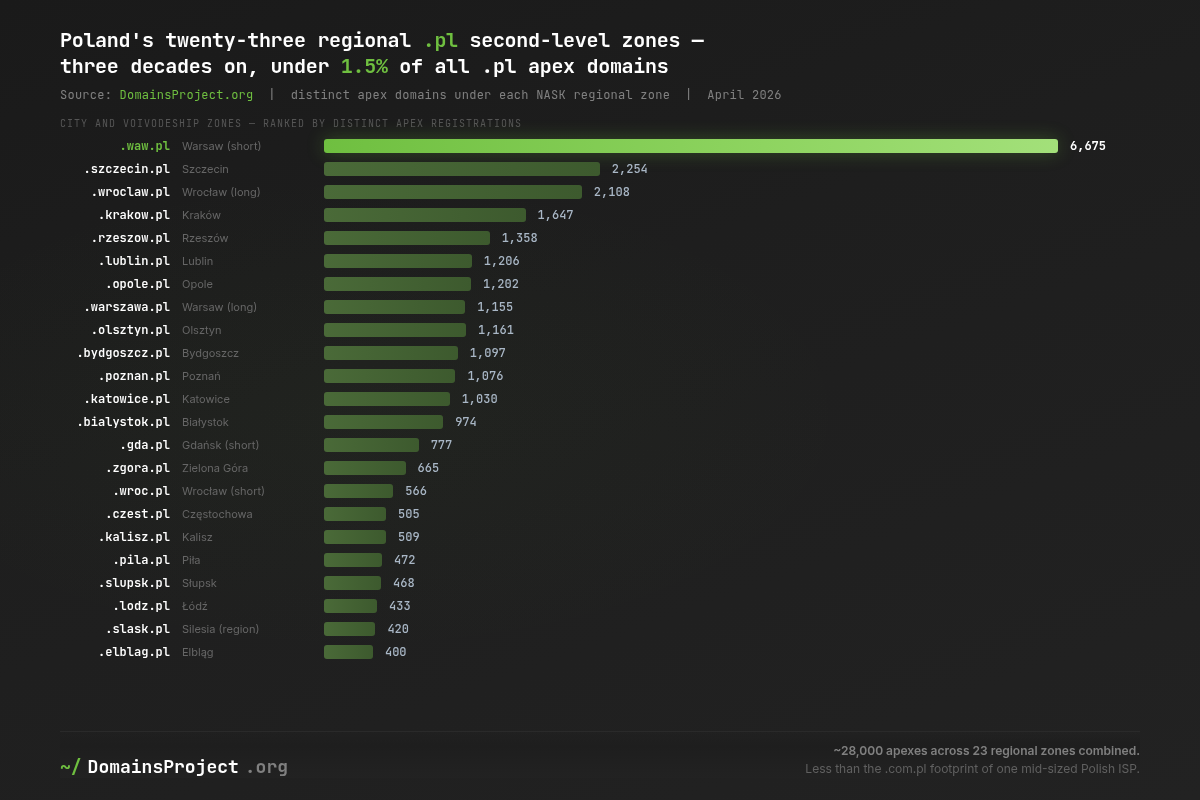
The combined regional second-level architecture across all twenty-three zones holds 49,278 distinct apexes — 1.48% of the .pl apex namespace, and less than the .com.pl registrations of any single mid-sized Polish ISP. Where NASK created two zones for the same city (Warsaw: .waw.pl and .warszawa.pl; Wrocław: .wroc.pl and .wroclaw.pl; Gdańsk: .gda.pl and .gdansk.pl), the short forms generally dominate — .waw.pl has 5.2× more apexes than .warszawa.pl; .gda.pl (998 apexes) has roughly 4.6× more than .gdansk.pl (219). The Wrocław pair is the exception: .wroclaw.pl (long form, 3,559 apexes) overtakes .wroc.pl (short form, 724 apexes) by registrant count, though .wroc.pl still produces more total hostnames (41,536 vs 13,043) because the apexes inside it expand much more aggressively into subdomains. The architectural reading is that short forms set in the early NASK era acquired registrant inertia that long forms launched later cannot displace, except where local registrant communities consciously prefer the long form (Wrocław apparently does).
The regional zones are not used for what NASK envisioned in the 1990s — local-government web estates, municipal small-business directories, regional cultural identity. Polish municipalities in our .gov.pl data overwhelmingly use direct .pl apexes (um.warszawa.pl exists, but most municipal sites resolve at <city>.pl or <city>.um.gov.pl). Polish small businesses overwhelmingly use direct .pl or .com.pl. The regional zones, like France's regional new-gTLDs (.bzh, .alsace, .corsica, .paris), have settled into a long-tail role: serviceable for niche identity claims, not central to commercial web life.
Polish Web 2.0, Frozen in DNS
Beneath the operator backbone and the institutional architecture sits a set of Polish-language Web 2.0 hosting platforms whose commercial moments were the mid-2000s and whose user content, in many cases, is fifteen years old — but whose hostnames continue to resolve in 2026 at substantial scale.
Polish free-hosting and Web 2.0 platforms in our crawl
| Apex | Hostnames | Distinct user subdomains | Platform |
|---|---|---|---|
pinger.pl |
100,463 | 94,714 | Polish microblog platform circa 2006–2010 — now the largest |
digart.pl |
86,207 | 85,953 | Polish art-sharing community — DeviantArt analog founded 2003 |
beep.pl |
84,399 | 10,805 | Free hosting and blogging |
prv.pl |
48,477 | 39,964 | Free hosting under user.prv.pl convention |
fora.pl |
47,374 | 34,349 | Polish phpBB-hosted forum federation |
pun.pl |
33,463 | 27,546 | PunBB-style forum hosting |
republika.pl |
28,200 | 23,268 | Onet's Polish GeoCities-equivalent (2000–) |
cba.pl |
21,357 | 17,289 | Free PHP/MySQL hosting, founded mid-2000s |
blog.pl |
20,276 | 19,215 | Generic blogging |
bloog.pl |
18,708 | 17,815 | Polish blogging platform |
blip.pl |
13,338 | 13,327 | Polish microblog (2007–2013, shut down — but hostnames persist) |
flog.pl |
12,931 | 12,866 | Photo-blog platform |
| Twelve-platform aggregate | 515,193 | 397,111 | — |
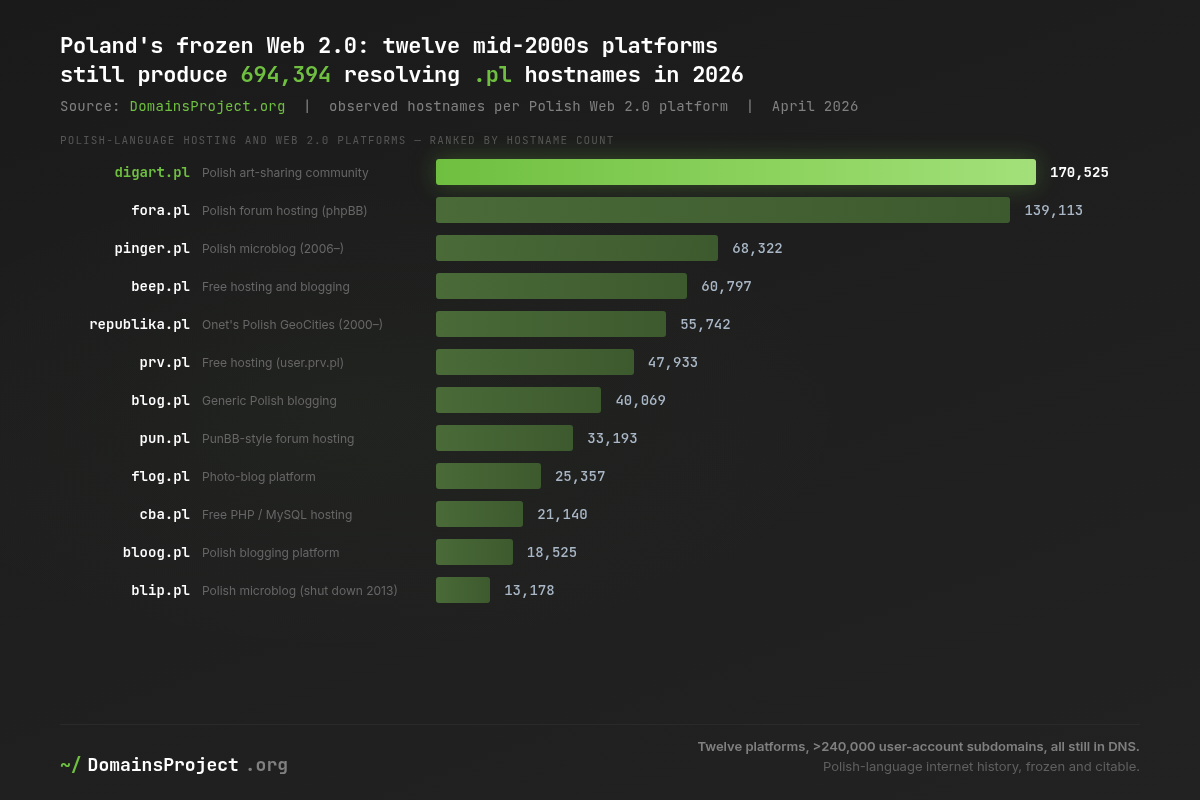
Twelve Polish-language hosting platforms together generate 515,193 hostnames across roughly 397,000 distinct user-account subdomains. After operator reverse-DNS (about 10.5M hostnames) is excluded from the 29.3M namespace, this Web 2.0 layer is on the order of 2.7% of the remaining non-rDNS hostnames — a long, durable tail rather than a dominant share, but one with no equivalent in the peer ccTLDs we have analyzed. The list reads as a snapshot of Polish-internet 2005–2010: pinger.pl (the Polish microblog whose 94,714 user subdomains in our data are a structural artefact of a 2006–2010 platform that lost most of its active base to Twitter and Facebook by 2012 but never shut down, and which is now the single largest platform apex), digart.pl (Polish DeviantArt-equivalent, founded 2003 by Wojciech Maliszewski, peaked as the dominant Polish art-sharing site in 2009), fora.pl (free hosting for Polish phpBB-style internet forums, the platform Polish-language hobbyist communities used before Facebook Groups consolidated them), republika.pl (Onet's free-pages product, the Polish GeoCities — 23,268 user accounts still resolving), blip.pl (a Polish microblog that shut down 2013 — yet 13,338 hostnames still resolve under the apex, presumably from operators preserving the DNS infrastructure for archival or redirect purposes).
A few observations:
-
The Polish free-hosting tail is structurally larger and more diverse than any other European ccTLD's. France's analog is essentially
free.frplus a long thin tail of niche platforms; Spain's analog has more or less been absorbed into the.esoperator-rDNS pool. Poland in 2026 still has at least twelve Polish-language platforms generating tens of thousands of hostnames each —pinger.pl,digart.pl, andbeep.pleach in six figures — and roughly 397,000 user-account subdomains between them. -
The platforms' active commercial moments are long past, but the DNS records persist. Onet sold most of
republika.plto Ringier Axel Springer Polska in 2014; the platform has not actively recruited new users in close to a decade.pinger.plhas not produced significant Polish-press coverage since 2014.blip.plformally shut down in 2013. Yet the hostnames continue to resolve — operationally cheap to maintain, and tied to backlink profiles, archived content, and SEO anchors that any operator who shut them down would lose. -
The Polish Web 2.0 layer is a useful proxy for archived-Polish-web research. Researchers studying Polish-language internet history through the 2000s, the social-media transitions of 2010–2015, or the platform-consolidation effects of Facebook Polska's market entry have a documentable resolvable apex set against which to ground archival queries. The hostnames themselves are not all live — many serve "this account no longer exists" or registrar-default placeholder pages — but they are citable.
What's at Stake
- Poland's
.plis a single-operator-concentrated ccTLD by the same standards that flag.nland.es. Orange Polska's three rDNS zones generate 16.0% of every observable.plhostname, and twenty-eight operators together supply roughly a third of the namespace. Any benchmark of Polish DNS scale against, say, Germany's.deor France's.frthat does not normalise for ISP rDNS materially overstates Polish web-publishing density. - NASK's pricing structure (cheap registration, expensive renewal) is a deliberate disincentive to portfolio speculation that no other major European ccTLD imposes at the same magnitude. A
.plportfolio is roughly 2–3× more expensive to maintain year-over-year than a.frportfolio of equal size. The structural effect is a smaller speculative aftermarket and a registrant base biased toward names actually intended for use. - The functional
.com.pland.net.plzones together hold more apexes than the entire registered.esnamespace. Poland's commercial DNS operates substantially under second-level functional zones rather than direct.pl, and any analysis of.plregistrant behaviour that looks only at direct.plregistrations under-counts the active commercial namespace by a factor of roughly two. .gov.plworks, and it works at a deeper subdomain layer than its peers — but that depth is now one ministry. 1,015 apexes generate 52,062 hostnames — a hosts-per-apex ratio of 51.3, well above.fr's.gouv.fr(~1) and.es's.gob.es(~5%). The ratio is dominated bymofnet.gov.pl(Ministry of Finance), which alone now accounts for roughly 60% of observed.gov.plhostnames; strip it out and the rest of the state's estate is operationally dense but unremarkable, with the BIP federation contributing 1,511 hostnames under one organising apex.- The twenty-three regional zones are cosmetic. Combined apex share 1.48%. Where two zones exist for one city, the short form usually dominates by a factor of five (Wrocław being the exception). NASK's 1990s-era anticipation of municipal-and-regional-led Polish digital identity has not materialised in the namespace.
- The Polish Web 2.0 layer is structurally larger than any peer ccTLD's.
pinger.pl,digart.pl,beep.pl,prv.pl,fora.pl,pun.pl,republika.pl,cba.pl,blog.pl,bloog.pl,blip.pl,flog.pltogether produce 515,193 hostnames across roughly 397,000 user subdomains. Most platforms' active commercial moments are over, but the DNS persists — making.pla uniquely durable archive of Polish-language mid-2000s user content for researchers, archivists, and digital-history scholars. - NASK's institutional hybridity (registry + CERT + research institute + state cybersecurity operator) has no exact peer in Western European ccTLDs. The structural consequence is unified national-DNS incident response within a single state institute, in contrast to France's tri-partite DINUM/AFNIC/ANSSI architecture. The trade-off is that any failure of trust in NASK governance — were such a failure to occur — would propagate across registry, CERT, and state-cybersecurity functions in a single shock.
What Would Help
1. Registries: publish lapse-and-churn data alongside the live counter. NASK's quarterly market reports at naskpartner.pl are excellent on registered counts, registrar concentration, and creates/deletes flow, but the live counter alone obscures how much .pl history accumulates outside the active base. Our deduplicated dataset has now observed 3,319,758 distinct .pl apexes — about 27% more than the 2,614,293 currently registered — because deduplicating over time unions domains that were live when we saw them and have since lapsed or been deleted. That gap is a churn-and-lapse signal, not a coverage figure, and it is a measurable quantity NASK is uniquely positioned to publish authoritatively: a cumulative "ever-registered, since-deleted" count per second-level zone would let researchers separate the durable namespace from the transient one, and would let NASK and the Polish digital-affairs ministry see whether the second-level zone structure is producing the patterns of use NASK intended.
2. Researchers studying Polish-internet history: the Web 2.0 platform list is your ground truth. Anyone studying the 2005–2015 Polish-language internet — pre-Facebook social platforms, Polish-language blogging, Polish-language fan communities — should anchor their archival queries against the twelve Polish Web 2.0 platforms enumerated above. The hostnames are citable; the user-account subdomains are enumerable; backlink profiles into these platforms are recoverable from third-party crawl archives.
3. Cross-ccTLD researchers: distinguish operator-rDNS from user-published content. When .pl is benchmarked against .fr, .de, or .nl on hostname count, the figures conflate two fundamentally different categories: PTR records auto-allocated by ISPs and user-published web content. For .pl, a clean comparison requires subtracting at minimum the 10.5M operator-rDNS hostnames from the headline number. The same correction matters for .es (Jazztel) and .nl (Ziggo) but is largest in proportional terms for .pl. The methodology section above lists the 28 Polish operator zones to subtract.
4. NASK: revisit the regional zone architecture. Twenty-three city and voivodeship zones, three decades of operation, under 1.5% of the namespace. Either consolidate the short and long forms (allowing .warszawa.pl registrants to claim .waw.pl strings without a separate transaction, or vice versa), or formally retire the smaller zones (.koszalin.pl, .kalisz.pl, .pila.pl, .elblag.pl) into a transition path under direct .pl. The current architecture imposes operational maintenance cost on NASK's EPP and DNS infrastructure for namespace tiers that have produced sub-thousand-apex registrations across thirty years.
5. Polish municipalities: the regional zones are available. Where NASK's regional zones exist, they are operationally suitable for municipal web identity but are not in fact heavily used by Polish local governments. Warsaw's um.warszawa.pl lives under a hierarchical convention, but most Polish municipalities run their public-facing sites under direct .pl or .com.pl. The regional zones could be deployed as municipal-trust signals (citizens learning that bip.<city>.pl always resolves to the city BIP, citizens learning that urzad.<city>.pl is always the city office) — but only if Polish local-government communications policy converged on the convention. It has not.
Methodology and sources: This analysis used the DomainsProject .pl country file (29,314,881 observed hostnames, June 2026 snapshot) and a 9 June 2026 IPv4 A-record crawl of the namespace (21,660,146 hostnames returning a live A record, 73.9%, against the 58.9% whole-dataset baseline); NASK's dns.pl real-time registry counter (2,614,293 active .pl domains as of Q1 2026); the NASK / naskpartner.pl Q1 2025 quarterly market report (2,579,014 active .pl end of March 2025; 193,918 Q1 2025 new registrations averaging 2,155 daily); the dns.pl historical timeline page documenting NASK's institutional history from 1990 establishment through the 2003 EPP and IDN deployment, the 2008 one-million-domains milestone, the 2013 transfer of .gov.pl from PAN to NASK, the June 2015 discontinuation of direct end-user registration, and the 2025 wholesale price update; the dns.pl registrar wholesale price list (14.90 PLN registration; 50.00 PLN direct-.pl renewal; 30.00 PLN SLD-zone renewal); IANA's root-zone delegation entry for .pl; Wikipedia entries for .pl and Naukowa i Akademicka Sieć Komputerowa; Statistics Poland (GUS) Information Society in Poland 2025 (96.2% household internet access; 70.3% fixed broadband; 78.2% mobile broadband); DataReportal Digital 2025: Poland (34.5M internet users, 89.8% penetration); Omdia Poland Country Regulation Overview 2025 on broadband market structure; Polish national telecommunications regulator UKE filings on Orange Polska, Polsat Plus Group, Vectra/Multimedia, T-Mobile Polska, Play, and regional ISP market shares. Detailed source list and full numerical workings are in the research file. Explore the DomainsProject statistics dashboard and the full dataset.