On 2 September 1986 — five months after Germany's first six .de registrations and four months after Piet Beertema put cwi.nl into the DNS as the first active ccTLD outside the United States — IANA delegated .fr to the Institut national de recherche en informatique et en automatique (INRIA) in Le Chesnay. Day-to-day management fell to a two-person team: Annie Renard and Jean-Yves Babonneau. Eligibility was defined by a Naming Charter that read like a bureaucratic admissibility test. To register a .fr domain, an applicant needed an exact-match registered company name, a French trademark certificate, or an INSEE identifier. Common words were forbidden. Place names were forbidden. The minimum length was three characters. For nearly two decades, France's national namespace operated as a verifiable digital corollary to the Registre du commerce et des sociétés — a state-sanctioned identity space, not a market.
Then France did something almost no other major ccTLD operator did. It liberalized in stages, each stage permitting a new class of applicant rather than relaxing the verification framework itself. May 2004 opened registration to anyone in an official national database. June 2006 admitted individuals. December 2011 extended eligibility to all EU/EEA residents. May 2012 turned on diacritical IDN. March 2015 finally allowed one- and two-character labels. By the end of 2025, AFNIC — the public-interest non-profit that took over from INRIA in 1997 — counted 4,319,120 registered .fr domains, with 853,000 new creates in 2025 (a then-all-time record), under wholesale fees of €5.07/year (raised from €4.56 on 1 March 2024).
.fr is the seventh-largest ccTLD in the world. It is operated by a single non-profit. Its registry also runs the back-end for five French overseas-territory ccTLDs (.re, .yt, .pm, .wf, .tf), four regional new-gTLDs (.bzh, .alsace, .corsica, .paris), and a stack of .brand TLDs (.ovh, .leclerc, .sncf, .mma, .aquarelle, .bostik, .lancaster, .total). Inside the .fr zone itself, AFNIC administers nine identity-verified professional sub-namespaces governed by ordinal verification: .avocat.fr (lawyers), .notaires.fr (notaries), .medecin.fr (physicians), .pharmacien.fr (pharmacists), .veterinaire.fr (veterinarians), .chirurgiens-dentistes.fr (dentists), .experts-comptables.fr (accountants), .geometre-expert.fr (surveyors), and .huissier-justice.fr (bailiffs). It also runs .gouv.fr for the central state, .aeroport.fr for the airport sector, and the legacy generic zones .com.fr, .asso.fr, .nom.fr, .tm.fr, .prd.fr, and .presse.fr.
We crawled and indexed 20,369,784 hostnames under .fr (snapshot 17 March 2026), cross-referenced against AFNIC's .FR in 2024 annual report, AFNIC's June 2025 Global Domain Name Market observatory, ARCEP's optical-fibre press release of 2 April 2026, ANSSI's CERT-FR 2025 Cyber Threat Panorama, INSEE's end-2024 demographic update, the Conseil National des Barreaux's 2025 directory, and the Fourth Circuit ruling and Supreme Court certiorari denial in Frydman v. France (the france.com litigation that ended in December 2021).
The headline: France engineered the most architecturally elaborate national namespace in Europe and runs it almost entirely empty. Nine identity-verified professional TLDs together generate 658 hostnames, of which the regulatory orders themselves account for the largest single bucket. The Order of Pharmacists owns 35 of 37 .pharmacien.fr hostnames. The Order of Physicians owns 87 of 98 .medecin.fr hostnames. France's 78,938 verified avocats produced 57 distinct .avocat.fr apex domains. Sixty percent of all 9.27 million .fr apexes in our crawl resolve to exactly one hostname — the bare apex itself, with no subdomains. France's .fr is, structurally, a continent's worth of registered identity sitting on a flat web.
The Data
DomainsProject continuously crawls and indexes hostnames across every delegated TLD in the IANA root zone. For .fr, the snapshot used in this post breaks down as follows.
| Category | Count | Coverage |
|---|---|---|
| Active TLDs tracked | 1,519 | 100% of IANA root zone |
| Total domains indexed | 2.3B+ | Largest public dataset |
.fr hostnames observed |
20,369,784 | 0.89% of dataset |
.fr distinct apex domains |
9,273,770 | Subdomain multiplier 2.20× |
AFNIC registered .fr (end-2024) |
4,216,786 | Official registry |
AFNIC registered .fr (end-2025) |
4,319,120 | Official registry |
.fr rank among ccTLDs |
7th globally | per AFNIC observatory 2024 |
The 20.37M crawl figure exceeds the 4.32M registry figure because we count distinct hostnames — every <login>.free.fr user page, every *.blogspot.fr redirect, every <id>.dyn.bbox.fr reverse-DNS entry, every www.example.fr and example.fr pair when both resolve. The registry counts only registered second-level (and a small set of registered third-level) domains. Both numbers describe the same namespace from different angles.
Methodology
What we count. A hostname appears in our dataset when our crawler observed it resolving in the DNS over the rolling crawl window. We deduplicate exact strings; we do not deduplicate by IP, certificate, or content. www.example.fr and example.fr count as two hostnames if both resolve.
Apex extraction. For each hostname, we identify the apex by walking from the right. Direct .fr apex is the rightmost two labels (e.g. example.fr). For France's twenty-two administered second-level zones (the six legacy generics — .com.fr, .asso.fr, .nom.fr, .tm.fr, .prd.fr, .presse.fr — plus .gouv.fr, .aeroport.fr, the nine ordinal-profession TLDs, and a handful of historical zones such as .cci.fr, .port.fr, .greta.fr, .barreau.fr), the apex is the rightmost three labels (e.g. example.gouv.fr). All other strings to the left of the apex are treated as subdomains.
Classification labels used in this post.
- "Direct
.fr": an apex domain registered directly under.fr(example.fr). - "Third-level apex": an apex registered under one of the twenty-two administered second-level zones (
example.gouv.fr). - "Verified-profession TLD": any of the nine ordinal-profession second-level zones (
.avocat.fr,.notaires.fr,.medecin.fr,.pharmacien.fr,.veterinaire.fr,.chirurgiens-dentistes.fr,.experts-comptables.fr,.geometre-expert.fr,.huissier-justice.fr). Registration requires the applicant's order to validate enrolment on its professional roll. - "ISP infrastructure subdomain": a hostname matching reverse-DNS conventions like
<id>.<infra>.<isp>.fror<ip-pattern>.<isp>.fr. We classify based on hostname structure (rDNS-style labels), not on inspection of the hosted content. - "Bare-apex domain" (used in the long-tail analysis): an apex domain whose only observed hostname in our crawl is the apex itself, or the apex plus a single canonical
www.form. By "60% of.frapexes resolve to exactly one hostname" we mean: 5,564,056 of 9,273,770 apex domains generated exactly one observed hostname during our crawl window.
Known limitations. Our crawler under-observes domains that never resolve outside the registrant's country, are not linked from the wider web, or are parked at registrar nameservers we don't probe. We therefore systematically under-count dark portfolios and over-count portfolios with heavy subdomain scaffolding (CDN edge nodes, blogging platforms, ISP rDNS). The 199–200 hostname ceiling visible in our long tail of .fr apex counts (15 apexes hit exactly 199, three apexes hit exactly 200) reflects a per-host crawl cap, not a real plateau in those domains' subdomain populations.
Dataset vs. registry counts. Where our crawl-based ratios diverge from registry counts, we report both and the inferred multiplier. The .fr subdomain multiplier of 2.20× is dramatically lower than peer ccTLDs we have analyzed (.es 4.99×, .nl 4.6×, .net 16.7×). The multiplier is itself the finding: in .fr, almost every registered apex is one or two hostnames in our observable web. The flat distribution is a structural feature of the French namespace, not an artifact of our crawl.
Reproducibility. The full dataset is available at domainsproject.org/dataset. The aggregations in this post can be reconstructed with a single GNU awk pass over the country file.
The Scorecard
.fr Among Top Country-Code TLDs
| Rank | ccTLD | Country | Domains (registry, latest) | Per capita |
|---|---|---|---|---|
| 1 | .de |
Germany | 17.7M | 1 per 4.7 |
| 2 | .cn |
China | ~22M | 1 per 64 |
| 3 | .uk |
United Kingdom | 10.3M | 1 per 6.6 |
| 4 | .nl |
Netherlands | 6.06M | 1 per 2.97 |
| 5 | .br |
Brazil | 5.5M | 1 per 38.7 |
| — | .fr |
France | 4.32M | 1 per 15.7 |
| 6 | .es |
Spain | 2.13M | 1 per 22.7 |
France registers one .fr domain per 15.7 inhabitants — sitting between Germany (1 per 4.7) and Spain (1 per 22.7), in a country with FTTH coverage of 95.5% as of September 2025 (per ARCEP) and broadband subscription penetration in the same band as the Netherlands. The gap to Germany is structural rather than infrastructural.
.fr Subdomain Multiplier vs. Peers
| ccTLD | Hostnames observed | Distinct apexes | Multiplier |
|---|---|---|---|
.net |
209.1M | 20.4M | 16.7× |
.es |
10.15M | 2.04M | 4.99× |
.nl |
27.8M | 6.06M | 4.59× |
.com.br |
32.8M | ~5.5M | ~6× |
.fr |
20.37M | 9.27M | 2.20× |
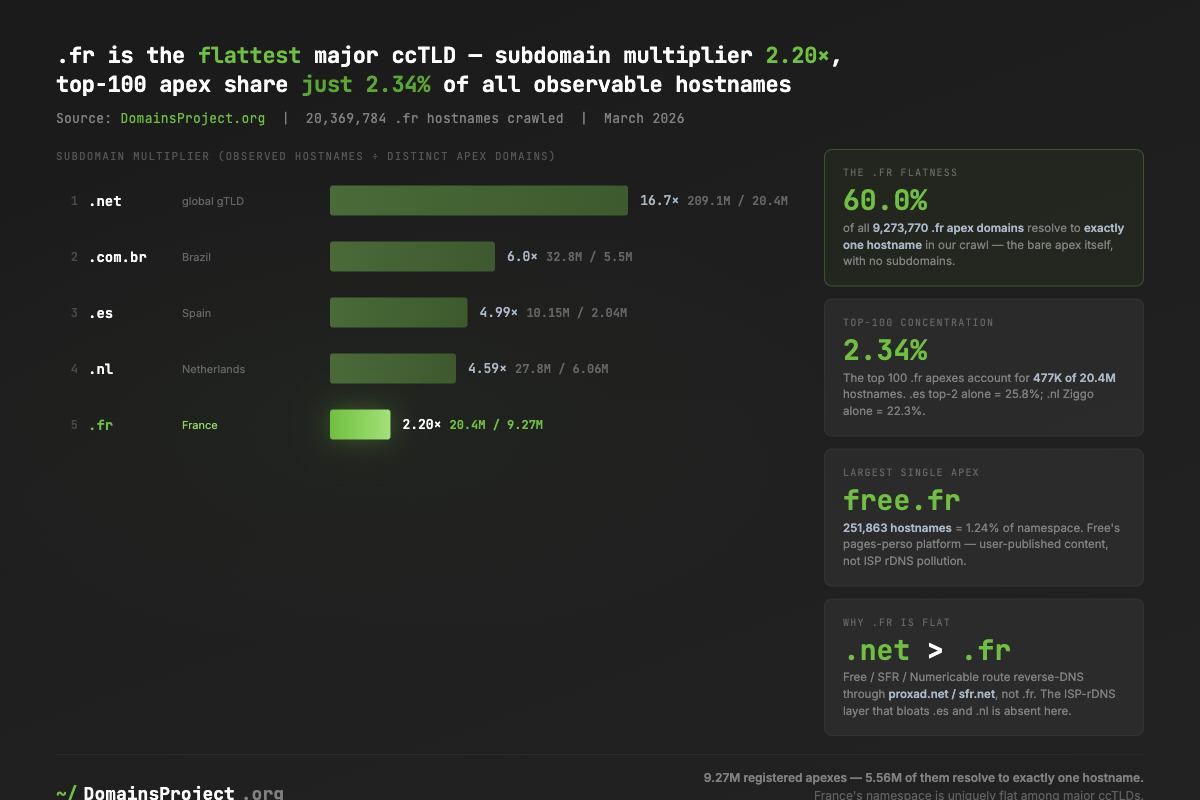
.fr is the flattest major ccTLD we have analyzed. A subdomain multiplier of 2.20× means that, on average, every registered French apex contributes barely more than two hostnames to the observable web. The Spanish, Dutch, and Brazilian namespaces all sit at four to six observed hostnames per apex. The .net namespace, dominated by ISP reverse-DNS, runs at sixteen. France's .fr is, in this respect, an outlier across the ccTLDs we have studied — and the outlier behaviour is not concentrated in a few dark zones, it is uniform across the namespace.
.fr and the Plurinational Architecture Question
| TLD | Type | Sponsor / Operator | Registered (latest) | Backend registry |
|---|---|---|---|---|
.fr |
ccTLD | French State / AFNIC | 4,319,120 (end-2025) | AFNIC |
.bzh |
sTLD (Brittany) | PointBZH | ~12,000 | AFNIC |
.alsace |
sTLD (Alsace) | Région Alsace | ~2,447 | AFNIC |
.corsica |
sTLD (Corsica) | Collectivité de Corse | ~2,388 | AFNIC |
.paris |
gTLD (City of Paris) | Ville de Paris | ~3,000–5,000 | AFNIC |
.re |
ccTLD (Réunion) | French State / AFNIC | ~36,000 | AFNIC |
.tf |
ccTLD (TAAF) | French State / AFNIC | ~1,550 (2004 baseline) | AFNIC |
.yt .pm .wf |
ccTLDs (overseas) | French State / AFNIC | ~thousands | AFNIC |
France's regional and overseas namespace is administered by a single technical operator. This is a different architectural choice from Spain's. Spain's plurinational namespace splits across four genuinely separate registries — Red.es for .es, Fundació puntCAT (rebranded Accent Obert in June 2025) for .cat, Asociación puntoGAL for .gal, and PuntuEus for .eus — each with its own technical stack and registration rules. France's regional new-gTLDs are sponsored by separate cultural and territorial institutions, but the registry itself runs on the same AFNIC platform as .fr. The result is that France's regional architecture is, in practice, a cosmetic separation on a unified registry stack. The Brittany .bzh registry's operational continuity depends on AFNIC; the Corsican .corsica registry's resolution path runs through the same anycast cluster as lamoncloa.gouv.fr. The plurinational signature of .fr is administrative, not infrastructural.
From Postage Stamp to Public Square: The Long Liberalization
For its first eighteen years, .fr operated under what the AFNIC literature politely calls a "documented eligibility regime" and what registrants at the time called trop compliqué. The actual policy was more restrictive than that phrasing suggests.
- Right to the name required. A registrant had to provide an exact-match company name, French trademark, INSEE identifier, or other documented basis for the chosen string. No fanciful brands, no portfolios, no speculation.
- Common words and place names disallowed. A blanket prohibition that excluded most of the namespace small businesses would naturally reach for.
- Three-character minimum. Two-character
.frregistrations remained closed until 17 March 2015 — twenty-nine years after delegation. - One domain per right. Registrants couldn't accumulate names without a documented basis for each.
- Application by paper. Until the late 1990s, registration involved fax and postal forms processed by INRIA staff.
The cumulative effect was that French businesses and individuals who wanted a domain registered .com instead. By early 2004, .fr had roughly 176,000 registrations. Germany's .de had passed five million in 2001. The Netherlands' .nl had passed one million in 2003. France was, in domain-density terms, the underregistered major Western European country.
Liberalization came in stages.
- 11 May 2004: AFNIC opened registration to anyone listed in an official national identification database (companies, self-employed professionals, INSEE-registered associations, trademark holders). Registrations went from 176,000 (start of 2004) to 321,000 (end of 2004), a 82% increase in a single year.
- June 2006: Eligibility opened to individuals — any adult resident in France or its overseas territories.
- 22 March 2011 law + Decree 2011-926 of 1 August 2011 transposed the entire framework into Articles L.45-2 to L.45-8 of the Code des postes et des communications électroniques (CPCE), with the new regime taking effect 1 July 2011.
- 6 December 2011: Eligibility extended to all residents and legal persons in the EU/EEA. Same day:
.re,.yt,.pm,.wf, and.tfopened to public registration on the same terms. - 3 May 2012: IDN registration opened, supporting Latin-script diacritics across
.frand the five sister AFNIC TLDs. - 17 March 2015: One- and two-character
.frregistrations finally allowed.
The post-liberalization growth was real but bounded. End-2023 brought 4,127,956 registered .fr domains; end-2024 brought 4,216,786 (+2.13% YoY); end-2025 brought 4,319,120 (+~2.4% YoY) on 853,000 new creates — a then-all-time record for new registrations driven, AFNIC noted in its annual review, by SME digitization programmes and a slight rebound in retail registrar promotions. .fr accounts for 40.4% of all domains held by French users in 2024, an all-time high — but the absolute count remains less than a quarter of .de's, despite France's population of 68 million being only 18% smaller than Germany's 84 million.
AFNIC: Public-Interest Cooperative on a State-Adjacent Mandate
The institution behind .fr is unlike both the for-profit Verisign model (.com) and the cooperative DENIC model (.de). AFNIC — Association Française pour le Nommage Internet en Coopération — was founded 4 December 1997 as a non-profit association under the French Law of 1 July 1901, jointly by INRIA and the French State (Ministries of Telecommunications, Industry, and Research). Its supervisory ministry is whichever ministry holds the Electronic Communications portfolio at any given time, currently the Ministry of the Economy. Its registry mandate is conferred by ministerial decree, on a five-year renewable term, subject to a competitive designation process.
AFNIC's mandate has been renewed three times — in 2012, 2017, and 2022 — without a competitor having ever displaced it. The 2012 designation came after the Conseil constitutionnel struck down the previous statutory scheme as too informal; the Law of 22 March 2011 and its implementing Decree 2011-926 rebuilt the framework, and the arrêté of 25 June 2012 designated AFNIC under the new regime.
AFNIC governance
| Body | Composition |
|---|---|
| Board of Directors | 10 members: 5 appointed by founding members (INRIA + 3 ministries); 5 elected by the General Assembly |
| Three colleges | Registrars, International Correspondents, Users |
| CEO | Pierre Bonis (since September 2017, succeeding Mathieu Weill 2005–2017) |
| Employees | ~90 (CSR Report 2024) |
The board's split between appointed and elected seats encodes AFNIC's hybrid status. Half the directors come from the founding institutional set (INRIA + three ministries); the other half are elected by the General Assembly across a registrar/correspondent/user college structure that gives commercial registrars proportional representation alongside non-commercial users. Compared to DENIC's pure cooperative model (members are registrars only) or Verisign's for-profit shareholder model (no community governance), AFNIC's is a third pattern: a state-adjacent non-profit with a structurally guaranteed user voice and a five-year competitive renewal cycle that has so far never produced a successful challenger.
AFNIC pricing and registrar landscape
| Metric | AFNIC (.fr) |
DENIC (.de) |
SIDN (.nl) |
Red.es (.es) |
|---|---|---|---|---|
| Wholesale price (latest) | €5.07 (1 Mar 2024) | €2.20 | €4.38 | €4.09 (channel) |
| Registrations | 4.32M | 17.7M | 6.06M | 2.13M |
| Accredited registrars | 400+ | ~300 | ~1,058 | 106 |
| Top-3 registrar share of stock | ~60% | <30% | <40% | ~33% |
| Largest single registrar | OVH (~33%) | (more fragmented) | (more fragmented) | IONOS (17.7%) |
At €5.07/year wholesale, .fr is the most expensive of the four major Western European ccTLDs by a non-trivial margin — 22% above .nl, 24% above .es channel rate, and 2.3× DENIC's .de. The fee was raised from €4.56 on 1 March 2024 (+11.1%), the first material increase in the AFNIC era. AFNIC's 2024 satisfaction survey reported a 96% recommendation rate from registrars, and the registry committed publicly to maintaining the €1.3 million annual contribution to the Fondation Afnic pour la solidarité numérique — the digital-solidarity foundation AFNIC seeded inside the Fondation de France in April 2015, to which AFNIC channels 11% of revenues. Cumulative impact through 2024: 424 projects supported, total budget over €8.4M.
OVH's roughly one-third share of .fr is the highest single-registrar concentration of any major Western European ccTLD. OVH (Roubaix-headquartered, founded 1999 by Octave Klaba) is also the operator of the .ovh brand TLD on AFNIC's back-end stack — the registry that runs .fr is also the technical operator for the brand TLD of the registrar that runs a third of all .fr registrations. The structural circularity does not seem to have produced a competition concern at the regulatory level, but it does mean that .fr's distribution is highly dependent on a single domestic hoster's commercial stability.
The Empty Professional Namespace
This is the finding that most distinguishes .fr from any other ccTLD we have studied. France engineered, between roughly 2009 and 2014, a tier of identity-verified second-level domains for nine regulated professions, each one validated against the relevant professional order's enrolment roll. The legal framework was formalized in AFNIC's Naming Charter version of 8 December 2014. The intended use case was that a registered avocat could claim firstname-lastname.avocat.fr with the certainty that no impostor could ever obtain the same string, because the Conseil National des Barreaux validates each request against its directory of practising lawyers.
Nine professions were given second-level zones: avocats (lawyers), notaires (notaries), médecins (physicians), pharmaciens (pharmacists), vétérinaires (veterinarians), chirurgiens-dentistes (dentists), experts-comptables (accountants), géomètres-experts (surveyors), and huissiers de justice (bailiffs, since the 2022 reform: commissaires de justice).
The verified-profession TLDs in our crawl
| Profession TLD | Hostnames observed | Distinct apexes | Largest apex (count) |
|---|---|---|---|
.chirurgiens-dentistes.fr |
101 | 74 | dr-lascombes-nivet-caroline.chirurgiens-dentistes.fr (3) |
.experts-comptables.fr |
100 | 54 | (top apexes have 4–6 each) |
.medecin.fr |
98 | 9 | ordre.medecin.fr (87) |
.avocat.fr |
96 | 57 | cnb.avocat.fr (9) |
.notaires.fr |
84 | 76 | immobilier.notaires.fr (4) |
.geometre-expert.fr |
77 | 48 | (top apexes have 2–3 each) |
.huissier-justice.fr |
43 | 37 | (top apexes have 1–2 each) |
.pharmacien.fr |
37 | 2 | ordre.pharmacien.fr (35) |
.veterinaire.fr |
22 | 18 | (top apexes have 1–2 each) |
| Total (9 TLDs) | 658 | 375 | — |
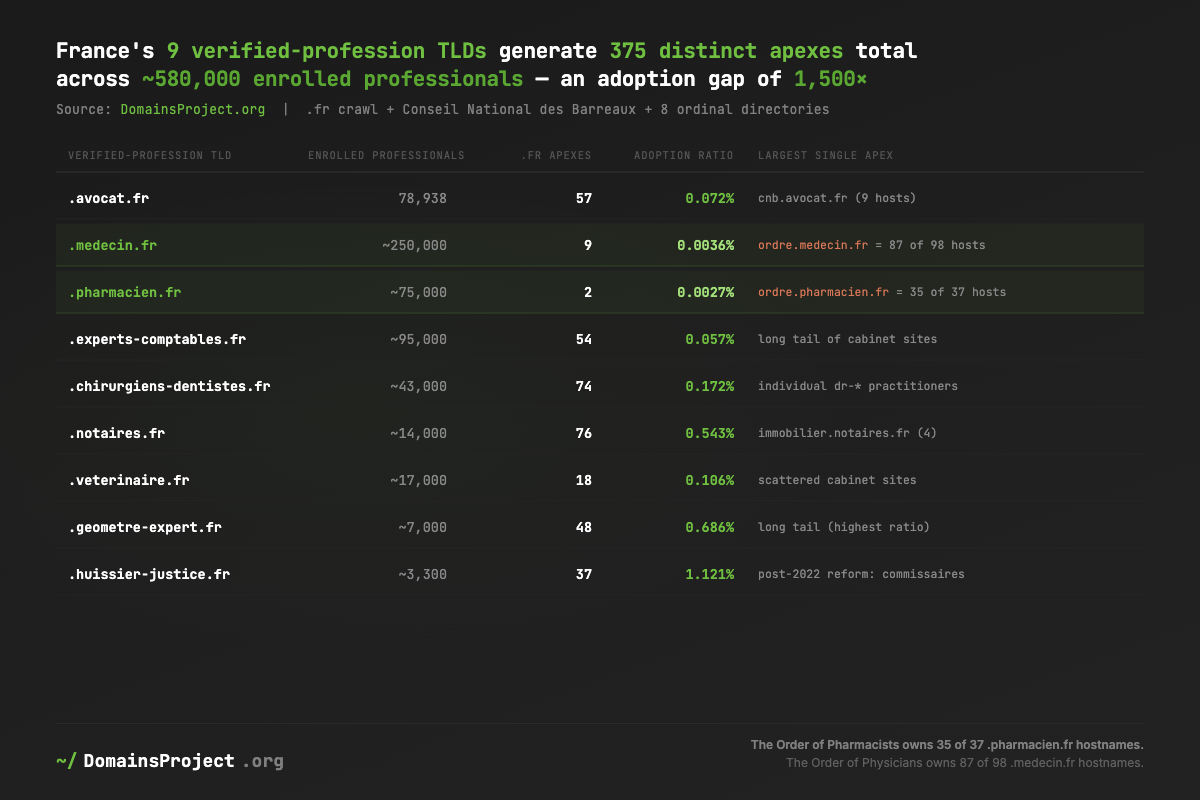
The nine verified-profession TLDs together produce 658 observable hostnames across 375 distinct apex domains — fewer than the 5,160 hostnames generated by the legacy .asso.fr zone alone.
The numbers behind these zones make the gap between intent and reality concrete. France has, per its professional orders' published 2024–2025 directories:
- ~78,938 registered avocats (Conseil National des Barreaux)
- ~250,000 registered médecins (Conseil National de l'Ordre des Médecins)
- ~75,000 registered pharmaciens (Conseil National de l'Ordre des Pharmaciens)
- ~95,000 registered experts-comptables (Conseil supérieur de l'OEC)
- ~17,000 registered vétérinaires (Ordre des Vétérinaires)
- ~14,000 registered notaires (Conseil supérieur du notariat)
- ~43,000 registered chirurgiens-dentistes (Ordre National)
- ~7,000 registered géomètres-experts (Ordre des Géomètres-Experts)
- ~3,300 registered commissaires de justice (Chambre Nationale, post-2022 merger)
Adoption ratios across the verified-profession TLDs do not exceed 0.2%, and most sit below 0.1%. France's 78,938 verified avocats produced 57 distinct .avocat.fr apexes — an adoption ratio of 0.072%. France's ~250,000 registered médecins produced 9 distinct .medecin.fr apexes, 0.0036% — and 87 of the 98 hostnames in the entire .medecin.fr zone resolve under one of those apexes: ordre.medecin.fr, the order itself. In the .pharmacien.fr zone, 35 of 37 observed hostnames — 94.6% — resolve under ordre.pharmacien.fr. The regulator's web estate is, almost arithmetically, the entire .pharmacien.fr namespace.
The .fr verified-profession TLDs were sold as identity-verified spaces for individual professionals. In the 2026 web, they are essentially the regulators' web estates plus a long thin tail of individual practitioners. The investment in identity verification has not been redeemed in adoption.
A few hypotheses, none confirmed:
- The retail price of an ordinal-validated
.avocat.frregistration runs higher than a generic.fr(validation requires the order's intervention), reducing incentive vs. the avocat simply registeringnom-prenom-avocat.frdirectly. - The verified-profession namespaces require a publication condition (the validated registrant's professional content must remain the primary content of the site). Many practitioners use third-party platforms (Doctolib, Pages Jaunes, Conseils-Avocats marketplaces) and never deploy their own site at all.
- Search engines do not assign trust premium to verified-profession TLDs. Google ranks an
nom-avocat-paris.comand annom.avocat.fron the same SEO basis. There is no observable consumer signal that "if it's.avocat.frit must be a real avocat" because the consumer never sees the URL bar long enough to read the SLD.
These are hypotheses worth testing. What the data show is that the namespace was built and is not used — by the people for whom it was built.
The Legacy Generic Zones: Asso, Com, Tm, Nom, Presse, Prd
The six legacy generic second-level zones sit closer to the "intended size" of an institutional namespace, but only one of them (.com.fr) is still open to new registrations. .asso.fr was closed to new registrations on 6 December 2011 — the same day EU/EEA eligibility opened on direct .fr — making it a frozen legacy zone whose stock can only shrink via deletion.
| Zone | Status | Hostnames observed | Distinct apexes |
|---|---|---|---|
.com.fr |
Open | 6,199 | 5,006 |
.asso.fr |
Closed to new (6 Dec 2011) | 5,160 | 5,012 |
.tm.fr |
Open (trademark holders) | 3,060 | 2,985 |
.gouv.fr |
Restricted (DINUM) | 1,206 | 1,053 |
.nom.fr |
Open (individuals) | 682 | 606 |
.presse.fr |
Restricted (press orgs) | 202 | 134 |
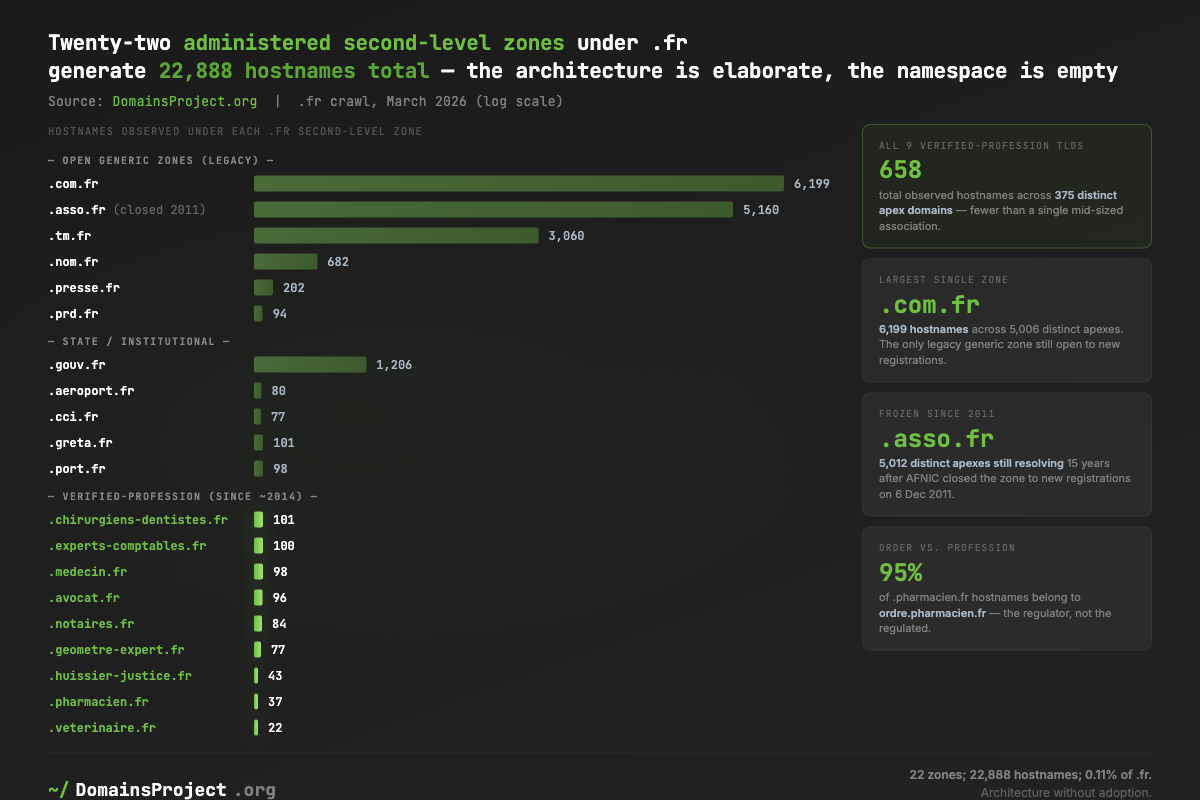
The .asso.fr and .com.fr zones each carry ~5,000 distinct registered apexes that resolve to almost exactly one hostname per apex — a hosts-per-apex ratio of 1.03 for .asso.fr and 1.24 for .com.fr. There is essentially no subdomain layering inside these zones. Each association under .asso.fr runs <assoname>.asso.fr and stops there. The frozen .asso.fr namespace, fifteen years after closure, still has 5,012 distinct apexes resolving in our crawl — a remarkable retention rate for a zone that has been unable to accept new registrations since 2011.
The top .asso.fr apex is amf.asso.fr (the Association des maires de France) at 9 hostnames. The next-largest are sfds.asso.fr (Société Française de Statistique), cemea.asso.fr (an educational NGO), and asei.asso.fr (a disability-services charity), all at 5 hostnames apiece. The zone remains a who's-who of the secteur associatif circa 2011, frozen in amber.
The State Estate: .gouv.fr Is Real, but Small
Spain's .gob.es zone — Madrid's nominal central-government namespace — generated 66 observable hostnames against 1,204 registered domains in our previous research, an effective usage ratio under 6%. France's .gouv.fr looks materially better: 1,206 observed hostnames across 1,053 distinct apex domains. Almost every registered .gouv.fr resolves to at least one hostname in our crawl. The top apexes paint a coherent map of the French federal state's web estate:
api.gouv.fr(38) — the unified API gatewaydeveloppement-durable.gouv.fr(16) — sustainable development ministryrie.gouv.fr(10) — Réseau Interministériel d'État (the federal intranet)social.gouv.fr(9),finances.gouv.fr(9) — health/social affairs and finance ministriesnumerique.gouv.fr(8) — the digital-administration ministry, host of DINUM itselfants.gouv.fr(8) — Agence nationale des titres sécurisés (passport/ID infrastructure)beta.gouv.fr(7) — DINUM's startup-style incubator for state digital serviceseducation.gouv.fr(6),culture.gouv.fr(6),cohesion-territoires.gouv.fr(6)interieur.gouv.fr(4),impots.gouv.fr(3),diplomatie.gouv.fr— top-line ministries
The federal state's digital estate is widely deployed, narrowly subdomain-fragmented, and uniformly under .gouv.fr rather than scattered across .com or other vendor namespaces. This is a deliberate policy: the Référentiel général de sécurité and the Politique de Sécurité des Systèmes d'Information de l'État both require that public-facing federal services run under .gouv.fr whenever administratively feasible, with allocation centralized through DINUM (Direction interministérielle du numérique, created 2017, succeeding SGMAP). Compared to .gob.es's sparse 5–6% usage ratio, France's .gouv.fr is functionally complete: of 1,053 apex registrations, essentially all resolve in our crawl. The usage ratio is approximately 1:1.
Sub-zone fragmentation is rare. The same ministry typically runs a small portfolio of public-facing apexes (travail.gouv.fr, emploi.gouv.fr, solidarites.gouv.fr for the social-affairs ministry), each with a handful of subdomains. Inter-ministerial portals (service-public.fr, data.gouv.fr, france-identite.gouv.fr, numerique.gouv.fr) carry the unified-citizen-experience layer. The architecture is conventional. What distinguishes it is that the architecture is used — at a usage ratio approximately 18× higher than Spain's analogous .gob.es.
The Flat Web Below: 60% of .fr Apexes Are Bare
Underneath the elaborate second-level architecture sits direct .fr — the 9,258,382 distinct apex domains that account for 99.83% of all observable .fr hostnames. And here the data run flat.
| Apex hostname count | Number of apexes | Share of apex population |
|---|---|---|
| Exactly 1 hostname | 5,564,056 | 60.0% |
| Exactly 2 hostnames | ~1.85M | ~20% |
| ≥10 hostnames | 178,475 | 1.92% |
| ≥100 hostnames | 10,815 | 0.117% |
| ≥1,000 hostnames | 5 | <0.0001% |
| ≥10,000 hostnames | 3 | <0.00003% |
Sixty percent of all .fr apexes in our crawl resolve to exactly one hostname — typically the apex itself or its www. equivalent, with no other observable subdomains. Cumulatively, more than 80% of the namespace consists of one- or two-hostname apexes. The top 100 apexes together account for only 2.34% of all observable .fr hostnames — a top-100 concentration roughly an order of magnitude lower than .es (top-2 alone = 25.8%) or .nl (Ziggo alone = 22.3%).
The top of the long tail is dominated by a small number of ISP and platform apexes:
| Rank | Apex | Hostnames | Share | Type |
|---|---|---|---|---|
| 1 | free.fr |
251,863 | 1.24% | Free ISP — pages-perso platform |
| 2 | blogspot.fr |
185,914 | 0.91% | Google Blogger geo-redirect |
| 3 | webnode.fr |
14,780 | 0.073% | Web-builder platform (CZ) |
| 4 | eklablog.fr |
5,536 | 0.027% | French blogging platform |
| 5 | blogs.fr |
2,386 | 0.012% | Generic blog hosting |
| 6 | freeboxos.fr |
572 | 0.003% | Iliad Freebox web UI |
| 7 | wanadoo.fr |
541 | 0.003% | Orange legacy ISP brand |
free.fr alone — the personal-pages namespace operated since circa 2000 by Iliad's Free SAS — accounts for more .fr hostnames than the next eight apex domains combined. Free's <login>.free.fr URL convention is the closest French analog to GeoCities or AOL Hometown: every Free subscriber received an email address and ~10 MB of ad-free PHP/MySQL hosting, with the resulting <login>.free.fr address structure preserved across more than two decades of Iliad's organic growth into a national fixed-line and mobile operator. The pages-perso.free.fr rebrand of the mid-2020s migrated existing accounts to HTTPS but did not break legacy URLs. Iliad has not publicly disclosed the peak personal-pages user count, but the 251,863 free.fr hostnames in our crawl set a credible floor.
Notably absent from the long tail is the kind of national-ISP reverse-DNS pollution that drives .es (Jazztel, 21.4% of namespace) and .nl (Ziggo, 22.3%). France's three largest residential ISPs — Free/Iliad, Orange, SFR/Numericable — collectively show modest .fr apex footprints in our data because the bulk of their reverse-DNS infrastructure lives under .net domains: Free uses proxad.net, SFR uses sfr.net. Only Bouygues Telecom (bbox.fr) and Orange (legacy wanadoo.fr / modern orange.fr) put substantial reverse-DNS in .fr, and neither approaches the scale of what Jazztel created in Spain or Ziggo created in the Netherlands. The structural decision by France's three largest ISPs to route reverse-DNS through .net is, accidentally, what keeps .fr's observable namespace clean enough to expose its underlying flatness.
A Plurinational Internet à la française: .bzh, .alsace, .corsica, .paris
France's republican constitutional framing — République une et indivisible — does not invite the kind of plurinational namespace architecture Spain produced with .cat/.gal/.eus. Cultural and territorial new-gTLDs nevertheless exist for four French regions, all delegated by ICANN in the 2014–2015 wave, and all operated technically by AFNIC as registry service provider.
The four French regional/cultural TLDs
| TLD | Sponsor | Delegation | General availability | Registered (latest) |
|---|---|---|---|---|
.paris |
Ville de Paris | 16 Apr 2014 | 2 Dec 2014 | ~3,000–5,000 |
.bzh |
PointBZH (Brittany) | 17 Jun 2014 | 4 Dec 2014 | ~12,000 |
.alsace |
Région Alsace | 2 Oct 2014 | 2014 | ~2,447 |
.corsica |
Collectivité de Corse | 12 May 2015 | Sep 2015 | ~2,388 |
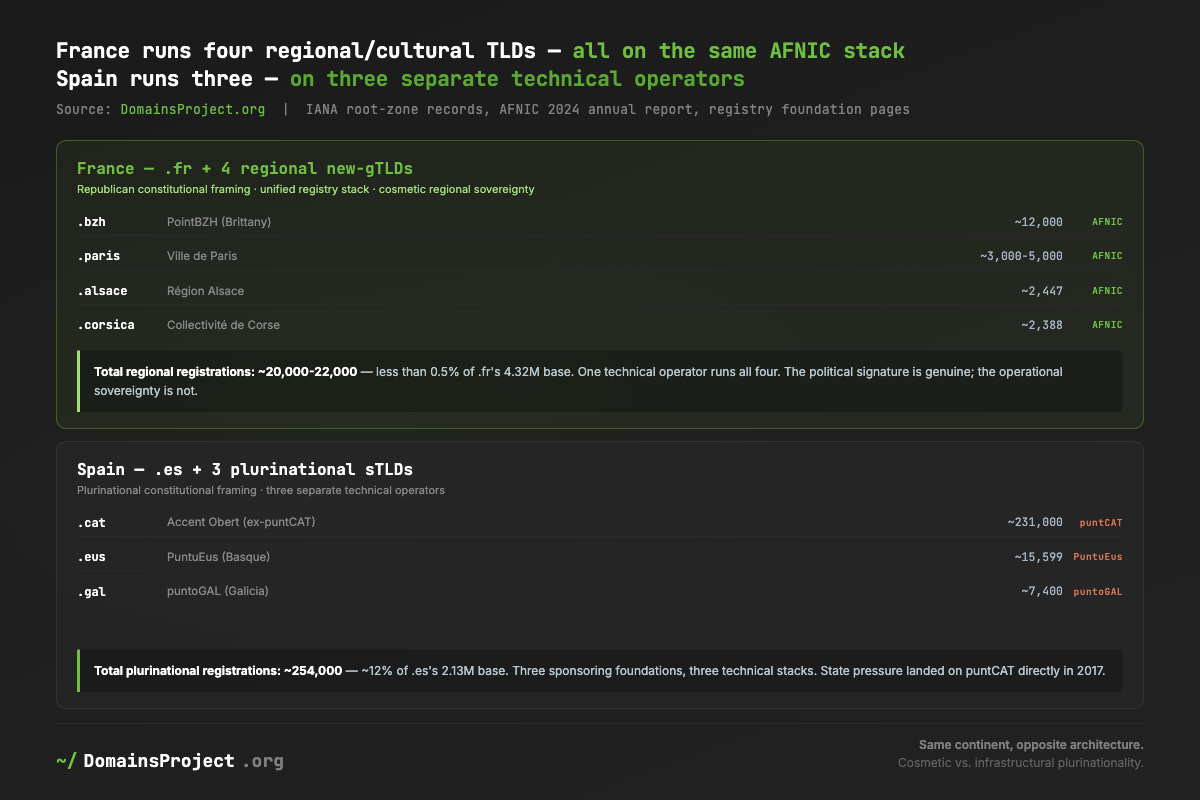
.bzh is the largest and structurally most established of the four French regional new-gTLDs. PointBZH (the doing-business-as of Association www.bzh, founded 2008 by activists from the Brittany cultural-language movement) prepared its ICANN application as a community sTLD application, won approval on 10 May 2013, signed the Registry Agreement on 27 February 2014, achieved root delegation 17 June 2014, and entered general availability on 4 December 2014. By 2023 the registry counted more than 12,000 registered domains, and the public storefront Pik.bzh surfaces both administrative tools and Breton-language content programs.
.alsace, .corsica, and .paris each occupy ~2,000–5,000 registrations after a decade — the institutional-density model of .gal rather than the mass-adoption model of .cat. The total registered population across all four regional French TLDs combined is in the range of 20,000–22,000 domains, less than 0.5% of .fr's registered base. Per-speaker densities are not comparable to .eus (Basque, 1 per 48 speakers) or .cat (Catalan, 1 per 88), because the underlying populations are small and the namespaces are open to non-residents on AFNIC's standard rules.
The structural difference vs. Spain remains the unified registry stack. PuntuEus's January 2024 reported 90% Basque-language content fidelity is a metric .bzh could not produce in identical form because .bzh does not contractually require Breton-language content (only a community-eligibility nexus), and because the registry's technical operator is the same neutral national registry that runs Brittany's regional government's .fr domains. In policy terms, Spain operates four genuinely separate digital-identity spaces that happen to all serve Spanish citizens. France operates one digital-identity space — .fr — with cosmetic regional and territorial decorations, all on the same registry stack.
The State Versus the Diaspora: france.com
The institutional cleanest comparison vs. Spain's 2017 puntCAT raid on a sponsored-TLD registry runs in the opposite direction. Where Spain's state intervened against a domestic linguistic-community registry, France's signature .fr-adjacent legal incident was the state intervening against a non-French-territory diaspora registrant.
france.com was registered on 10 February 1994 by Jean-Noël Frydman, a French-born U.S. citizen based in New York. Frydman built the domain into a small French-cultural portal aimed at the American diaspora and Francophile market, which traded under his small company. In 2015 the Ministry of Foreign Affairs brought suit in French court asserting trademark rights over the string "France." The Paris Court of Appeals ruled for the state in 2017. In March 2018, registrar Web.com transferred france.com to the Ministry without notice to Frydman. Frydman sued France in U.S. federal court (E.D. Va.) the following month. On 25 March 2021, the U.S. Fourth Circuit held France immune under the Foreign Sovereign Immunities Act (FSIA), with Judge Diana Gribbon Motz writing for the panel that the seizure did not fit within the commercial-activity or expropriation exceptions. In December 2021, the U.S. Supreme Court denied certiorari, ending the litigation.
The puntCAT raid and the france.com seizure are the two most consequential European TLD-state-intervention precedents of the 2017–2021 window. They run in opposite directions: Spain's state attacking a domestic linguistic-community sTLD, France's state attacking a foreign-resident registrant of a .com domain matching the state's name. Both incidents are now incorporated into the operational risk-modelling of every TLD operator and registrar legally exposed to either jurisdiction. In .fr's case, the precedent is that the French state has demonstrated political and procedural will, plus international cooperation from a major U.S. registrar, to assert sovereign rights over a name string regardless of registration jurisdiction. The chilling effect on .fr-adjacent diaspora and international branding is documented in the French-language domain-attorney literature (Dreyfus & associés, INPI commentary).
What's at Stake
- France engineered nine identity-verified professional TLDs and registrants did not come. Total observable hostnames across
.avocat.fr,.notaires.fr,.medecin.fr,.pharmacien.fr,.veterinaire.fr,.chirurgiens-dentistes.fr,.experts-comptables.fr,.geometre-expert.fr, and.huissier-justice.fr: 658. The professional Orders themselves account for the largest single buckets in two of the nine zones (ordre.pharmacien.fr= 95% of.pharmacien.fr;ordre.medecin.fr= 89% of.medecin.fr). The investment in identity verification is unredeemed. .fris the flattest major ccTLD we have analyzed. Subdomain multiplier 2.20×; 60% of apexes resolve to exactly one hostname; top-100 apex share 2.34%. There is no Jazztel-equivalent or Ziggo-equivalent reverse-DNS pollution under.frbecause France's three largest ISPs route rDNS through.netdomains. The flatness exposes a structural feature: the average French registrant publishes almost no subdomain content under their registered apex..gouv.frworks. Spain's.gob.esresolves at ~5% of registered count. France's.gouv.frresolves at ~1:1 — every registered apex appears in the operational web. The federal-state digital identity is functionally complete, despite (or because of) DINUM's centralized allocation.- The regional architecture is administrative, not infrastructural.
.bzh,.alsace,.corsica, and.parisare sponsored by separate territorial institutions but operated on a single AFNIC stack. The political signature is genuine; the operational sovereignty is not. - OVH manages roughly one-third of
.frand operates.ovhon AFNIC's back-end. Single-registrar concentration is the highest of any major Western European ccTLD and is structurally circular: the registrar with the highest market share runs its own brand TLD on the registry's platform. No competition issue has been raised, but the dependency is real. .frcarries the highest wholesale fee of any major Western European ccTLD. €5.07 vs..de€2.20,.nl€4.38,.eschannel €4.09. AFNIC's 11% revenue commitment to the digital-solidarity Foundation absorbs some of the differential into public-interest activity, but registrants pay the fee. Whether French SMEs perceive the trust premium of.fras worth the price differential vs..comor.euis an empirical question AFNIC does not publicly measure.- The france.com precedent is binding. The French state has demonstrated, with a Paris-court ruling, U.S. registrar cooperation, and Fourth Circuit FSIA-immunity confirmation, that it can recover sovereign-name strings from foreign registrants of foreign-jurisdiction domains. The precedent does not attach to
.frdirectly, but the institutional muscle that produced it shapes the legal risk environment of every commercial registrant of a French-identity-adjacent string.
What Would Help
1. Registries: publish observable-vs-registered ratios per second-level zone. AFNIC's .FR in 2024 annual report is excellent on registered counts, registrar concentration, and creates/deletes flow, but does not report DNS-resolution rates per zone. Publishing the share of .medecin.fr apexes that resolve a website would let the regulated-profession governance bodies understand whether their members are using the namespaces that were built for them, or whether the investment in ordinal validation is producing a near-empty zone.
2. Professional Orders: rethink the operational signal. The Conseil National des Barreaux validates 78,938 avocats and ends up with 57 .avocat.fr apexes in our crawl. The verification investment is real; the consumer-trust payoff requires a search-engine, browser, or directory-platform integration that surfaces the SLD as a verified-identity signal. That integration does not exist in 2026. Without it, the verified-profession TLDs are an unredeemed coupon.
3. AFNIC: revisit .asso.fr. The frozen-since-2011 zone retains 5,012 active apexes fifteen years after closure to new registrations. Either reopen .asso.fr to associations under the post-2011 EU/EEA eligibility model — preserving the legacy holders' position and admitting new 1901-law associations on the same terms as direct .fr — or formally sunset the zone with a transition path to .asso (a hypothetical new gTLD or <x>.fr direct).
4. Researchers: stop counting Free.fr the same way you count Jazztel.es. When .fr is benchmarked against other ccTLDs on hostname count, the figures are inflated by 251,863 <login>.free.fr personal-page hostnames — a different beast from the 2.17M <ip>.dynamic.jazztel.es reverse-DNS records. Pages-perso are real human-published content. Reverse-DNS records are infrastructure noise. Best practice for cross-ccTLD comparison should distinguish "platform-aggregated user content" from "ISP rDNS infrastructure" as separate categories. France's free.fr belongs to the first.
5. Spanish observers: study the gouv.fr deployment ratio. The contrast between .gob.es (≈5% resolution) and .gouv.fr (≈100% resolution) is one of the cleanest natural experiments in public-sector TLD policy in Europe. France's central allocation through DINUM, paired with the Référentiel général de sécurité requirement to use .gouv.fr for public-facing federal services, produces a national-state digital identity that is consistently legible to citizens. Spain's looser policy produces the opposite. Compare to Spain's plurinational internet for the sTLD-level analog.
Methodology and sources: This analysis used the DomainsProject .fr country file (20,369,784 hostnames, snapshot 17 March 2026); AFNIC's 2024 annual report (4,216,786 registrations end-2024) and the AFNIC 2025 review (4,319,120 / 853,000 creates); the AFNIC June 2025 Global Domain Name Market observatory; the AFNIC pricing notice of 1 March 2024 (€4.56 → €5.07); the AFNIC Naming Charter version of 8 December 2014 governing the verified-profession second-level zones; the AFNIC Foundation 2022 impact report; ARCEP's optical-fibre press release of 2 April 2026 (FTTH coverage 95.5%, subscriptions 80%); INSEE's end-2024 demographic update (population ~68M); ANSSI/CERT-FR's 2026 Cyber Threat Panorama; the Conseil National des Barreaux's 2024–2025 directory (78,938 avocats); the IANA root-zone database entries for .bzh, .alsace, .corsica, and .paris; the Fourth Circuit ruling and Supreme Court certiorari denial in Frydman v. France; and the registry-foundation pages for PointBZH, Région Alsace, Collectivité de Corse, and Ville de Paris. Detailed source list and full numerical workings are in the research file. Explore the DomainsProject statistics dashboard and the full dataset.