On June 3 the European Commission proposed the Cloud and AI Development Act. It defines four "assurance levels" for the cloud services Europe's public sector may use; from the third, the provider must be "owned and controlled in the EU" (European Commission, Covington). Parliament and Council are still working through it (Legislative Train). In Canada, Shared Services Canada is preparing its tender for a sovereign government cloud (ITIF), a year after Prime Minister Carney promised one (BetaKit). On July 1 the United States declined to renew the USMCA in its current form, which puts the agreement under annual review (USTR). Its digital-trade chapter forbids Mexico and Canada from requiring that computing facilities be local (USMCA Art. 19.12).
The argument is conducted in market shares. European providers hold about 15% of Europe's own cloud market, down from 29% in 2017 (Synergy Research). That measures spending. It says nothing about where a country's own namespace lives — the businesses, municipalities, schools and clubs registered under its country code — or about who carries their mail and answers their DNS. Studies of popular websites (Akiwate et al., SIGCOMM 2025), government sites (Kumar et al., IMC 2024) and municipal email (Bischof et al., 2026) each measure one slice. None follows a whole national namespace, across layers, over time.
We built that measurement. For every national country-code TLD with at least 20,000 live websites, 10,000 mail-capable domains and 20,000 delegated domains — 78 countries, plus .eu as a reference — we measured three layers:
- Web: where each live website is hosted, in 29 crawls from April 2023 to September 2026.
- Mail: who runs each domain's mail servers, in 12 crawls from April 2025 to September 2026.
- DNS: who runs each domain's nameservers, in 10 crawls over the same period.
Each layer becomes a score from 0 to 100: the share of the namespace hosted in the country (web) or run by operators headquartered there (mail and DNS). Front doors with no single location count where their operator is headquartered. The index is the average of the three scores, published for April 2025 and September 2026, with the web layer back to April 2023. It is a descriptive composite of the domestic control of a national namespace — or, read the other way, of its dependence on foreign providers. It is not a measure of sovereignty, resilience or technological health.
The headline: national websites are not moving abroad; they are moving to the edge. Among websites with a single location, the median share hosted at home barely moved in three and a half years, from 52.8% to 50.1%. What grew is everything that has no home: the median share of a country's websites answering from anycast front doors doubled, from 10.9% to 22.7%, and it rose in all 78 countries. Almost all of those front doors are run by American companies. Mail and DNS drifted the same way: US-headquartered operators gained mail share in 76 of 78 countries and DNS share in 74. Together these pulled the index down in 70 of 78 countries in seventeen months, from a median of 42.1 to 38.1. Iran, the United States, Japan and Germany keep most of their namespaces at home, and they are the top four however the unattributed domains are counted. Among the 30 largest national namespaces, Mexico, Canada and India keep the least. In much of Europe the largest foreign host is not American but German.
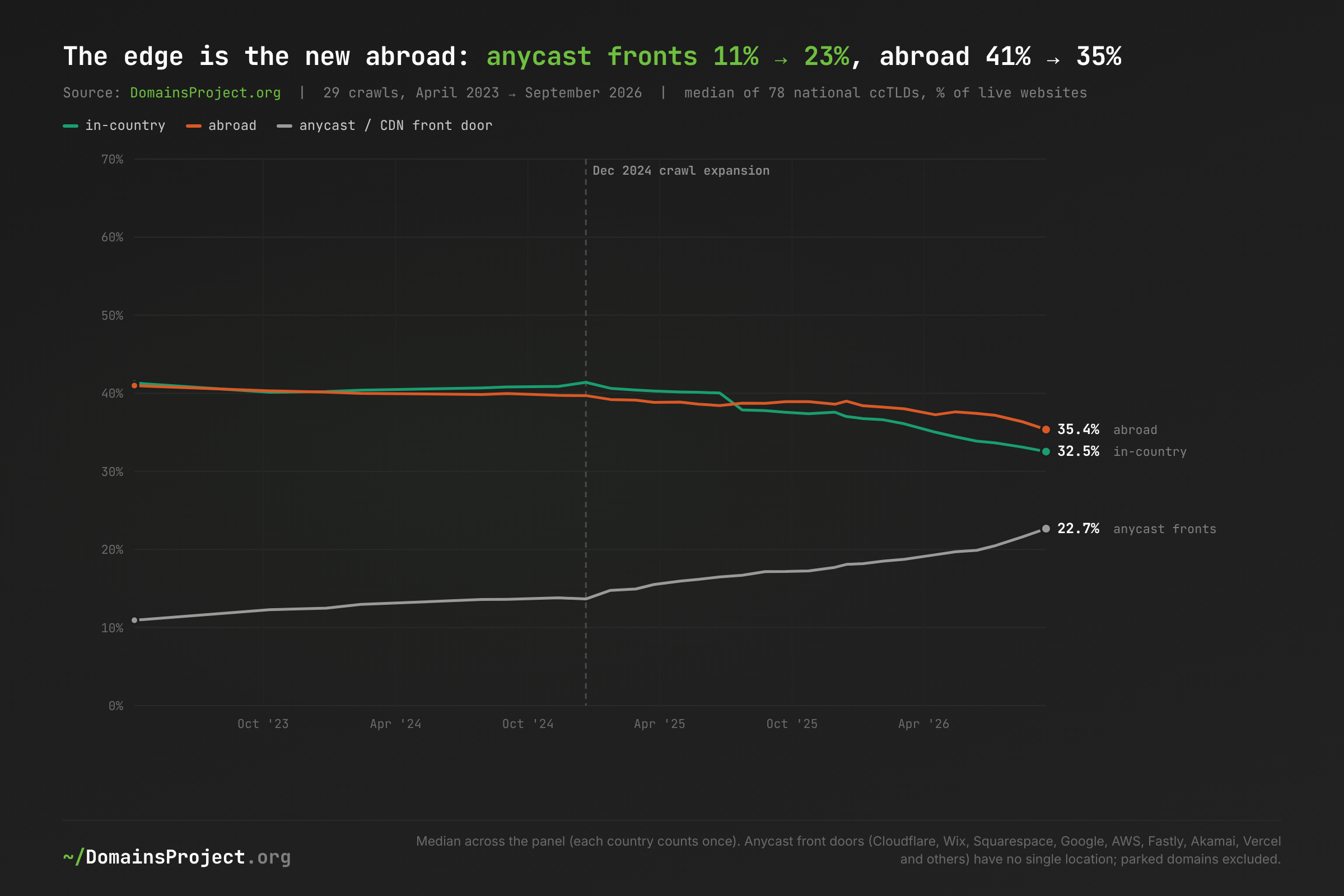
Download: hai-edge-trend.csv — median of the 78 countries per crawl; each country counts once
What this index does not measure. It describes where a national namespace's websites answer from and who runs its mail and DNS, counted domain by domain. It does not measure:
- Data sovereignty or legal jurisdiction: which country's law governs the data, or who can be compelled to hand it over. Mail and DNS count at the operating group's headquarters, not where a subsidiary is incorporated or the data is held.
- Data residency: where mailboxes, databases and backups are stored.
- Application and backend location: the CDN origins, mailbox stores and application servers behind a front door or a mail gateway. We see the front door and the first mail hop.
- Ownership of physical infrastructure: who owns the data centres, cables and networks. In the web layer AWS Tokyo counts as Japanese hosting.
- Traffic or user dependence: how many people use a service, or how much traffic it carries. A parked page and a ministry count the same.
- Economic value retained domestically: where the revenue, jobs and taxes go.
- Resilience: whether the namespace would keep working through an outage, a cable cut or a sanctions order. Concentration on a few operators is one input to that question, not the answer.
- Sovereignty or technological health in any broader sense. A high score is compatible with a competitive domestic market and with an isolated one.
The Data
| Web (hosting) | Mail (MX) | DNS (NS) | |
|---|---|---|---|
| Crawls in the series | 29, April 6, 2023 → September 17, 2026 | 12, April 10, 2025 → September 20, 2026 | 10, April 10, 2025 → September 22, 2026 |
| Unit | live website (parked excluded) | mail-capable apex domain | delegated apex domain |
| Count in the panel, first crawl | 50.8M | 46.9M | 64.7M |
| Count in the panel, last crawl | 68.5M | 51.2M | 70.2M |
| What is attributed | server location (country) | operator headquarters | operator headquarters |
| Not attributable, last crawl | 0.5% (RTT contradicted geoIP) | 5.1% (operator unidentified) | 8.0% (operator unidentified) |
| Self-run (record under the domain's own name), last crawl | — | 27.7% | 0.5% |
| Excluded | parked websites, registry wildcards | null MX, parking MX, broken MX | parking nameservers |
Who is in the panel:
- Included: the 78 countries span every continent. Second-level zones count with their ccTLD (
co.ukis.uk). .eu: scored against the 27 EU member states as "home", and shown as an unranked reference row.- Excluded:
- ccTLDs sold as global brands rather than national namespaces (
.io,.ai,.co,.me,.tv,.cc,.cvand similar); - overseas departments of other panel states;
- Russian-administered TLDs;
- four further ccTLDs, under the project's data policy.
- ccTLDs sold as global brands rather than national namespaces (
Methodology
Definitions.
- Web score. The share of a country's live websites hosted in that country.
- A website with k addresses counts 1/k at each.
- Websites behind anycast and CDN front doors have no single location: Cloudflare, Wix, Squarespace, Google, AWS CloudFront and Global Accelerator, Fastly, Akamai, Vercel and others. They count toward the country where the front-door operator is headquartered. For nearly all of them that is the United States; for Wix it is Israel.
- Denominator: live websites, minus the 0.5% whose geoIP location our speed-of-light tests contradicted.
- Mail score. The share of mail-capable domains whose primary MX is run by an operator headquartered in the country. MX is the first hop: a domain whose mail passes through a filtering gateway counts for the gateway.
- DNS score. The same, for the primary NS operator.
- Self-run. An MX or NS record under the domain's own name, such as
mail.example.gr.- The server behind it is usually the website's own (see validation below), so a self-run mail domain takes the location of its own website.
- Domains without a located live website take their country's hosting geography: the shares of the country's single-location websites hosted at home and in the US. That covers domains with no website, parked domains, domains behind an anycast front and unresolved ones.
- Self-run NS is under 1% of delegations and always takes the country's hosting geography.
- Index. The mean of the three scores. We weight the three layers equally because the index is intended as a descriptive cross-layer measure; we make no claim that web, mail and DNS have equal policy importance. Every layer score is published, so a reader who weights them differently can recompute the index.
- Range and possible ranks. The index if every unattributed mail and DNS domain were foreign, or all domestic, and the best and worst rank consistent with every country's range (see Sensitivity).
- Home. The ccTLD's country. For
.eu, the 27 EU member states. That makes.euincomparable with single countries, so it is shown but not ranked.
Locations. The web layer runs the hosting-location pipeline of How Much of the Web Runs on Virginia's Grid? unchanged, for every ccTLD. Each address is located by the best evidence available, in this order:
- anycast and CDN edge lists;
- 213 Globalping round-trip measurements;
- the cloud providers' own region tags, in the version current at each crawl;
- RFC 8805 geofeeds;
- DB-IP City Lite geoIP.
Operators and their headquarters. Mail and DNS operators are first labelled with the classifiers of our published mail and DNS studies. Each label then maps to the headquarters country of the operating group that controls it, checked against annual reports and company filings. Financial owners such as private-equity funds are not consolidated.
-
US groups: 123 Reg, Host Europe and domainFactory count as American (GoDaddy, since 2017), as do SpamExperts (N-able) and Hornetsecurity (Proofpoint, since December 8, 2025).
-
European groups:
- IONOS (Germany): STRATO, Arsys, Fasthosts, home.pl and World4You.
- team.blue (Belgium): Register.it, Combell, TransIP, Nominalia, Loopia and Simply.com.
- group.one (Sweden): one.com and Hostnet.
- Aruba (Italy): Forpsi.
The same rule applies on both sides of the Atlantic. The sensitivity section shows what changes if each brand counts at its own headquarters instead.
-
Ownership is held at its September 2026 state for every crawl, so a series moves only when domains move. The one change of headquarters country inside the window is Proofpoint's purchase of Hornetsecurity. It is 0.46% of
.demail, and counting it at its historical owner changes no trend. -
Unlabelled operators. These are handled in three steps:
- We reviewed the 140 largest unlabelled mail operators and the 110 largest DNS operators by hand. Those the heuristics below would get wrong or could not place were attributed directly —
easyname.euto Austria, for example, and 20i'sstackdns.comto the UK. - Below that, an operator registered under a national ccTLD (
seznam.cz) is assigned to that country. - An operator 80% of whose national-ccTLD customers sit in one country is assigned to that country.
The rest is unattributed and left out of the score's denominator.
- We reviewed the 140 largest unlabelled mail operators and the 110 largest DNS operators by hand. Those the heuristics below would get wrong or could not place were attributed directly —
How good is the attribution?
Shares of operator-run domains (self-run excluded), September 2026:
| Method | DNS | |
|---|---|---|
| Published rules | 76.1% | 66.2% |
| Hand attribution | 5.0% | 3.4% |
| ccTLD heuristic | 12.9% | 15.1% |
| Concentration rule | 2.1% | 9.1% |
| No method applies | 4.0% | 6.3% |
Hand attribution includes a few large operators our review could not identify. Counting those as well, 5.1% of all mail-capable domains and 8.0% of all delegated domains are unattributed, as in The Data.
- Heuristic accuracy. Among the reviewed operators that the heuristics would have attributed, our review agreed with them for 97.9% of the mail domains and 97.0% of the DNS domains involved. The disagreements were parking services and one US email host. The heuristics do far worse on the multinationals that the published rules already label: they agree for only 78–80%, because those brands register local domains such as
ionos.co.ukorhostinger.com.br. That is why the rules run first.
Self-run validation. How self-run mail is located is the largest modelling choice in the index. Self-run MX is 27.7% of the mail layer, and over 60% in 17 countries, from Iran (93%) to Bosnia and Herzegovina, Nigeria, Kenya, Croatia and Greece.
We tested the per-domain rule on a live sample of 2,742 self-run mail hosts, about 200 from each of 14 ccTLDs. Each host was resolved on October 3 and located with the same September 2026 location table.
- Same country: where both have a single location, the mail host is in the same country as the domain's website for 95.9% of domains.
- Same server: 69% sit on the website's own IP address.
- Accuracy at country level: our estimate of each country's in-country self-run rate falls inside the sample's 95% confidence interval in all 14 countries, with a mean error of 1.9 points.
- The alternative fails: a national average of website locations would miss by 10.8 points on average, because self-run mail is in-country more often than the country's websites are.
| ccTLD | Sampled | Measured: mail host in-country (95% CI) | Our per-domain estimate | A national average would say | Mail host on the website's own IP |
|---|---|---|---|---|---|
.at |
196 | 57.7% (50.7–64.6) | 54.1% | 37.7% | 37.2% |
.br |
192 | 73.9% (67.7–80.2) | 71.3% | 67.3% | 78.7% |
.ca |
195 | 56.0% (49.0–63.0) | 52.4% | 39.7% | 73.1% |
.de |
194 | 88.0% (83.3–92.6) | 89.9% | 91.2% | 58.2% |
.es |
198 | 70.1% (63.7–76.4) | 71.4% | 48.2% | 65.5% |
.fr |
196 | 85.1% (80.1–90.1) | 83.9% | 68.7% | 61.3% |
.gr |
196 | 40.8% (33.9–47.7) | 40.2% | 33.4% | 74.9% |
.in |
188 | 46.3% (39.1–53.4) | 48.3% | 38.9% | 90.4% |
.it |
198 | 86.8% (82.1–91.5) | 84.3% | 67.1% | 27.5% |
.jp |
199 | 99.0% (97.6–100.0) | 98.4% | 95.4% | 84.6% |
.mx |
197 | 10.3% (6.0–14.6) | 9.3% | 8.8% | 86.1% |
.nl |
197 | 83.1% (77.8–88.3) | 85.1% | 70.8% | 84.0% |
.pl |
198 | 88.7% (84.3–93.2) | 91.6% | 82.5% | 85.1% |
.uk |
198 | 61.4% (54.6–68.2) | 62.1% | 52.9% | 65.8% |
At the two anchor crawls, 90–92% of self-run mail domains are located through their own website; the rest take the national hosting geography. Between the anchors the per-country rates are interpolated by date.
Sensitivity.
-
Brand instead of group. Counting every brand at its own headquarters changes the index by more than a point for nine countries:
Country Index, group rule Index, brand rule Brands that change country Denmark 38.3 68.9 one.com and Simply.com count as Danish, not Swedish and Belgian Czechia 63.5 69.9 Forpsi counts as Czech Netherlands 54.2 61.9 Italy 59.4 64.8 United Kingdom 23.5 28.1 Austria 31.0 35.1 Poland 66.8 70.6 Spain 36.4 38.5 Belgium 20.3 19.2 US shares change only for the US-owned brands listed above. Both values are in the index CSV.
-
Self-run as home. Counting all self-run mail as home, wherever it is hosted, raises the median mail score from 34.7 to 60.1. Dropping self-run mail and scoring only domains on third-party operators lowers it to 18.2.
-
Unattributed bounds. Counting every unattributed domain as home, or as foreign, brackets each mail and DNS score.
- Width: the median bracket is 4.9 points for mail and 13.3 for DNS.
- Flagged countries: it exceeds 25 points for the DNS score of 18 countries, mostly in Africa and South and Southeast Asia, marked † in the table.
- Where the truth likely lies: our review of the largest unattributed operators found mostly small local hosts, so the true scores probably sit in the upper half of their brackets.
- Carried into the index: each country's index range is the mean of its web score and its mail and DNS brackets. The median range is 6.0 points wide; Kenya's is the widest, at 18.0.
- Possible ranks: a country takes its best possible rank when it sits at the top of its range and every other country at the bottom of its own, and its worst rank in the reverse case. Both are worst-case bounds: each pushes the country's unattributed domains to one extreme and every other country's to the opposite one at once. Both are in the index table and hai-index.csv.
Known limitations.
- Front door and first hop only. We see the address a website resolves to, the first mail hop and the delegated nameservers. We do not see CDN origins, mailboxes behind a gateway, or application backends.
- Domains, not traffic. A parked page and a ministry count the same. The index measures where a namespace lives, not where its users' data flows.
- Location and operator. The web layer is mostly location: AWS Tokyo counts as Japanese hosting.
- Websites behind anycast front doors have no location, so for those alone the web layer uses the operator.
- The mail and DNS layers are operator nationality throughout.
- The index therefore averages two kinds of dependency — where the servers are, and who runs the service — and should be read layer by layer as well as in total. Akiwate et al. attribute hosting by provider headquarters instead, and find that Japan relies most on Amazon. Both readings are true at once. The location-only web share is in the CSV.
- Composition. A score can fall because new domains choose foreign providers, not because existing ones move. Our MX Flux and NS flux studies found that 90.9% of domains never change mail provider in sixteen months, and 82.7% never change DNS operator in fifteen. So most movement in this index is composition. Where a namespace roughly doubled — Malaysia and China — we say so.
- Past crawls, current files. DB-IP serves only its current edition, so addresses from 2023 are located with the September 2026 database.
- At country level, DB-IP agrees with the crawler's own contemporaneous geoIP for 91.5% of geoIP-located websites in April 2023 and 90.4% in September 2026, so we see no decay with age.
- Cloud region tags are the version current at each crawl.
- Anycast verdicts, the edge lists and operator ownership are September 2026 versions applied to every crawl.
- Excluded. Russian-administered TLDs are excluded from every figure.
Reproducibility. Per-chart CSVs are linked under each chart. Also published:
- the full per-country series for each layer: web, mail and DNS;
- the index with every component, bound and variant: hai-index.csv;
- the self-run validation sample: hai-selfrun-validation.csv.
The Scorecard
| Layer (median of the panel) | April 2023 | April 2025 | September 2026 | Countries where it fell, Apr 2025 → Sep 2026 |
|---|---|---|---|---|
| Index | — | 42.1 | 38.1 | 70 of 78 |
| Web: websites hosted in-country | 42.0 | 41.4 | 34.8 | 69 of 78 |
| Mail: domains on a home operator | — | 36.7 | 34.7 | 60 of 78 |
| DNS: domains on a home operator | — | 49.4 | 44.2 | 71 of 78 |
| Web: answered by a US-located server or US-run front door | 18.3 | 23.3 | 32.1 | rose in 74 of 78 |
| Mail: run by a US-headquartered operator | — | 17.4 | 19.9 | rose in 76 of 78 |
| DNS: run by a US-headquartered operator | — | 25.2 | 30.5 | rose in 74 of 78 |
Every layer moved the same way.
- The decline is broad: the index fell in 70 of 78 countries, by a median of 2.6 points in seventeen months.
- It survives the uncertainty: with every unattributed domain counted as foreign at both dates, the index fell in 64 countries; counted as domestic, in 74. The median fall is 2.2 or 3.1 points.
- The web layer fell furthest, by 6.6 points at the median, as anycast front doors spread.
- DNS fell by 5.2 points. That is the layer where Cloudflare is winning.
- Mail fell least, by 2.0 points, because 91% of domains never change mail provider.
- The US share rose in every layer: a US-located server or US-run front door now answers a median 32.1% of each country's websites, up from 18.3% in April 2023.
Data → inference: the decline in domestic control is not concentrated in one layer or one region. Implication: no single policy lever — a cloud procurement rule, a hosting subsidy, a mail mandate — would reverse it alone.
The Home Advantage Index, September 2026
| Rank (possible ranks) | Country (ccTLD) | Index, Sep 2026 (range) | Change since Apr 2025 | Rank, Apr 2025 | Web | DNS | |
|---|---|---|---|---|---|---|---|
| 1 (1–4) | Iran (.ir) |
85.6 (80.3–86.4) | +7.6 | 6 | 83.7 | 87.2 | 85.8 |
| 2 (1–4) | United States (.us) |
85.5 (80.4–86.3) | -0.7 | 2 | 84.2 | 82.2 | 90.2 |
| 3 (1–3) | Japan (.jp) |
84.3 (83.0–84.6) | -2.5 | 1 | 83.5 | 85.3 | 84.1 |
| 4 (2–4) | Germany (.de) |
81.8 (78.5–82.5) | -1.9 | 3 | 81.6 | 84.4 | 79.3 |
| — | European Union (.eu, reference) |
77.4 (74.3–78.3) | -4.9 | — | 77.3 | 80.9 | 74.0 |
| 5 (5–6) | Hungary (.hu) |
76.8 (74.8–77.4) | -1.6 | 5 | 72.1 | 76.7 | 81.6 |
| 6 (5–8) | South Korea (.kr) |
75.1 (71.0–76.2) | -5.4 | 4 | 68.2 | 78.9 | 78.2 |
| 7 (6–12) | Estonia (.ee) |
71.2 (67.0–72.4) | -5.3 | 7 | 62.4 | 72.7 | 78.4 |
| 8 (6–10) | South Africa (.za) |
70.9 (68.2–72.0) | -4.3 | 8 | 70.8 | 70.4 | 71.5 |
| 9 (7–10) | Vietnam (.vn) |
69.5 (67.6–70.5) | -1.5 | 12 | 72.4 | 58.9 | 77.4 |
| 10 (7–14) | Lithuania (.lt) |
68.2 (66.1–68.9) | -3.4 | 9 | 54.8 | 74.1 | 75.7 |
| 11 (9–14) | Poland (.pl) |
66.8 (65.8–67.4) | -4.7 | 10 | 68.3 | 74.7 | 57.4 |
| 12 (10–19) | Romania (.ro) |
65.1 (62.4–66.4) | -5.7 | 13 | 59.7 | 68.6 | 67.1 |
| 13 (9–21) | Bulgaria (.bg) |
64.6 (59.8–67.0) | -5.5 | 14 | 57.8 | 70.4 | 65.6 |
| 14 (10–21) | Slovenia (.si) |
64.0 (58.8–66.7) | -5.1 | 15 | 60.8 | 65.3 | 65.8 |
| 15 (12–21) | Ukraine (.ua) |
63.9 (59.8–65.7) | -3.1 | 16 | 51.0 | 70.9 | 70.0 |
| 16 (12–21) | Slovakia (.sk) |
63.7 (60.0–65.3) | -0.4 | 17 | 55.0 | 69.1 | 66.9 |
| 17 (12–19) | Czechia (.cz) |
63.5 (61.9–64.4) | -7.8 | 11 | 62.7 | 69.0 | 58.8 |
| 18 (12–21) | Switzerland (.ch) |
62.5 (60.3–63.5) | -1.0 | 18 | 55.9 | 62.5 | 69.0 |
| 19 (14–21) | Italy (.it) |
59.4 (57.5–60.6) | -2.7 | 20 | 57.3 | 59.2 | 61.7 |
| 20 (12–25) | Turkey (.tr) |
59.4 (53.9–63.4) | -1.9 | 21 | 56.0 | 66.3 | 55.7 |
| 21 (14–23) | France (.fr) |
59.3 (56.2–61.4) | -3.9 | 19 | 56.4 | 62.8 | 58.9 |
| 22 (21–26) | China (.cn) |
55.0 (52.8–55.6) | -4.8 | 22 | 16.2 | 83.5 | 65.2 |
| 23 (21–27) | Norway (.no) |
54.3 (52.4–55.8) | +0.5 | 26 | 54.6 | 46.6 | 61.8 |
| 24 (20–27) | Netherlands (.nl) |
54.2 (51.7–56.6) | -4.9 | 23 | 58.3 | 53.3 | 51.1 |
| 25 (20–28) | Finland (.fi) |
53.7 (49.5–57.0) | -3.7 | 24 | 52.5 | 51.7 | 56.7 |
| 26 (22–30) | Croatia (.hr) |
50.2 (46.0–53.2) | -4.0 | 25 | 45.0 | 44.5 | 61.2 |
| 27 (26–34) | Sweden (.se) |
45.7 (43.9–47.9) | -4.1 | 29 | 47.8 | 46.1 | 43.1 |
| 28 (25–43) | Portugal (.pt) |
45.0 (40.1–50.5) | -3.7 | 30 | 40.8 | 48.9 | 45.4 |
| 29 (26–37) | Brazil (.br) |
44.0 (42.4–46.0) | -3.9 | 31 | 45.0 | 46.4 | 40.7 |
| 30 (27–39) | Georgia (.ge) |
43.6 (41.6–45.9) | -6.5 | 28 | 40.5 | 43.6 | 46.6 |
| 31 (27–46) | Serbia (.rs) |
42.0 (39.0–44.9) | -4.3 | 33 | 33.1 | 38.3 | 54.8 |
| 32 (23–49) | Thailand (.th) |
42.0 (36.7–52.7) | -5.5 | 32 | 52.4 | 44.5 | 29.1 † |
| 33 (28–48) | Chile (.cl) |
40.5 (38.1–43.5) | -4.3 | 37 | 38.3 | 36.6 | 46.7 |
| 34 (28–48) | Israel (.il) |
40.2 (37.6–43.6) | -5.4 | 34 | 37.5 | 31.0 | 52.2 |
| 35 (27–49) | Taiwan (.tw) |
39.5 (36.6–44.3) | -6.2 | 35 | 39.3 | 43.1 | 36.0 |
| 36 (29–50) | Bosnia and Herzegovina (.ba) |
38.8 (36.0–41.7) | -0.6 | 44 | 28.7 | 33.2 | 54.6 |
| 37 (31–48) | Denmark (.dk) |
38.3 (37.7–40.0) | -1.9 | 43 | 63.7 | 23.0 | 28.3 |
| 38 (28–53) | Ireland (.ie) |
38.2 (34.5–43.6) | -4.0 | 39 | 29.1 | 26.7 | 58.8 |
| 39 (30–50) | Indonesia (.id) |
38.2 (36.2–41.3) | -6.7 | 36 | 36.6 | 40.5 | 37.4 |
| 40 (30–51) | Greece (.gr) |
38.0 (35.3–40.6) | -4.2 | 38 | 25.7 | 31.5 | 56.8 |
| 41 (31–52) | Spain (.es) |
36.4 (34.7–39.5) | -2.4 | 46 | 38.9 | 33.3 | 37.0 |
| 42 (30–54) | Moldova (.md) |
35.7 (33.0–40.8) | -6.4 | 40 | 31.7 | 42.3 | 33.0 |
| 43 (32–54) | Argentina (.ar) |
35.0 (32.8–38.4) | -5.8 | 41 | 29.4 | 35.6 | 40.1 |
| 44 (37–54) | Iceland (.is) |
34.9 (33.9–36.6) | -5.6 | 42 | 29.5 | 27.1 | 48.3 |
| 45 (35–55) | Latvia (.lv) |
33.4 (30.5–37.5) | -6.0 | 45 | 22.3 | 30.9 | 47.0 |
| 46 (39–54) | Australia (.au) |
33.0 (32.0–35.5) | -5.4 | 47 | 41.5 | 25.5 | 32.0 |
| 47 (27–56) | Hong Kong (.hk) |
32.9 (29.0–44.2) | -2.9 | 48 | 42.6 | 33.8 | 22.4 † |
| 48 (30–58) | Tunisia (.tn) |
32.7 (28.3–40.6) | -0.6 | 51 | 27.2 | 35.0 | 35.8 † |
| 49 (29–56) | Malaysia (.my) |
32.6 (29.4–41.8) | -18.0 | 27 | 27.3 | 49.0 | 21.4 † |
| 50 (40–56) | Austria (.at) |
31.0 (29.2–35.2) | -2.0 | 52 | 31.4 | 34.3 | 27.2 |
| 51 (42–58) | UAE (.ae) |
30.2 (27.4–34.4) | -4.9 | 49 | 20.4 | 26.4 | 43.7 |
| 52 (31–58) | Singapore (.sg) |
29.9 (27.4–40.1) | -3.7 | 50 | 41.0 | 32.4 | 16.2 † |
| 53 (46–62) | New Zealand (.nz) |
27.5 (26.0–30.9) | +0.5 | 54 | 26.1 | 20.7 | 35.6 |
| 54 (32–62) | Bangladesh (.bd) |
27.1 (24.3–39.0) | +3.2 | 58 | 30.1 | 33.6 | 17.6 † |
| 55 (41–75) | Kenya (.ke) |
24.1 (16.6–34.6) | -2.0 | 55 | 13.3 | 14.4 | 44.6 † |
| 56 (53–68) | United Kingdom (.uk) |
23.5 (22.7–26.9) | -5.4 | 53 | 32.0 | 22.5 | 16.1 |
| 57 (50–72) | Luxembourg (.lu) |
23.5 (21.7–28.4) | -0.9 | 57 | 19.3 | 15.9 | 35.1 |
| 58 (47–73) | North Macedonia (.mk) |
23.1 (18.5–29.6) | -1.6 | 56 | 9.2 | 11.3 | 48.8 † |
| 59 (53–74) | Morocco (.ma) |
21.3 (17.8–27.3) | -0.5 | 61 | 8.6 | 8.1 | 47.1 |
| 60 (50–74) | Uruguay (.uy) |
20.6 (17.3–28.9) | -1.3 | 60 | 15.3 | 16.5 | 30.0 † |
| 61 (55–73) | Belgium (.be) |
20.3 (19.2–23.8) | -1.1 | 62 | 20.0 | 9.9 | 31.0 |
| 62 (56–73) | India (.in) |
18.7 (18.2–22.1) | -4.2 | 59 | 24.5 | 20.7 | 11.0 |
| 63 (55–76) | Saudi Arabia (.sa) |
18.1 (16.0–22.9) | +0.7 | 65 | 10.1 | 8.1 | 36.1 |
| 64 (56–74) | Canada (.ca) |
17.9 (17.1–22.3) | -2.4 | 63 | 22.2 | 16.8 | 14.7 |
| 65 (56–77) | Paraguay (.py) |
15.7 (13.1–22.3) | -2.1 | 64 | 8.1 | 7.5 | 31.5 |
| 66 (53–77) | Zimbabwe (.zw) |
15.5 (11.9–26.7) | -1.8 | 66 | 8.6 | 11.3 | 26.6 † |
| 67 (55–77) | Peru (.pe) |
14.9 (12.0–24.2) | -1.0 | 67 | 10.0 | 8.8 | 25.9 † |
| 68 (57–77) | Azerbaijan (.az) |
13.9 (12.8–20.4) | -1.7 | 68 | 12.0 | 15.7 | 14.1 |
| 69 (53–78) | Tanzania (.tz) |
13.9 (9.1–26.8) | -0.3 | 71 | 6.0 | 6.7 | 29.1 † |
| 70 (55–78) | Nigeria (.ng) |
13.8 (9.1–23.0) | -1.4 | 69 | 0.8 | 0.9 | 39.8 † |
| 71 (55–77) | Nepal (.np) |
13.6 (12.1–23.8) | +1.5 | 72 | 11.6 | 18.2 | 10.8 † |
| 72 (56–77) | Albania (.al) |
12.8 (11.3–22.4) | +2.6 | 74 | 11.6 | 13.1 | 13.8 † |
| 73 (63–77) | Mexico (.mx) |
12.1 (11.0–17.0) | -2.5 | 70 | 6.0 | 8.2 | 22.0 |
| 74 (55–78) | Ecuador (.ec) |
10.2 (7.5–22.8) | -0.7 | 73 | 6.1 | 5.0 | 19.4 † |
| 75 (64–78) | Dominican Republic (.do) |
8.6 (6.9–16.6) | +0.3 | 76 | 2.0 | 1.3 | 22.4 |
| 76 (60–78) | Sri Lanka (.lk) |
8.0 (6.7–18.1) | -0.6 | 75 | 4.4 | 7.8 | 11.7 † |
| 77 (65–78) | Pakistan (.pk) |
6.6 (5.2–15.9) | -0.8 | 77 | 2.2 | 2.7 | 14.9 † |
| 78 (72–78) | Liechtenstein (.li) |
2.1 (1.9–10.0) | -0.3 | 78 | 2.0 | 2.5 | 1.8 |
Scores are 0–100: the share of each layer under domestic control (see Methodology). Range, in brackets after the index = the index if every unattributed mail and DNS domain were foreign, or all domestic. Possible ranks, in brackets after the rank = the best and worst rank consistent with every country's range. † = DNS score uncertain: unattributed operators bracket it by more than 25 points. .eu is scored against all 27 EU states and is not ranked.
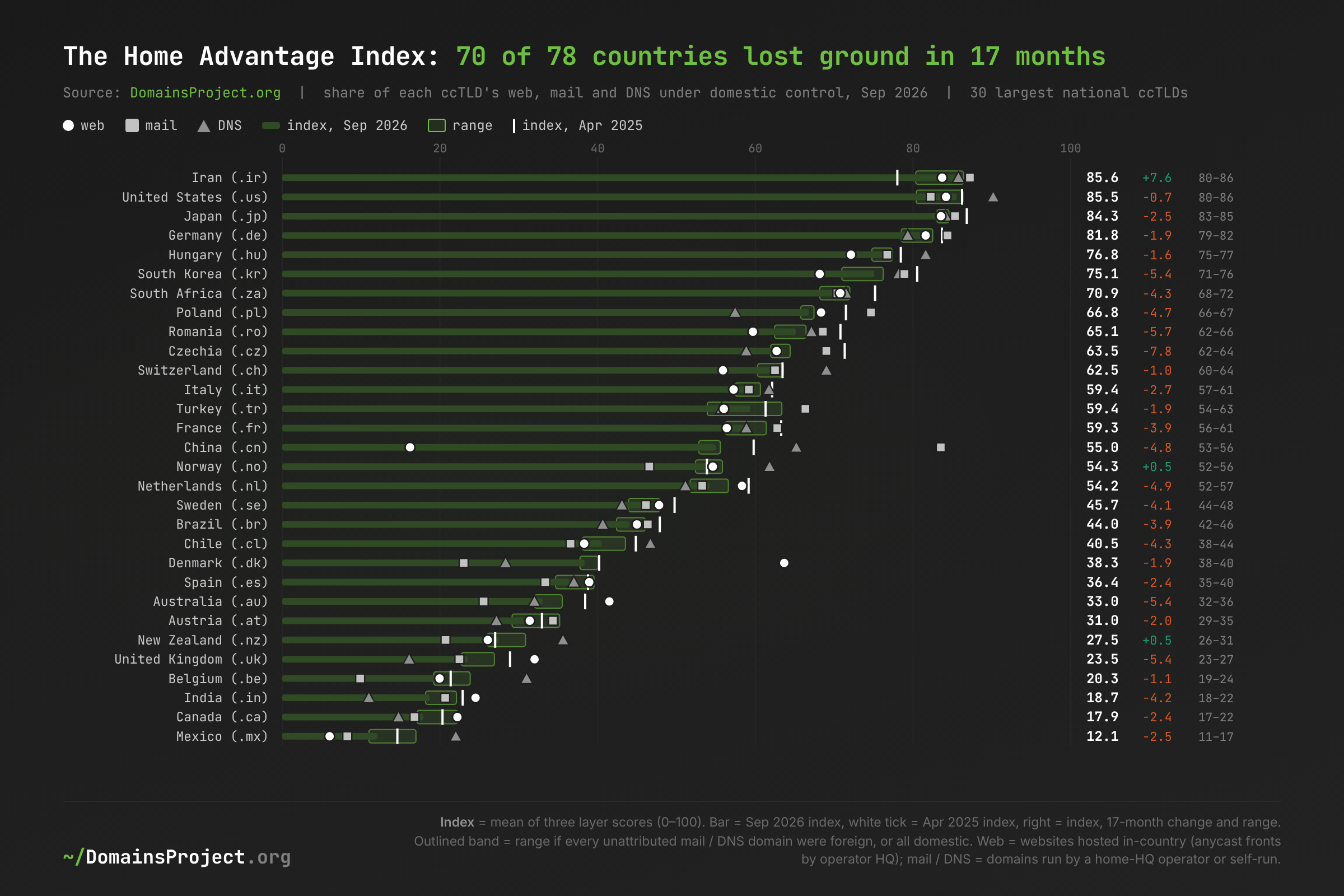
Download: hai-scorecard.csv · hai-index.csv (all 78 countries and .eu, every component, bounds and variants)
Read the ranking as tiers, not places. The unattributed mail and DNS domains give every index a range: a median 6.0 points wide, and up to 18.0 for Kenya.
- The top four is firm. Iran, the United States, Japan and Germany are the top four however the unattributed domains are counted: Hungary's highest possible index (77.4) is below Germany's lowest (78.5). Their order among themselves is not firm.
- The middle is a crowd. The median country's possible ranks span 18 places, and the median for the 18 countries marked † spans 25.5. Only 25 of the 78 countries have possible ranks spanning ten places or fewer.
- Neighbouring ranks rarely mean much. Turkey (20th) and France (21st), or Ireland and Indonesia, are separated by less than their ranges. Compare countries by range, not by rank.
Four namespaces score above 80: Iran (85.6), the United States (85.5), Japan (84.3) and Germany (81.8). Their routes there differ.
- The United States and Japan: the US needs no foreign operators, and Japan's market chooses domestic hosting — 95.4% of its located websites are in Japan.
- Germany: it has Europe's largest hosting industry.
- Iran: it rose from sixth to first because policy closed the alternatives. US sanctions keep Google and Microsoft out of its mail, and its National Information Network keeps domestic services running through shutdowns.
Data → inference: a high index is compatible with both a competitive domestic market and an isolated one. Implication: the index measures dependency, not health.
The bottom of the table is the Americas, South Asia and the microstates. Among the 30 largest national namespaces, Mexico (12.1), Canada (17.9) and India (18.7) keep the least at home, and Mexico is last among them under any assignment of unattributed domains. The microstates are lower still: Liechtenstein (2.1) is hosted, mailed and resolved almost entirely in Switzerland, its customs-union partner.
Rank changes are mostly small; two are not.
- Japan slipped from first to third. Its web score fell 3.3 points as its anycast share grew. The fall holds however the unattributed domains are counted; the order of the top three does not.
- Czechia fell from 11th to 17th, losing 7.8 points, more than any other country except Malaysia.
- Malaysia fell from 27th to 49th, almost all of it composition (below).
Only eight countries gained. Iran gained 7.6 points; the other seven gained 0.3–3.2.
The Edge Is the New Abroad
The web layer is the longest series: 29 crawls over 41 months. In that time the typical country's websites rearranged in one direction, as the chart at the top of this article shows.
| Median across the 78 countries, % of live websites | April 2023 | April 2025 | September 2026 |
|---|---|---|---|
| Hosted in-country | 41.3 | 40.2 | 32.5 |
| Hosted in another country | 41.0 | 38.9 | 35.4 |
| Behind an anycast / CDN front door | 10.9 | 15.9 | 22.7 |
| Answered by a US-located server or US-run front door | 18.3 | 23.3 | 32.1 |
| Hosted in-country, of websites with a single location | 52.8 | 51.8 | 50.1 |
Websites did not leave home for another country. They left the map.
- Anycast fronts: the median share of a country's websites behind anycast front doors doubled, and it rose in all 78 countries.
- In-country and abroad both shrank: the in-country share fell in 66 countries and the abroad share in 69.
- Located websites stayed put: among websites that still have a single location, the home share moved by under three points in three and a half years. It rose in 38 countries and fell in 40.
Data → inference: the decline in home hosting is a move to the edge, not an exodus to foreign data centres. Implication: measured by who runs the front door, it is a move to American companies all the same. The share of each country's websites answered by a US-located server or a US-run front door rose from a median 18.3% to 32.1%, in 70 of the 78 countries.
Part of this is composition. The crawl expanded in December 2024, and newer names sit on the edge more often. Even among websites present in every crawl the edge grew: in the fixed panel that How Much of the Web Runs on Virginia's Grid? measured across all TLDs, it rose from 28.2% to 35.9%.
The edge share varies widely by country:
| Most on anycast front doors, Sep 2026 | Least on anycast front doors, Sep 2026 | ||
|---|---|---|---|
| Nepal | 49.9% | Iran | 6.5% |
| Canada | 44.1% | Hungary | 9.7% |
| Israel | 42.4% | Slovakia | 10.2% |
| Australia | 41.9% | Germany | 10.6% |
| Azerbaijan | 40.7% | Czechia | 10.8% |
| New Zealand | 40.5% | Japan | 12.5% |
| United Kingdom | 39.5% |
In Israel a sixth of the edge is Wix's, which counts as home; the rest, as everywhere, is mostly Cloudflare. Where national hosting industries are strong, the edge has made the least headway.
Who Came Home, Who Left
Measured on all live websites, the in-country share fell almost everywhere. A few countries move far more than the general drift:
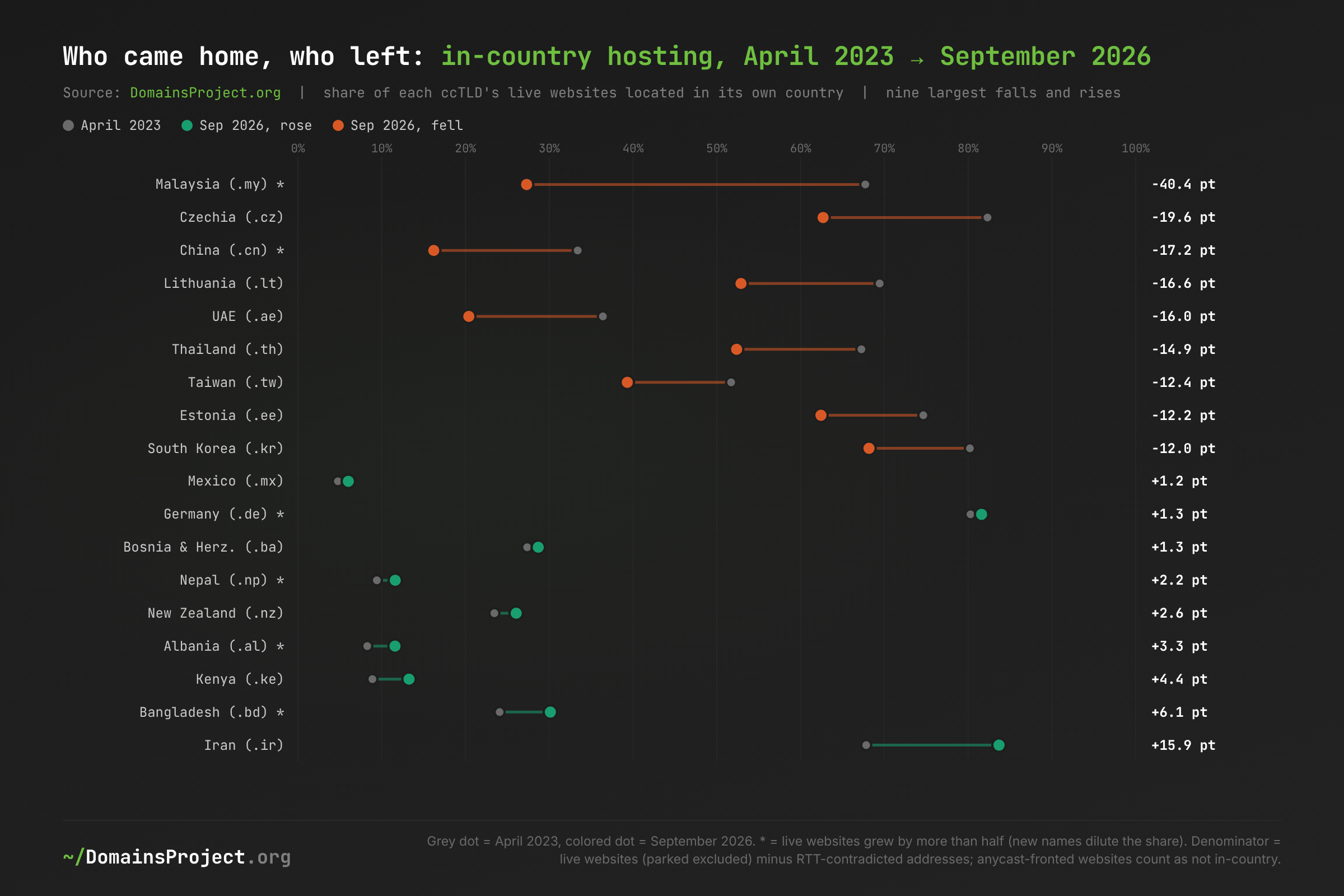
Download: hai-web-movers.csv — in-country share of live websites; * marks namespaces whose live websites grew by more than half
Iran is the only large namespace that came home: 67.8% of live .ir websites were hosted in Iran in April 2023, 83.7% in September 2026.
- Germany's share fell from 18.6% to 6.0%.
- The crawls show the shutdowns. Three of our crawls ran during or just after Iran's international shutdowns of June 2025, January 2026 and February–May 2026 (Cloudflare, Filterwatch). In each, the number of
.irnames we could resolve from outside fell, by 11–42%. - What stays: the National Information Network keeps domestic services running while international links are cut, and the web that stays reachable is the web hosted at home.
This home share is consistent with policy more than with market choice; we will publish the shutdown record separately.
Czechia is the clearest case of a namespace moving out.
- Home share: 82.3% of live
.czwebsites were hosted in Czechia in April 2023, against 62.7% now. - Abroad share: it doubled, from 13.4% to 26.5%, mostly to Germany and to Bratislava across the Slovak border.
- Why it is not composition: the edge grew only to 10.8%, and the namespace grew by a sixth, not a half.
China and Malaysia are mostly composition.
- China: live
.cnwebsites grew 5.5-fold, from 0.87 million to 4.77 million, and the new names went to Hong Kong. It now hosts 39.6% of them, against the mainland's 16.2%. A mainland server needs an ICP licence; one in Hong Kong does not. - Malaysia: live
.mywebsites roughly doubled between December 2024 and September 2026, from 149,000 to 308,000.- Hong Kong went from a minor location to 16.3% of the namespace.
- The number of
.mywebsites hosted in Malaysia fell too, from 104,000 in January 2025 to 84,000.
The index treats both the same way, because a country's namespace is what it is today.
Korea, the United Arab Emirates, Thailand, Taiwan and Lithuania each lost 12–17 points of in-country hosting, much of it to the edge. Korea's edge share went from 14.0% to 25.7%; AWS CloudFront and Global Accelerator together are larger there than Cloudflare.
Next-Door Landlords
The sovereignty debate pictures the dependency as American. For many smaller European countries, the largest foreign host is a neighbour.
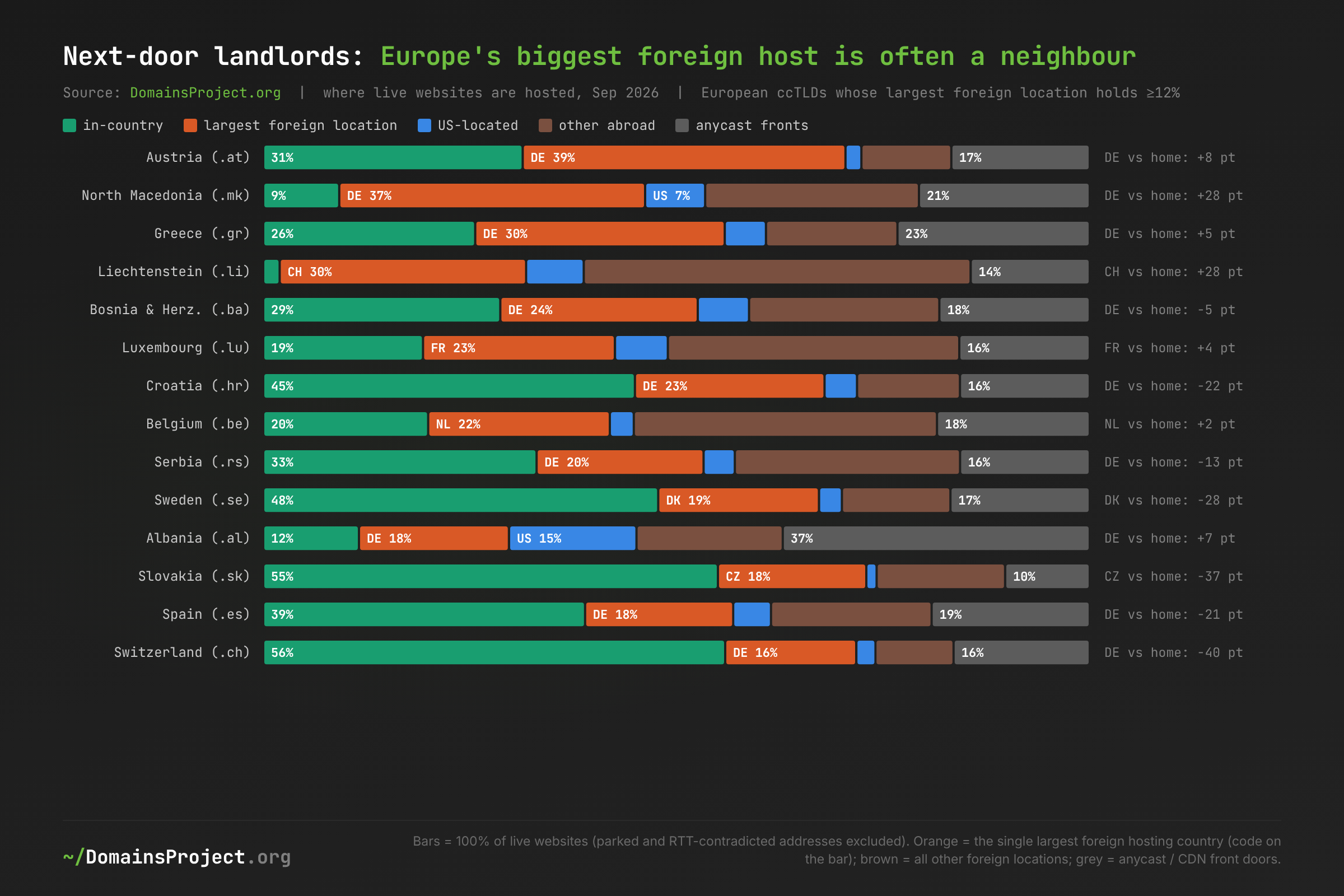
Download: hai-neighbours.csv — share of live websites by location, September 2026, with April 2023 for comparison
Six European countries host less of their own namespace than one neighbour does.
| ccTLD | Largest foreign host | Hosted there | Hosted at home |
|---|---|---|---|
| Austria | Germany | 39.0% | 31.4% |
| North Macedonia | Germany | 37.0% | 9.2% |
| Greece | Germany | 30.2% | 25.7% |
| Liechtenstein | Switzerland | 29.8% | 2.0% |
| Luxembourg | France | 23.2% | 19.3% |
| Belgium | Netherlands | 22.0% | 20.0% |
Germany is the largest foreign host for nine of the fourteen countries in the chart. Across all 35 European countries in the panel besides Germany itself, it is the largest foreign host for 23. For Greece, the largest single location of any kind is not Athens but Falkenstein in Saxony, where Hetzner runs 22 data centres (Hetzner). Falkenstein hosted 27.4% of live .gr websites in April 2023 and 19.8% now; Athens hosts 6.9%. An independent survey of popular sites finds the same shape: Germany ahead of the home country for .at (40.9% vs 37.3%) and .gr (40.1% vs 18.8%) (W3Techs).
Neighbour dependence is shrinking, not growing. Between April 2023 and September 2026 the largest neighbour's share fell in 12 of the 14 countries, and rose only for North Macedonia and Croatia. Germany's share of Greek websites fell from 37.4% to 30.2%; the Netherlands' share of Belgian ones from 25.3% to 22.0%. The difference went to the edge.
Data → inference: inside the EU, the measured dependency of smaller states runs through German and Dutch data centres more than through American ones. Implication: CADA's ownership test would class those providers as sovereign for Greece and Austria, because they are European. A national measure of domestic control does not, so EU-level rules and national measures will describe the same namespace differently.
Mail and DNS Drift West
The mail and DNS series are shorter, seventeen months, but they move faster than the web, and in one direction.
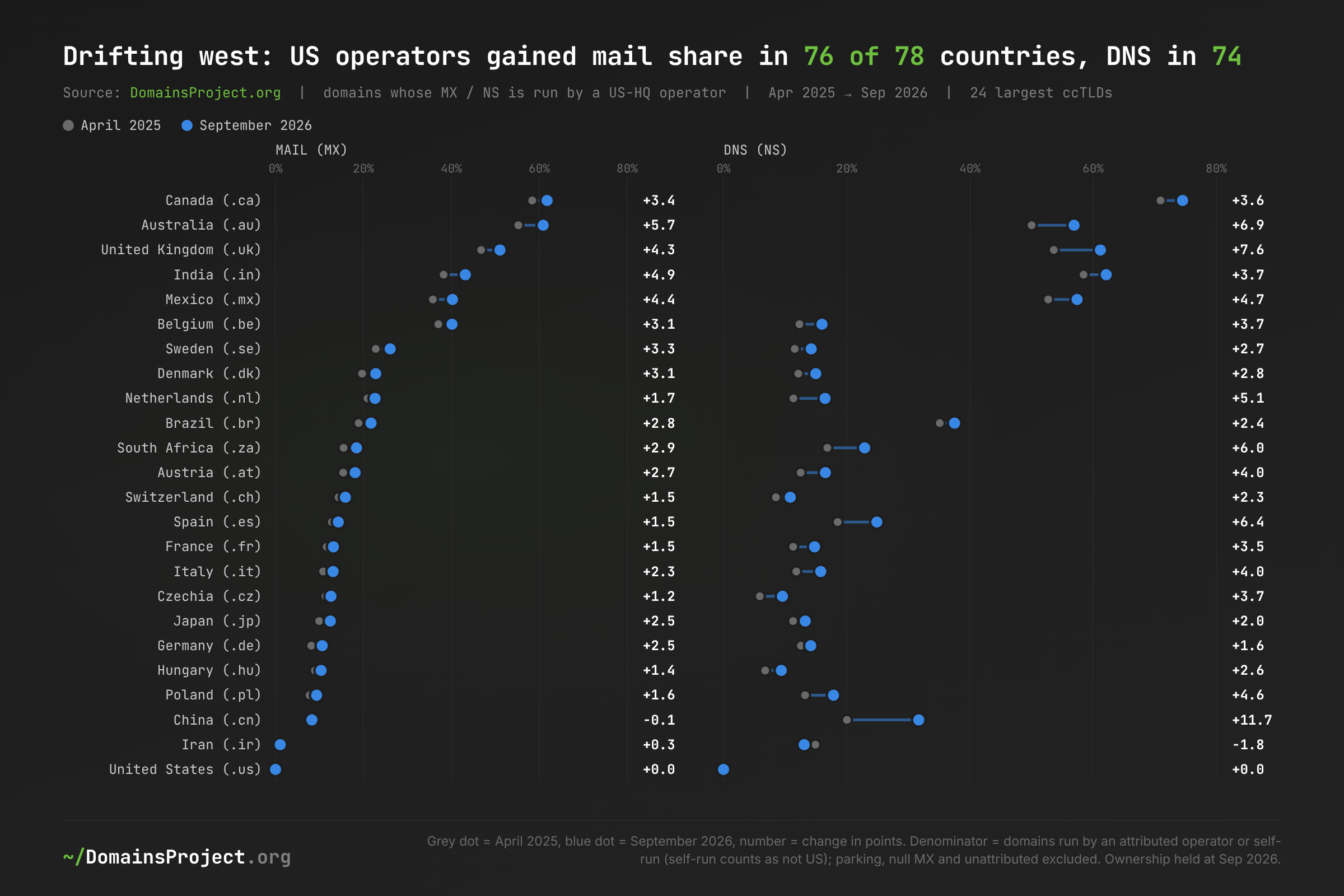
Download: hai-drift.csv — share of domains with an attributed or self-run operator; self-run counts as not US
US-headquartered operators gained mail share in 76 of 78 countries and DNS share in 74. The median US share of mail went from 17.4% to 19.9% in seventeen months, and of DNS from 25.2% to 30.5%.
A few operators account for the gains. Pooled across the 77 countries other than the US:
| US-HQ share, Apr 2025 | US-HQ share, Sep 2026 | Largest gainers (points) | |
|---|---|---|---|
| 21.0% | 24.1% | Microsoft 365 +1.0, Google Workspace +0.9, Cloudflare Email Routing +0.6, Namecheap +0.3 | |
| DNS | 24.8% | 30.7% | Cloudflare +4.6 (8.33% → 12.96%), GoDaddy +1.1 |
Cloudflare alone accounts for more than three-quarters of the rise in the US share of national DNS.
These are not migrations.
- Few domains switch: our mail and DNS flux studies found that 90.9% of domains never change mail provider in sixteen months, and 82.7% never change DNS operator in fifteen.
- New domains choose differently: Google's lead in mail is built by new domains, which choose it over Microsoft 2.3 to 1. Cloudflare's DNS gains come from a steady trickle of owners leaving registrar defaults.
- China's two layers run in opposite directions. Its mail barely moved, with US operators at 8.3%. Its DNS score fell 13.9 points as the US share of
.cndelegations rose from 20.0% to 31.7%.
Data → inference: every month a national namespace adds domains that choose differently from the domains already in it. Implication: unless what new domains default to changes, the drift compounds.
Corporate deals do not explain it.
- Ownership is held constant: we use its September 2026 state for every crawl.
- The one change of country is small: Proofpoint's purchase of Hornetsecurity is the only acquisition in the window that changed a headquarters country, and it is 0.46% of
.demail. Without it, US operators still gained mail share in 76 of the 77 countries other than the US.
The mail map is a language map. US operators run 61.8% of mail-capable .ca domains, 60.9% of .au, 59.8% of .nz, 56.9% of .is and 51.1% of .uk. They run 1.1% of .ir, where sanctions put Google and Microsoft out of reach and 93% of domains run their own mail servers.
The municipal mail study finds the same split one level down. In April 2026, 7.2% of German municipalities used US cloud mail, against 67.0% in Austria and 53.3% in Switzerland (Bischof et al.). Across whole namespaces the gap is narrower but in the same direction: US operators run 10.6% of .de mail, 18.1% of .at and 15.9% of .ch. Austria's and Switzerland's municipalities moved to US cloud mail faster than their businesses did.
Checking Ourselves Against Others
| Comparator | What it measures | Their number | Ours |
|---|---|---|---|
| W3Techs, Oct 3, 2026 (source) | server location of popular sites, by TLD | .mx: 7.1% Mexico, 72.8% US. .ca: 30.3% Canada, 63.8% US. .jp: 91.1% Japan. .de: 84.3% Germany |
Of located websites: .mx 8.8% Mexico, 67.8% US; .ca 39.7% Canada, 50.3% US; .jp 95.4% Japan; .de 91.2% Germany |
| Kumar et al., IMC 2024 (source) | government websites, 61 countries | 79% of Mexican government URLs served from the US | 67.8% of located .mx websites are in the US |
| Akiwate et al., SIGCOMM 2025 (source) | provider HQ of each country's top-10K sites | US providers host the largest share in all but five countries; Iran 64.8% and Czechia 54.5% local | Of all live websites in April 2023: Iran 67.8% and Czechia 82.3% in-country, among the highest |
| Bischof et al., 2026 (source) | municipal email in Germany / Austria / Switzerland | US cloud: 7.2% / 67.0% / 53.3% | US mail operators: .de 10.6%, .at 18.1%, .ch 15.9% |
Every comparator measures a different population — popular sites, governments, municipalities — and the ordering agrees everywhere. The levels differ in the direction one would expect: popular sites and governments lean on large providers more than the long tail of a namespace does.
What's at Stake
- The policy target and the measured problem are different. CADA's assurance levels govern what the public sector buys. In the namespaces measured here the decline in domestic control comes from millions of small choices by new domains: where a website builder fronts them, where a registrar points their DNS, which mail suite a founder signs up for. Procurement rules will not reach those choices.
- Anycast front doors are the largest single shift, and they are American. A median 22.7% of each country's websites now answer from a front door with no location. Nearly all of those front doors are run by US companies, up from 10.9% in 2023. The three largest front-door operators in each country answer a median 19.2% of its websites, Cloudflare alone 15.3%. An outage, a sanctions order or a policy change at three companies now reaches nearly a fifth of the typical national web directly.
- DNS is concentrating fastest. Cloudflare added 4.6 points of the pooled national DNS market in seventeen months. DNS is the layer where a single operator's failure takes every dependent service offline, and it is the layer where national registries have the most direct relationship with the domains.
- Inside Europe, "sovereign" does not mean "home". Six European countries host less of their namespace than one neighbour does, and Germany is the largest foreign host for 23 of the 35 European countries in the panel besides itself. EU-level sovereignty rules will count that dependence as solved; a national view still sees it.
- High scores can mean isolation. Iran leads the index because policy shut the alternatives. The index measures dependency; whether a given level is healthy is a political judgement it cannot make.
What Would Help
1. Policymakers: measure the namespace, not only procurement. CADA, Canada's sovereign-cloud tender and the USMCA reviews all lack a baseline of where national namespaces actually live. This index is one. Publishing an official equivalent annually, layer by layer, would let governments see whether their measures move anything outside the public sector.
2. Registries: publish home-hosting and operator statistics for your ccTLD. Every registry already sees its delegations, and most crawl their zones. We found no registry-published "hosted at home" figure for .mx, .ca, .gr or .at. A yearly table of NS operators by headquarters and websites by location would make this index unnecessary, and better.
3. Hosting companies and registrars: compete on the defaults. Most of the drift comes from what domains are set up with — the registrar's DNS, the builder's front door, the suggested mail suite. In DNS, owners leaving their registrar's default for Cloudflare add to it. Domestic providers that bundle DNS and mail with domains, as many of Europe's and Japan's do, keep their customers. The countries with the highest scores are those whose domestic providers own the defaults.
4. Measurement researchers: attribute by location and by operator, and validate the imputations. Location and operator answer different questions; publish both. Self-run mail is a quarter of the mail layer and is usually hosted where the website is, which a 200-domain live sample per country can verify. A national average misses by about 11 points; a per-domain join misses by about 2.
5. Site owners: know who answers for your domain. A domain registered under a national ccTLD can still have its website fronted, its mail filtered and its DNS answered by three different foreign companies. A dig of your NS and MX records and a lookup of your website's address show you in a minute where your domain lives.
Methodology. Web layer: 29 full A-record crawls of the DomainsProject corpus, April 6, 2023 – September 17, 2026.
- One website record per ICANN-registrable domain; parked domains are excluded using the registry of The Parking Lot.
- Addresses are located as in How Much of the Web Runs on Virginia's Grid?: edge lists, 213 Globalping RTT measurements, cloud region tags as published at each crawl, RFC 8805 geofeeds, then DB-IP City Lite (CC BY 4.0).
Mail and DNS layers: the apex MX tuples (12 crawls, April 10, 2025 – September 20, 2026) and NS tuples (10 crawls, April 10, 2025 – September 22, 2026) of MX Flux and Who Moves the World's DNS.
- Operators are attributed to the headquarters of their operating group, with ownership held at its September 2026 state.
- Self-run mail is located through each domain's own website, validated on 2,742 live lookups.
Excluded from every figure: commercially repurposed ccTLDs, overseas departments, registry-wildcard TLDs, private-suffix pseudo-apexes and Russian-administered TLDs.
Data: index, web series, mail series, DNS series, self-run validation. For the global hosting map see Where the Web Lives. For any single TLD see the TLD statistics pages, and get the data on the dataset page.