On September 30, the National Telecommunications and Information Administration signed a contract of up to seven years that moves .us, the country code of the United States, from GoDaddy Registry to Identity Digital (Domain Incite; NTIA). It is the first time NTIA has chosen a different operator since 2001. Neustar ran .us from 2001, and its registry business became GoDaddy Registry when GoDaddy bought it in 2020 (DN Journal). A nine-month transition is under way, and all 256 accredited .us registrars will have to be re-accredited.
The new contract reads like a list of things the old arrangement did not deliver. It orders an initial audit of "the current registrant database to determine gaps in Nexus compliance" — the rule that .us registrants must be American or have a bona fide US presence. It requires the operator to "implement a prohibition of proxy and anonymous services". It asks for detailed policy on phishing, malware and other DNS abuse. It requires the operator to keep servicing the locality tree of school districts, libraries and towns that predates commercial .us, and lets it take back delegations whose managers will not follow the rules. It also asks bidders how they would revive the dormant kids.us (contract text, §6.18–6.31). And the namespace is shrinking. The registry's own monthly reports to NTIA show 2,550,544 names under management in May 2025 and 1,899,773 in May 2026. Domain Incite, citing NTIA documents, put the peak at 2,575,574 in mid-2025.
The usual line on .us is that it never mattered: Americans built their web on .com, and the country code is a curiosity. That is right about size. It misses what .us is made of, how fast it has been changing and who sits on it.
We measured what changes hands, using:
- every
.ushost name in our dataset, 16,147,866 of them, classified by kind; - 29 DNS passes from April 2023 to September 2026, recording what each resolving
.usname answers with; - the hosting, mail and DNS operators of the 687,464 live
.uswebsites in the September 2026 crawl; - nameserver passes from April 2025 and September 2026;
- 17 months of OpenPhish's public phishing feed;
- CISA's list of 17,151
.govdomains; - the registry's own monthly reports to NTIA.
The headline: Identity Digital is inheriting three namespaces that have little in common.
- The commercial second level is half parked. 50.5% of resolving
.usnames answer from a parking or for-sale front door, a larger share than any comparison TLD except.xyz. 45.2% sit on GoDaddy's own front door: GoDaddy's registrar business is the sibling of the outgoing registry. - The boom and bust tracks one wave of names. A wave of 427,785 random five- and six-character names, registered through NameSilo and parked at Sedo, came and went. Its rise is consistent with most of the registry's 2024–25 growth, and the 417,642 wave names that have stopped resolving are about three-fifths of the 675,801 names the registry lost between its peak and May 2026. Meanwhile the live
.usweb grew slightly, from 653,269 to 675,447 second-level websites. - The registry runs its own web. It answers for 99,381 five-digit names as ZIP-code information pages.
- The oldest part of
.usis the part that lasts. The 1990s locality tree is 12,060 resolving names for school districts, libraries, community colleges, towns and state agencies. 93.6% of school-district names that resolved in April 2023 still resolve, against 58.5% of that year's live second-level websites. - Phishing runs above
.com..usdrew 2.85 OpenPhish listings per 10,000 resolving names, 2.3 times.comand 12 times.caor.uk. More than half of them are lost-phone lures, mostly aimed at iPhone owners and many in Spanish.
Download: dotus-anatomy.csv — every .us host name in the dataset (November 2026), rule-based categories, first match wins
The Data
| Source | What it measures | Scope |
|---|---|---|
DomainsProject dataset, .us file (Nov 2026) |
Every observed host name under .us, including subdomains |
16,147,866 host names; 3,822,973 second-level names; 23,062 locality names |
| 29 A-record passes, Apr 7 2023 – Sep 17 2026 | What each resolving name answers with: a live website, GoDaddy's front door, another parking operator, a sinkhole | 3,150,388 distinct .us names resolving at least once; 1,491,423 second-level and 12,060 locality names in Sep 2026 |
| Nameserver passes, Apr 10 2025 and Sep 2026 | Nameserver family of each delegated name | 1,614,596 and 1,410,891 delegated second-level names |
| Mail passes, 11 from Apr 2025 to Aug 2026 | Whether a name accepts mail and who runs it | 1,561,163 .us names in Aug 2026, 630,320 with working MX |
| Per-domain stack, Sep 2026 crawl | Hosting location and owner, mail operator and DNS operator per live website | 687,464 live .us websites |
| OpenPhish public feed history (git), Jul 1 2025 – Nov 26 2026 | First listing of each registered domain | 58,890 registered domains; 429 under .us |
| Registry operator monthly reports to NTIA (May 2025; Dec 2025; Jan, Feb, Apr, May 2026) | Names under management, adds, renewals, renewal rate, locality counts, nexus spot checks | 6 reports, published on about.us |
NTIA .us contract (Sep 30 2026) |
Operator obligations | Full text |
CISA .gov registry list (current-full.csv) |
.gov domains by organisation type, city and state |
17,151 domains |
| Interisle Phishing Landscape 2025 | Multi-feed phishing counts, May 2024 – Apr 2025 | 8,067 .us phishing domains |
We count names, not registrations. The dataset holds every .us name we have ever observed, including expired ones, so its 3.82 million second-level names are about twice the registry's current count. The DNS passes show which of them resolve at a given moment, and the registry's reports give the registered total. Where the two disagree, we say so. Russian-territorial TLDs are excluded from every cross-TLD comparison.
Methodology
Definitions.
- Host name: any name under
.usin the dataset, at any depth (www.example.us,ci.boston.ma.us). - Second-level name: a registration directly under
.us(example.us), the commercial space opened in 2002. - Locality name: a registrable name in the original geographic tree, following the public suffix list. That means
<name>.<state>.usfor cities, counties and towns;<name>.k12.<state>.us,<name>.lib.<state>.usand<name>.cc.<state>.usfor school districts, libraries and community colleges;state.<state>.usfor state governments; and names under the affinity labelsfed.us,nsn.us(Native sovereign nations),dni.us,isa.usandkids.us. - Resolving: the bare name or its
wwwreturns an A record in that pass. The passes record successful answers only, so a name absent from a pass did not resolve, or was not crawled that month. - GoDaddy front door: the addresses GoDaddy uses for its default "coming soon" pages, its parked landers, its aftermarket ("this domain is for sale") pages and its CashParking product.
- Other parking: the addresses of 17 other parking and for-sale operators, including Sedo, Bodis, Above, Team Internet and HugeDomains.
- Live website: a resolving name that is neither on a parking front door nor sinkholed.
- Registry ZIP-code page: any five-digit second-level name (
90210.us). See the ZIP-code section for why this is a registry class. - The wave: the 427,785 second-level names that answered from Sedo's parking addresses in the May 25, 2025 pass. When these names later answered from three Linode addresses serving a JavaScript redirect page, we count them as parked, not live.
- IP-address host name: a host name whose subdomain contains a dotted or dashed IPv4 quad (
z-166-3-14-121.ip.fs.fed.us). These are reverse-DNS names for network addresses, not services. - Microsoft government cloud: 16 apexes (
azure.us,azure-api.us,azurehdinsight.us,azurecontainerapps.us,mcas-gov.usand others). All are delegated toazuregov-dns.usor Azure DNS, with Microsoft-run SOA records. - Listed domain: the registrable domain of a URL added to OpenPhish's public feed, counted once at its first listing.
- Survival: the share of names resolving on April 7, 2023 that still resolve, with any content, on September 17, 2026.
Classification heuristics.
- Front-door classes come from our registry of parking and lander addresses, built by auditing the most-used addresses in each pass. Any lander missing from it counts as "live", so live counts are upper bounds. In March to May 2026, one-pass spikes at Alibaba (50,327 names) and at unattributed addresses (44,000–58,000) may be landers of this kind. If so, they inflate "live" in those passes by up to about 58,000.
- Lure themes come from keyword rules on the phishing host names. We read all 429
.usnames. The "lost-phone / device-finder" class is the clearest: 144 of its 242 names name Apple, iCloud or iPhone outright, and the rest use device-finder vocabulary (encontrar-dispositivo-mxn.us,ilocate-devices.us). Two of the 242 name Samsung or Xiaomi. - The
.govoverlap matches a locality place name to CISA's list when an organisation's city, or a "City of X" or "X County" name, matches the label in the same state. We checked 25 matches by hand. All were plausible bodies in the same place, though not always the same body:addison.mi.usmatches a township office in Addison.
Dataset scope.
- The 29 passes are roughly monthly from November 2024, and one to six months apart before that.
- Between the December 2024 and January 2025 passes, our dataset's coverage expanded. Names that first resolve in January 2025 mix new registrations with older names we had not crawled before. For registration volume we therefore rely on the registry's counts, and on our passes for what names do.
- Mail and DNS attributions follow the operator rules of our earlier per-domain studies: the operating group's headquarters, and anycast edges counted at the edge operator.
Known limitations.
- Apex-level tests undercount the locality tree. In the tree, services often live one level down (
ci.boston.ma.us) while the place name itself has no address record. 2,842 of the 3,889 place names we have observed never resolved at apex level in any pass. Locality survival is therefore measured on the names that did resolve. - No registrant data. The registry's public RDAP and WHOIS services cut us off after about a hundred queries ("Number of allowed queries exceeded"). So we could not sample registrant countries or registrars directly, and nameserver families stand in for registrars. That proxy misses customers who move DNS to Cloudflare or a host.
- Nameserver gaps. The nameserver passes carry a known pass-level artifact in which large numbers of names return no NS record. We use them only for the September 2026 family shares.
- One phishing source. OpenPhish's public feed is one sample of phishing, not a census. Our rates are comparisons between TLDs, not totals.
- The registry's reports contradict themselves in places. The May 2026 report says names under management were "34.1% lower" than in May 2025, but its own totals imply 25.5% (1,899,773 against 2,550,544). The renewal rate printed for February 2026 is garbled in the published PDF, so we do not use it. NTIA's figure for January 2026 (2,175,340, via Domain Incite) differs from the January report (2,089,403) by 85,937. The contract's own background says "more than 2.4 million" registrations as of March 2026. We use the monthly reports throughout.
Dataset vs registry counts. The dataset's 3,822,973 second-level names include everything we have ever seen. 3,150,388 .us names resolved in at least one of 29 passes. In September 2026, 1,392,042 second-level names resolved, not counting the ZIP-code pages, against about 1.8 million registered at the end of July. The gap is consistent with registered names that are not delegated or do not answer on the bare name or www.
Reproducibility. Every chart links its CSV. The live-web stack table is in dotus-live-stack.csv, and the locality series for all 29 passes is in dotus-locality.csv. The registry figures come from the operator's monthly reports on about.us. The contract is on NTIA's site. CISA's list is public on GitHub as cisagov/dotgov-data. OpenPhish's feed history is the public openphish/public_feed repository.
The Scorecard
| Measure | .us |
Comparison |
|---|---|---|
| Registry names under management | 1,899,773 (May 2026) | 2,550,544 (May 2025); peak 2,575,574 (mid-2025) |
| Registry renewal rate | 43.4% (Jan 2026) | 67.1% a year earlier |
| Resolving second-level names | 1,491,423 (Sep 2026) | 1,813,390 at the May 2025 peak |
| Parked share of resolving names | 50.5% | .com 30.5%, .ca 36.1%, .uk 28.8%, .de 8.1% |
| On GoDaddy's front door | 45.2% | .com 23.5%, .ca 33.6%, .uk 25.0%, .de 1.2% |
| Live websites per 1,000 residents | 2.0 | .de 140.3, .uk 75.9, .ca 45.0, .mx 4.7, .in 1.3 |
| Registry ZIP-code pages | 99,381 resolving | 99,999 of the 100,000 possible five-digit names observed |
| Locality names resolving | 12,060 | registry count: 12,534 locality names (May 2026) |
| Still resolving after 3.5 years | 93.6% of school districts | 58.5% of live second-level websites |
| OpenPhish listings per 10,000 resolving names | 2.85 (2.59–3.14) | .com 1.25, all TLDs 2.02, .ca 0.24 |
| Live websites hosted in the US (of located) | 73.0% | 38.2% answer from anycast edges |
| Live websites with no MX record | 39.7% | — |
The country code is small for its country and unusual within it. At 2.0 live websites per 1,000 residents, .us sits beside .in (1.3) and .mx (4.7), not beside .de (140.3) or .uk (75.9). American businesses use .com, and nothing here says that will change. Data → inference: .us is a second national namespace for a country with a first one already, so its composition depends heavily on who finds it cheap or useful: parking operators, bulk registrants, platforms and the public sector. Implication: the new operator's policies will be felt most by those groups, not by the American web at large.
Three Namespaces in One Country Code
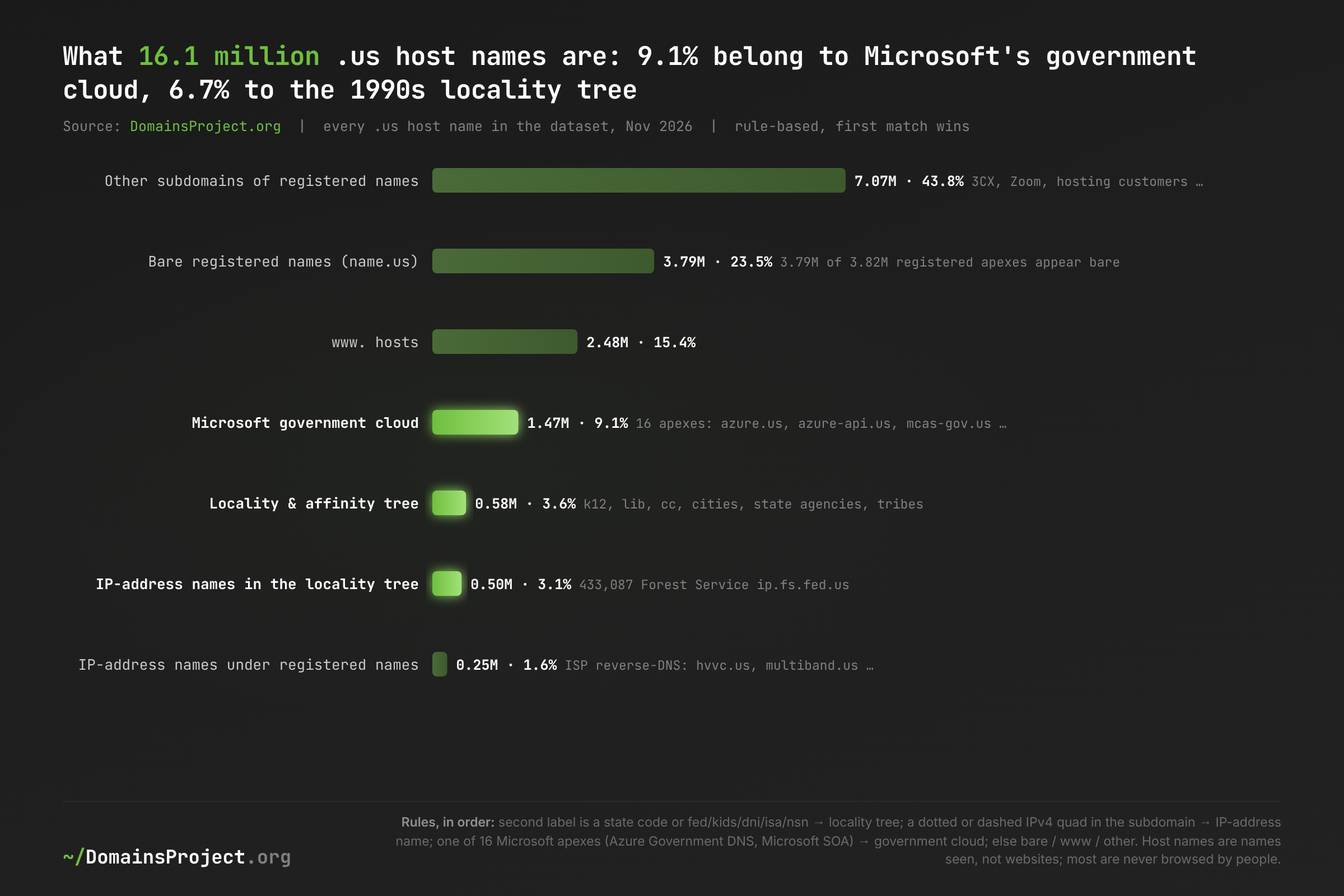
Most .us host names are machinery, not websites. Of 16,147,866 host names, 3,794,329 are bare registered names and 2,481,917 are www hosts. The rest are subdomains, and a handful of organisations account for a large share of them.
| Apex or tree | Host names | What they are |
|---|---|---|
| Microsoft government cloud (16 apexes) | 1,470,644 | Azure Government and Microsoft 365 Government endpoints. azure.us alone has 688,403, mostly certificate-service and Azure Arc machine names |
fs.fed.us |
433,155 | 433,087 reverse-DNS names under ip.fs.fed.us for US Forest Service addresses |
k12.<state>.us (all states) |
366,900 | School-district hosts: mail, portals, learning systems |
hvvc.us, multiband.us |
201,565 | Reverse-DNS names for network addresses (Hivelocity and Multiband) |
0gb.us, allseries.us |
187,815 | "downloadpdf" spam subdomains; both apexes now sit on Sedo and ParkingCrew parking |
3cx.us, my3cx.us |
82,815 | Customer instances of the 3CX phone system |
zoom.us, zoomdev.us |
40,492 | Zoom's primary domain and its development twin |
Microsoft's government cloud is the largest single user of .us by host names. Microsoft's 16 government-cloud apexes hold 9.1% of all .us host names, more than the entire locality tree (6.7% with its IP-address names). That is consistent with Microsoft's choice to give its sovereign US-government cloud a US-only namespace. The names are machine endpoints, not destinations people visit. The best-known commercial .us name, zoom.us, is similar: most of its 32,089 host names are meeting-server, messaging, SIP and telemetry endpoints.
The locality tree is small in host names and large in institutions. Its 576,672 non-IP host names spread over about 23,000 registrable names. That is the 1993 design of RFC 1480 still in use, with K-12 districts making up most of it.
Data → inference: host-name totals measure how many machines an organisation names, not how many people use the namespace. Implication: any account of .us built on host-name or "domain" counts alone will overstate how much the namespace is used. The DNS passes, which ask what each name actually answers with, are the better guide.
The Boom and the Bust: A Wave of Random Strings Came and Went
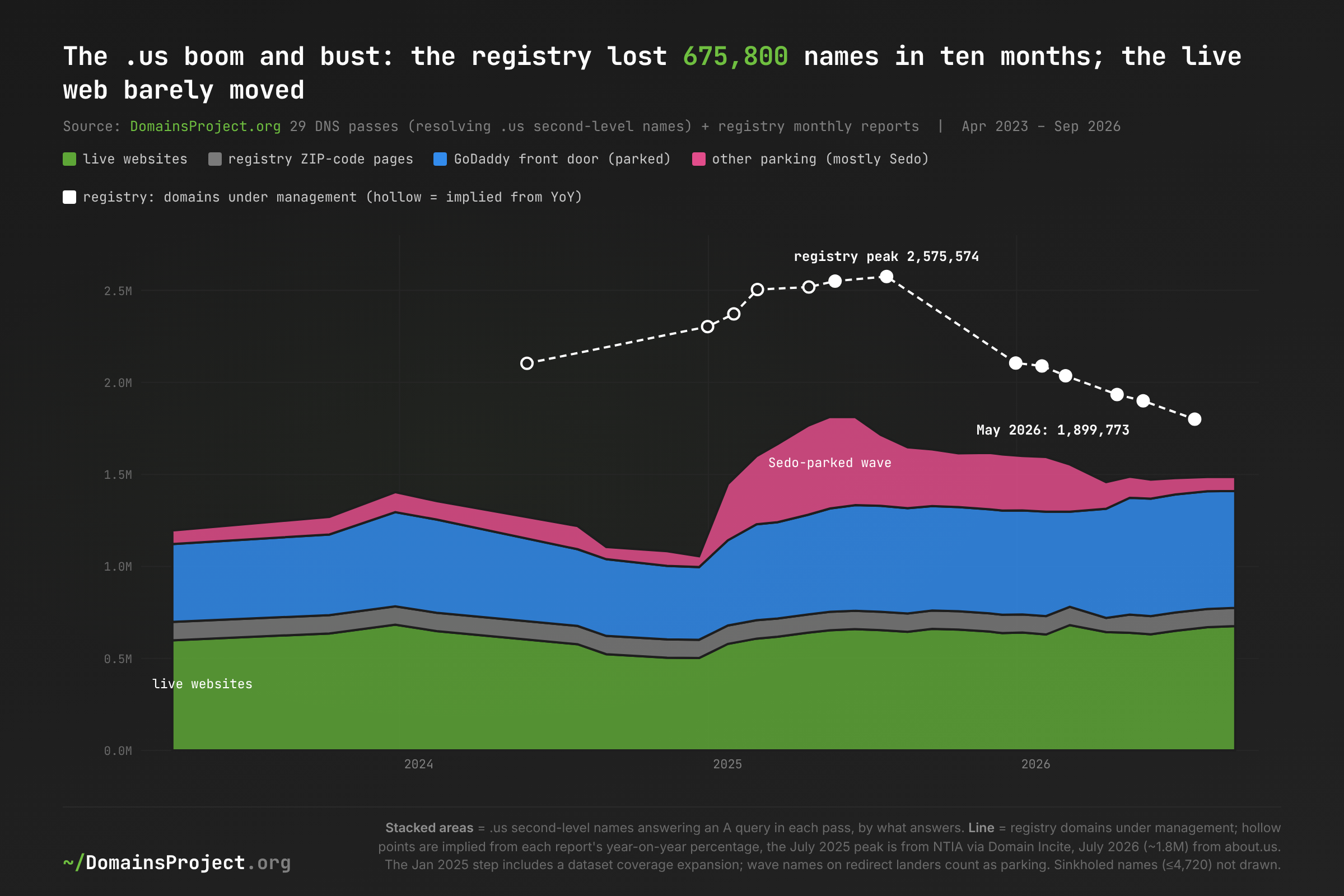
In the year to May 2025 the registry grew by about a fifth (21.26%), and in the ten months after its mid-2025 peak it lost 675,801 names.
| Month | Names under management | Adds (billable) | Year-on-year change stated in report |
|---|---|---|---|
| May 2024 | 2,103,365 (implied) | ≈86,300 (implied) | — |
| Feb 2025 | 2,504,740 (implied) | ≈164,600 (implied) | — |
| May 2025 | 2,550,544 | 32,316 | names +21.26%; new registrations −62.57% |
| mid-2025 (peak) | 2,575,574 | — | via NTIA documents |
| Dec 2025 | 2,105,289 | 27,158 | names −8.59%; new registrations −62.41% |
| Jan 2026 | 2,089,403 | 30,002 | names −11.91%; new registrations −71.02% |
| Feb 2026 | 2,036,354 | 29,137 | names −18.7%; new registrations −82.3% |
| Apr 2026 | 1,934,243 | 159,487 | names −23.19%; new registrations +116% |
| May 2026 | 1,899,773 | 37,247 | new registrations +15.3% |
Implied rows divide each report's count by its stated year-on-year change. The method checks out where both ends are known: May 2026's 37,247 adds are exactly 15.3% above May 2025's 32,316.
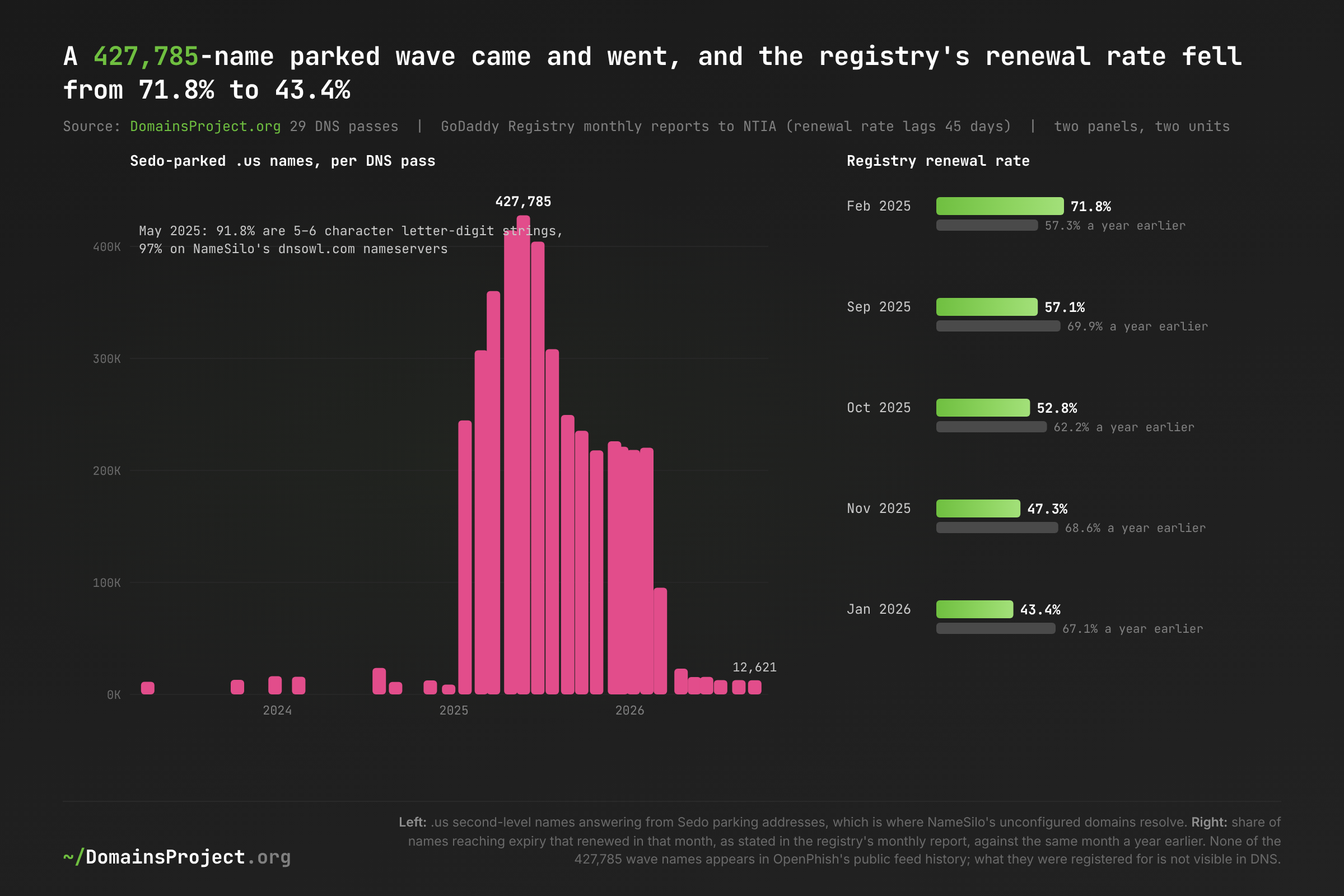
The renewal rate fell from 71.8% to 43.4%. The reports give the share of expiring names that renewed, with a 45-day lag: 71.84% in February 2025, 57.09% in September 2025, 52.75% in October, 47.3% in November and 43.36% in January 2026. In each case the same month a year earlier was between 57% and 70%.
Download: dotus-registry-vs-dns.csv — resolving second-level names per pass by front-door class, and registry names under management (reported and implied)
Our passes show what grew and what left. Sedo-parked .us second-level names numbered 8,734 in December 2024. They rose to 427,785 in May 2025, held near 220,000 from October 2025 to February 2026, then fell to 95,279 in March 2026 and 12,621 by September. Between May 2025 and September 2026, the live websites that are what most people mean by "using .us" went from 653,269 to 675,447.
Download: dotus-wave.csv — Sedo-parked .us second-level names per pass, and the registry's stated renewal rates
The wave had a machine signature. Of the 427,785 names:
- 91.8% are five- or six-character strings mixing letters and digits (
qsku6.us,b1idw.us,f8nvez.us). Only 33,400 are letters only. - Of the 338,863 present in the April 2025 nameserver pass, 96.9% (328,190) used
dnsowl.com, NameSilo's default nameservers. Sedo's parking addresses are where NameSilo's unconfigured names resolve, as Infoblox also observed in 2023. - Our newly-observed-hostname feed saw 311,247 of them, most first seen between February and May 2025. They made up 46.6% of all newly observed
.usnames in March 2025. The feed began in late December 2024, so first sightings are not registration dates. - By September 2026, 417,642 (97.6%) no longer resolved. In March to May 2026, tens of thousands answered from three Linode addresses serving a JavaScript redirect page before disappearing.
- None appears in OpenPhish's public feed history.
We cannot say who registered the wave or why. The mechanics match what Infoblox described in 2023 for "Prolific Puma", a link-shortening service that registered "alphanumeric, pseudo-random" .us names through NameSilo, parked them where "the IP address returned through DNS belongs to SEDO", and aged them for weeks before use (Infoblox; KrebsOnSecurity). But Prolific Puma's names were typically three or four characters, and it registered 35,000 to 75,000 names in total. This wave is several times larger, and none of it was listed for phishing. Many quite different operations can produce random strings at a cheap registrar. Data → inference: the timing is consistent with the wave being most of the registry's 2024–25 growth: registry adds well above 2026 levels through February 2025, and names under management up 21.26% in the year to May 2025. The non-renewal of those names is consistent with the renewal-rate collapse and most of the decline. Implication: the .us contraction of 2025–26 says little about American demand for .us. It mostly reflects one bulk inventory arriving and leaving.
April 2026's spike is not a second wave. The registry reported 159,487 adds that month, 116% more than in April 2025. Our April pass shows 47,479 second-level names resolving for the first time, 43.2% of them on GoDaddy's front door and the rest a wide mix of brand-like names. By September, 12,568 of them were on Afternic (GoDaddy aftermarket) nameservers. Whatever made up the rest of April's adds either did not resolve or did not stay.
Half Parked: The Outgoing Registry's Sibling Holds the Front Door
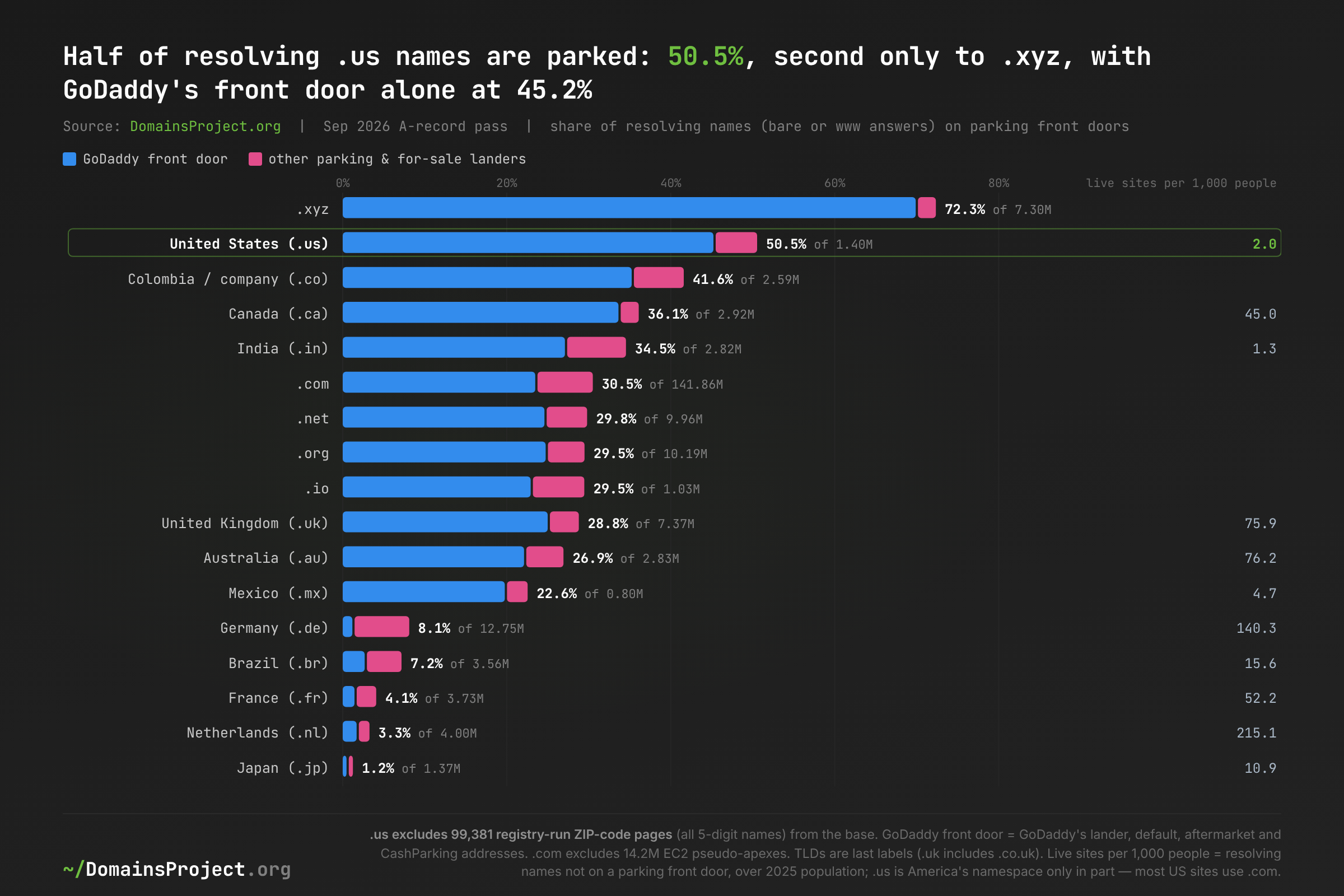
50.5% of resolving .us names are parked, more than any national namespace we compared. Among the TLDs we compared, only .xyz (72.3%) has a higher share, and its bulk-registration waves we have described before. .us is above .co (41.6%), .ca (36.1%), .in (34.5%) and .com (30.5%), and far above .de (8.1%), .fr (4.1%) and .nl (3.3%).
Download: dotus-parked-peers.csv — September 2026 pass; .us excludes the registry's ZIP-code pages; .com excludes EC2 pseudo-apexes; live sites per 1,000 people uses 2025 population estimates
GoDaddy's front door is the single most common thing a .us name answers with. In September 2026 it served 634,705 .us names, 45.2% of all resolving names, against 23.5% in .com. It also grew through the bust (second-level names only): 394,664 in December 2024, 562,254 in May 2025 and 634,683 in September 2026. Within it, the aftermarket "for sale" pages grew most, from 127,168 names in February 2026 to 202,357 in September. That rise is consistent with expiring names moving into GoDaddy's auction and resale inventory as renewal rates fell.
| Nameserver family (delegated second-level names) | Apr 2025 | Sep 2026 |
|---|---|---|
GoDaddy (domaincontrol.com, Afternic, Dan) |
36.1% | 45.7% |
| Cloudflare | 7.9% | 10.8% |
Registry ZIP-code pages (neustar.biz) |
0.4% | 6.4% |
| Namecheap and Spaceship | 3.3% | 5.6% |
| Google Cloud DNS / Squarespace | 3.1% | 3.3% |
NameSilo (dnsowl.com) |
23.0% | 0.4% |
name.com (Identity Digital's registrar) |
0.3% | 0.4% |
| Other | 19.6% | 19.6% |
Default nameservers are a lower bound for each registrar's customers: a GoDaddy customer who moves DNS to Cloudflare counts as Cloudflare. The neustar.biz row grew because in April 2025 most ZIP-code names returned no NS record in our pass.
One corporate family sits on both sides of the market. GoDaddy Registry runs .us until the transition ends. GoDaddy's registrar and aftermarket hold the default nameservers of 45.7% of delegated .us names and the front door of 45.2% of resolving ones. That overlap is what NTIA's draft RFP tried to rule out: it barred any bidder that owns a registrar selling .us. The final RFP replaced the ban with "a carve-out that will allow registry affiliates to operate a .us registrar, subject to certain safeguards" (Domain Name Wire). The incoming operator's own registrar, name.com, is a rounding error in .us at 0.4%. Data → inference: the registry–registrar overlap the safeguards now govern is small — name.com's 0.4% — while the large overlap, GoDaddy's, ends with the transition. Implication: the parked half of .us stays with GoDaddy's registrar after the registry moves, and the new operator's leverage over it is policy (pricing, abuse rules, nexus audits), not ownership.
99,999 ZIP Codes: The Registry's Own Web
The registry answers for nearly every five-digit .us name. Our host-name list holds 99,999 of the 100,000 possible five-digit names, from 00000.us to 99999.us. 99,381 resolved in September 2026, and between 98,192 and 99,989 resolved in every pass from April 2023, apart from one partial dip to 77,569 in April 2026. In September 2026, 89,991 were delegated to ns1/ns2.parkco2.neustar.biz — nameservers in the domain of Neustar, the registry business GoDaddy bought — and answered from AWS addresses in Northern Virginia (us-east-1). The pages serve a site titled "zipcode.us" with "Information on zip codes. Weather, local news, Wikipedia, area officials, area schools, and more!" These are not parked names for sale, and they are not independent websites. They are a registry program, and we count them as their own class.
This changes figures we have published. Our crawl counts them as live websites hosted on AWS us-east-1, so they inflate any "live .us" statistic that does not remove them.
Correction to How Much of the Web Runs on Virginia's Grid?. That post reported that Northern Virginia serves 17.4% of live .us websites, more than for any other TLD in its table. Excluding the ZIP-code pages and the expiring wave names, the figure is 5.5% (38,025 of 687,464). The post's conclusion that Northern Virginia's footprint is weighted to the Americas still holds, but .us no longer stands out. US-hosting shares for .us in our earlier country comparisons are also likely slightly overstated, because 89,991 of these pages sit on a US company in the US.
Data → inference: at 6.4% of delegated names, the ZIP-code program alone outweighs Namecheap's default nameservers (5.6%). Implication: the transition plan will have to say whether Identity Digital runs, rebuilds or retires about 100,000 registry-held names. Any count of the "real" .us web should remove them.
The Locality Tree: The Oldest Part of .us Is the Part That Lasts
The 1990s public-sector namespace is small, old and far more stable than the commercial one. RFC 1480 laid out a hierarchy by state and locality in 1993, and delegated managers — state education departments, library commissions, counties — still run about half of it.
| Locality kind | Resolving Apr 2023 | Resolving Sep 2026 | Host names observed |
|---|---|---|---|
School districts (k12.<state>.us) |
9,006 | 8,797 | 366,900 |
Libraries (lib.<state>.us) |
1,985 | 1,949 | 26,101 |
Cities, counties, towns (<place>.<state>.us) |
1,139 | 1,113 | 237,014* |
Community colleges (cc.<state>.us) |
156 | 135 | 12,540 |
State governments (state.<state>.us) |
46 | 44 | (within the state rows) |
Native sovereign nations (nsn.us) |
17 | 17 | 204 |
*Includes state.<state>.us agency hosts. The library series excludes a wildcard under lib.ms.us that made 1,268 phantom names resolve from July 2024 to August 2025.
About 12,060 locality names resolve, against the registry's 12,534. The registry's count moved from 12,548 in May 2025 to 12,534 in May 2026, with a brief rise to 13,265–13,284 in February–April 2026; the new contract cites 13,265 as of April 2026. Two other things did move. Delegated managers with agreements rose from 112 to 128, and the names the registry manages itself fell from 9,260 to 6,289, consistent with names moving under external delegated-manager agreements.
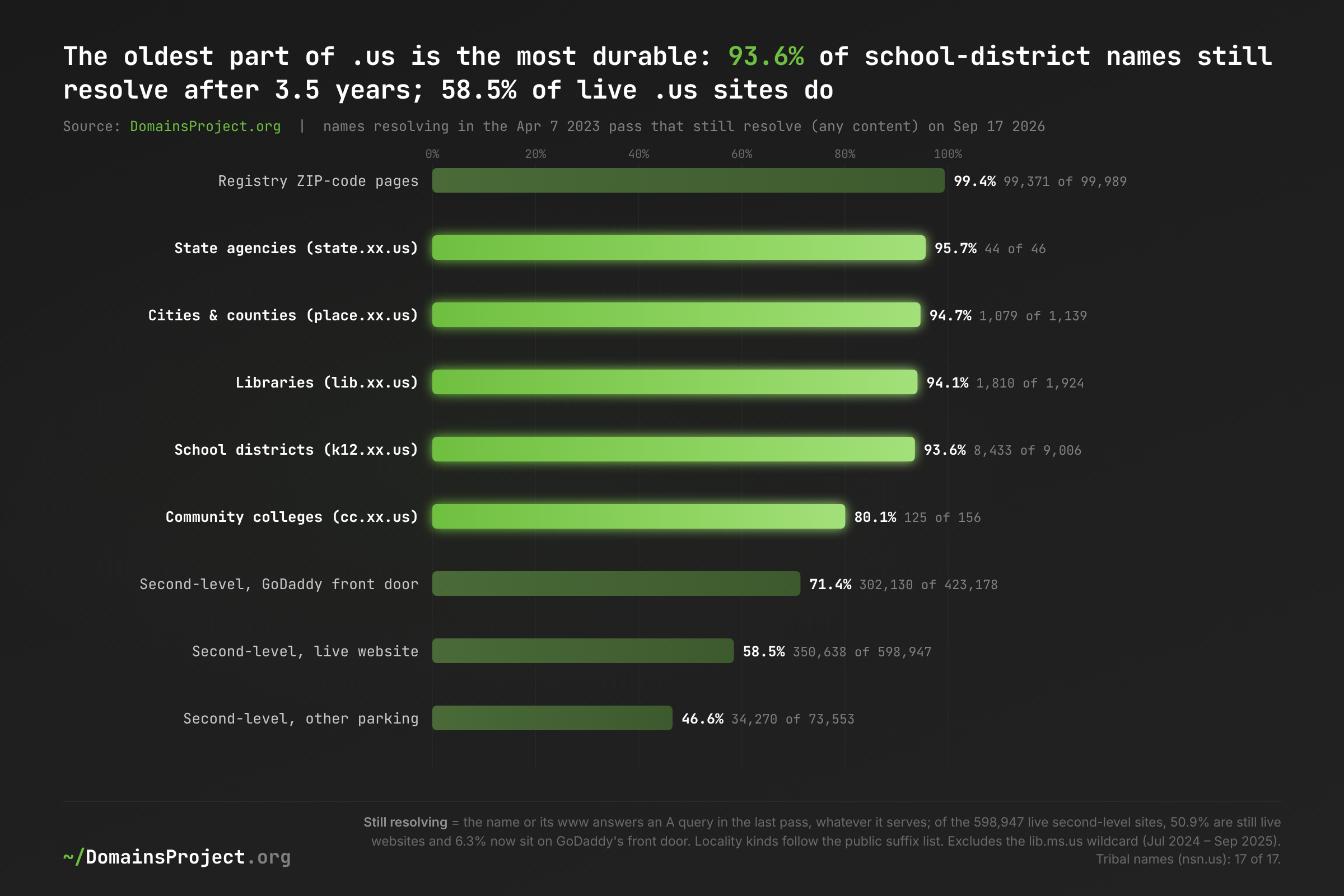
Download: dotus-survival.csv — names resolving on April 7, 2023 and still resolving on September 17, 2026, by kind
3.5 years on, 93.6% of school-district names still resolve. For libraries the figure is 94.1%, for cities and counties 94.7%, and for state agencies 95.7%. Among the 598,947 live second-level websites of April 2023, 58.5% still resolve and only 50.9% are still live websites; another 6.3% now sit on GoDaddy's front door. Parked names on GoDaddy's front door survive better than live sites (71.4%), consistent with portfolio holders renewing inventory that owners of small websites let go.
Many locality bodies already have a .gov, and keep the .us anyway. Of 3,889 place names we have observed in the tree, 2,709 (69.7%) match a .gov registered by a government body in the same place in CISA's list. Among the 1,111 place names that still resolve, the share is 64.1% (712). CISA made .gov free for eligible organisations in April 2021 (Route Fifty), and 9,707 cities and 3,052 counties now hold one. Data → inference: the pattern is consistent with the locality tree being supplemented rather than abandoned. Only 68 place names that resolved in at least one pass have since gone dark, and 53 of those have a .gov. Implication: the new contract's power to rescind non-compliant delegations (§6.22.2.3) touches names that schools, libraries and towns still use for mail and services. A school district's k12 name has a host-name tail (366,900 across the tree) that a domain change would break.
The Live .us Web: Hosted at Home, Fronted by Cloudflare, Often Without Mail
687,464 live .us websites remain once parking, the ZIP-code pages and the expiring wave are removed. Of those, 675,447 are second-level names and 12,017 are in the locality tree.
| Layer | Measure | Share of live .us websites |
|---|---|---|
| Hosting | Hosted in the US, of websites with a location | 73.0% |
| Hosting | Answering from an anycast edge | 38.2% (Cloudflare alone 26.8%) |
| Hosting | US-headquartered hosting operator | 79.2% |
| Hosting | Largest metros | Phoenix 5.7%, Northern Virginia 5.5%, Atlanta 3.9% |
| No MX record | 39.7% | |
| Largest operators | self-run 11.4%, Google Workspace 8.6%, Namecheap 6.6%, Microsoft 365 4.7% | |
| US-headquartered, of mail-capable sites | 72.0% | |
| DNS | Largest operators | Cloudflare 18.2%, GoDaddy 9.7%, Namecheap 8.7%, Google Cloud DNS 6.3% |
| DNS | US-headquartered operator | 60.0% |
Full table: dotus-live-stack.csv. Operator HQ follows the operating group; anycast edges are not assigned a location.
.us behaves like an American small-business namespace. Its live web is mostly American-hosted and American-operated, and two in five of its websites publish no MX record. That is consistent with a namespace of personal projects, side businesses and redirects more than corporate mail domains. Across all 1,561,163 .us names in the August 2026 mail pass, 40.4% (630,320) had working MX records. The top MX target is GoDaddy, consistent with default mail records that come with its parked names. Data → inference: the nexus rule asks whether registrants are American. Most of the live web also runs on American infrastructure, but that is a fact about infrastructure, not about registrants. Implication: our data can show where .us sites live. It cannot show who owns them, which is what the audit must establish.
Phishing: Above .com, Far Above Other Country Codes
Between July 2025 and November 26, 2026, OpenPhish's public feed listed 429 .us domains: 2.85 per 10,000 resolving names. That is 2.3 times .com (1.25), 1.4 times the all-TLD rate (2.02), and 9–12 times .de (0.33), .ca (0.24) and .uk (0.24). It is below the cheap namespaces that draw bulk abuse: .cc (26.94), .top (14.78), .shop (6.37), .cn (4.69) and .xyz (4.49).
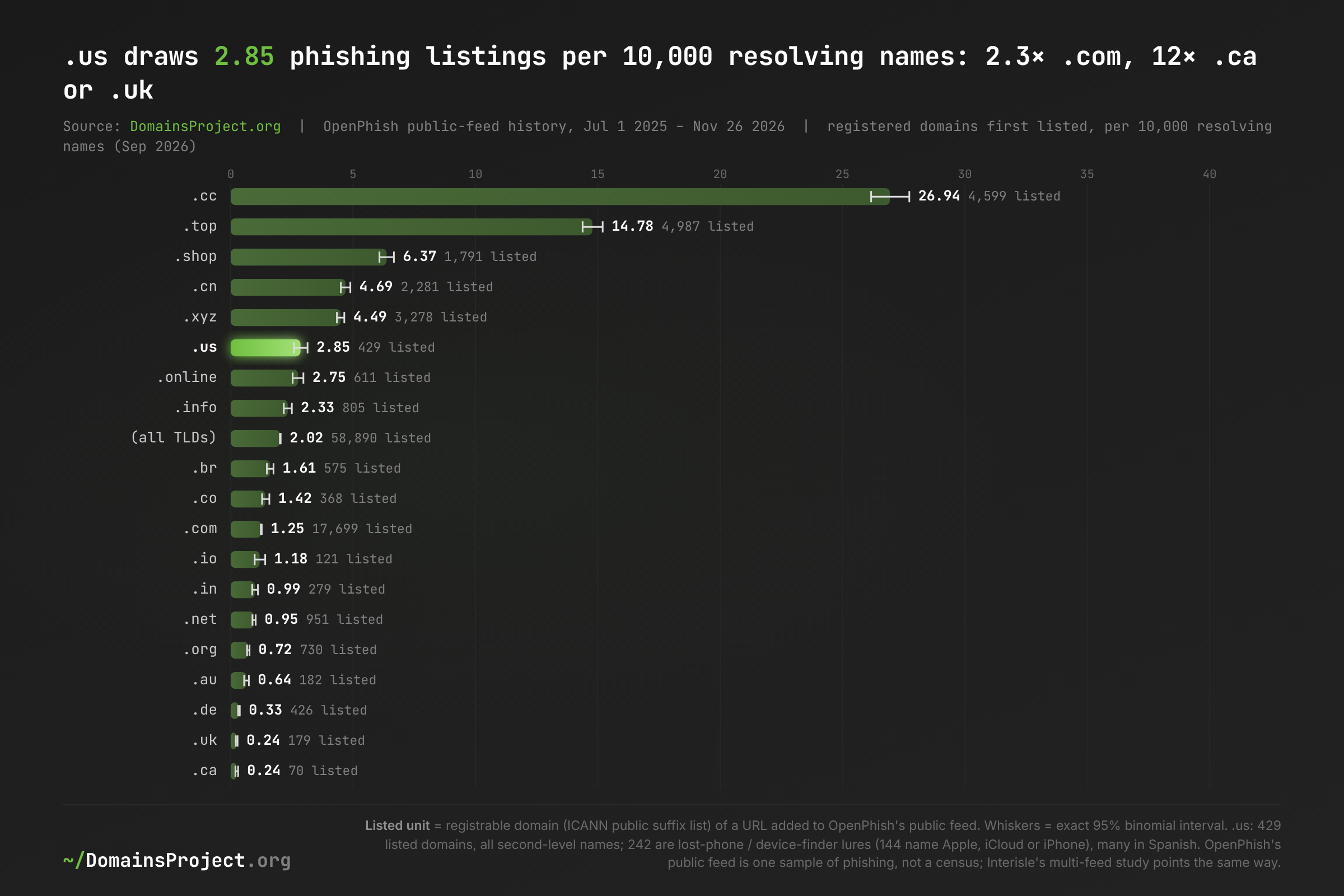
Download: dotus-phishing.csv — OpenPhish public feed, Jul 1 2025 – Nov 26 2026; registered domains first listed, per 10,000 names resolving in September 2026; exact 95% binomial intervals
Lure theme (.us listings) |
Domains | Share |
|---|---|---|
| Lost-phone / device-finder (144 name Apple, iCloud or iPhone) | 242 | 56.4% |
| Unbranded or other | 132 | 30.8% |
| Brokerage, bank or crypto wallet (Schwab, Ledger, Coinbase look-alikes) | 30 | 7.0% |
| Meta, Instagram, WhatsApp | 14 | 3.3% |
| Tax, postal, tolls, settlements (IRS, USPS) | 6 | 1.4% |
Zoom look-alikes (us02-web-zoom.us) |
5 | 1.2% |
.us phishing is a lost-iPhone business, and much of it speaks Spanish. The lost-phone names (encontrar-i-phone.us, localizar-icloud-apagado.us, lcloud-mex-loginmaps.us) fit the iCloud-unlock scheme, in which the owner of a lost or stolen iPhone gets a fake "device found" message asking for the Apple ID that would let the thief unlock it. At least 72 of the 242 carry Spanish words or Mexican and Colombian markers. They peaked in June 2026, when 85 of the month's 105 .us listings were device-finder lures. The five Zoom look-alikes copy the pattern of Zoom's own .us host names (us02web.zoom.us). All 429 listings are second-level names; none is in the locality tree.
Interisle's multi-feed studies point the same way, and show a decline. Interisle counted about 30,000 .us phishing domains between May 2022 and April 2023 (KrebsOnSecurity). For May 2024 to April 2025 it counted 8,067, of which 5,972 (74%) were registered by the phishers themselves, putting .us among the ccTLDs with the highest share of malicious registrations (Interisle, Phishing Landscape 2025). Against the registry's 2.10–2.55 million names over that period, that is roughly 32–38 phishing domains per 10,000. Interisle's averages are 14.0 for ccTLDs and 29.2 for .com/.net. Data → inference: two independent sources put .us above .com and well above other country codes, while the counts fell after 2023. Implication: registrations by phishers, not compromised sites, are the problem the new contract's abuse clauses must address. The nexus rule as practised has not prevented them. In 2023 Krebs described the nexus check as "little more than an affirmative response that is already pre-selected for all new registrants".
The registry's own nexus checks report high pass rates. Its spot checks reviewed 8,022 names in May 2026 with 99.21% passing a "primary investigation". The figure was 96.11% of 1,543 in April and 91.72% in December 2025. A primary investigation that passes 99% of names, in a namespace where phishers register thousands of names a year, is consistent with checks that confirm a declaration rather than verify an identity.
What the New Contract Asks For, Against What We Measured
| Contract requirement | Baseline the new operator inherits |
|---|---|
| Initial audit of the registrant database for nexus gaps (§6.18) | 1.9M names; registry spot checks pass 91.7–99.9% of names; 5,972 maliciously registered phishing names in Interisle's last year |
| Prohibition of proxy and anonymous services (§6.23.3) | Proxy use was found despite the ban in 2023 (nearly 2,000 Prolific Puma names, per Infoblox); not measurable in DNS |
| DNS-abuse policy (§6.19) | 2.85 OpenPhish listings per 10,000 resolving names; 56% lost-phone lures |
| Re-accreditation of all 256 registrars | GoDaddy holds the default nameservers of 45.7% of delegated names; NameSilo fell from 23.0% to 0.4% after its wave expired |
| Service and oversight of the locality tree; power to rescind delegations (§6.22) | 12,060 resolving locality names, 93.6–95.7% survival; 128 delegated managers; 69.7% of place names also have a .gov |
| Direct service of undelegated locality names (§6.22.3) | 6,289 names managed by the registry as delegated manager (May 2026) |
Revive kids.us (§6.31) |
6 host names observed under kids.us in our dataset |
| Fee overview, including possible "price floor" or "marketing incentives" (§7.0) | A bulk wave of 427,785 names, then a renewal rate of 43.4% |
Three scenarios for the first year of the new operator. We cannot assign them probabilities.
- Base case: the post-wave pattern continues. The live web stays near 675,000 second-level websites, as it has since mid-2025. Names under management drift towards the resolving base, and the parked share edges down as GoDaddy's aftermarket inventory clears.
- Audit shock: the nexus audit and re-accreditation remove names whose registrants cannot show a US connection. Names under management fall faster than the live web, which is mostly American-hosted. The parked share and the phishing rate both fall.
- Price-led rebound: marketing incentives or promotional pricing bring another bulk wave. Names under management rise again while the live web does not. A repeat of 2025's 43% renewal rate would follow a year later.
What's at Stake
- Half of resolving
.usnames are parked (50.5%) — the namespace's reputation, and its value to legitimate small businesses, depends on a stock of names that do nothing, and most of it is held by one registrar family that will no longer run the registry. - The 2025–26 contraction was mostly one wave — 417,642 of 427,785 bulk names stopped resolving while the live web grew slightly. Reading the registry's decline as falling American demand would misstate what happened.
- About 100,000 registry-held ZIP-code pages — a registry program inside the namespace, at 6.4% of delegated names, that must either migrate cleanly or be retired. Until then it distorts any hosting or "live site" statistic for
.us. - The locality tree is durable infrastructure — 8,797 school-district names still resolve, with 366,900 host names under them. A rescinded delegation or a botched migration would break mail and services for public bodies that have used these names for decades.
- Phishing at 2.3 times
.com's rate — the nexus rule has not kept.usout of lost-phone and brokerage phishing kits, and 74% of.usphishing domains in Interisle's latest study were registered by the phishers. - Registrant data cannot be sampled at scale — the registry's RDAP and WHOIS stopped answering us after about a hundred queries. Outside researchers cannot check the nexus rule that the contract makes central.
What Would Help
1. NTIA: publish the nexus audit's results, not just its existence. The contract orders an initial audit of the registrant database. Publish its sample size, its failure rate by registrar and its outcomes (corrected, suspended, deleted). Today the only public measure is a "primary investigation" that passes up to 99.85% of names in a namespace with 5,972 maliciously registered phishing names in a year.
2. Identity Digital: decide the fate of the ZIP-code pages in public. About 100,000 five-digit names are delegated to the outgoing operator's parking nameservers and served from AWS us-east-1. Announce whether they will be kept, released or retired, and on what timetable. If they are released, a sudden supply of five-digit names will draw speculators and phishers alike.
3. Registrars: treat bulk random-string orders as a signal. The 2025 wave was 427,785 names, 91.8% of them five- or six-character letter-digit strings on a single registrar's default nameservers. Whatever its purpose, an order book like that is detectable at registration. Re-accreditation is the moment to require velocity checks for .us.
4. School districts, libraries and towns: inventory what hangs off your .us name. Our data shows 366,900 host names under k12 alone. Before the new operator reviews delegated managers, list the mail, single sign-on and service records under your locality name. If you already hold a .gov (69.7% of place names do), plan any move deliberately. Free registration does not cover the cost of migrating.
5. Security teams: weight .us above .com, and watch the lost-phone lures. .us names were listed by OpenPhish at 2.85 per 10,000 resolving names, 2.3 times .com, and 56% of those listings were lost-phone or device-finder lures. Newly registered .us names using "find", "locate", "encontrar" or "dispositivo" vocabulary deserve the same scrutiny as cheap new gTLDs. Our stats page for .us and the dataset give the full name list for matching.
Methodology: 16,147,866 .us host names from the DomainsProject dataset (November 2026); 29 A-record passes from April 7, 2023 to September 17, 2026, classified by front door; nameserver passes of April 2025 and September 2026; 11 mail passes from April 2025 to August 2026; a per-domain hosting, mail and DNS stack for 687,464 live .us websites from the September 2026 crawl; OpenPhish public-feed history from July 1, 2025 to November 26, 2026; CISA's .gov list; the .us registry operator's monthly reports to NTIA for May 2025, December 2025, and January, February, April and May 2026; and the NTIA contract of September 30, 2026. Earlier context: The Parking Lot, Leaving America? and Who Runs the World's DNS. Per-TLD figures are on our TLD statistics dashboard; the full dataset is described on the dataset page.