In 2024 the government of Tuvalu took in A$11.2 million from the .tv domain. That is 13.1% of the country's GDP and 15.9% of all the revenue it raised itself, leaving aside foreign grants. It is 77% as much as all the taxes Tuvalu levies put together. Spread over the 10,632 people counted in the 2022 census, it comes to about A$1,050 each (IMF Country Report 25/257, Table 2a).
The story usually told about .tv is a story about demand. Tuvalu happened to be assigned the two letters that stand for television. Video moved online, streamers on twitch.tv came to draw more than 100 million viewers a month (ABC Pacific Beat), and a country of nine islands, none higher than 4.6 metres, got rich on the coincidence. When GoDaddy Registry replaced Verisign as operator at the end of 2022, the figure that took hold, on Wikipedia among other places, was that payments to Tuvalu had doubled to US$10 million a year. Our own March post on island country codes repeated it.
Tuvalu's government publishes the number every year in its budget, so the story can be checked. We rebuilt Tuvalu's .tv receipts for every year from 2005 to 2024 from 17 Tuvalu budget documents (2009–2025) and three IMF Article IV reports, then set them against what the namespace itself did:
- every
.tvname in our dataset: 2,519,675 host names under 607,023 registered names; - 29 DNS passes from April 2023 to September 2026, recording what each resolving
.tvname answers with; - nameserver passes from April 2025, April 2026 and September 2026;
- newly observed
.tvnames from our daily feed, December 2024 to September 2026; - 17 months of OpenPhish's public phishing feed.
The headline: Tuvalu's .tv income nearly doubled between 2022 and 2024 while the namespace stood still.
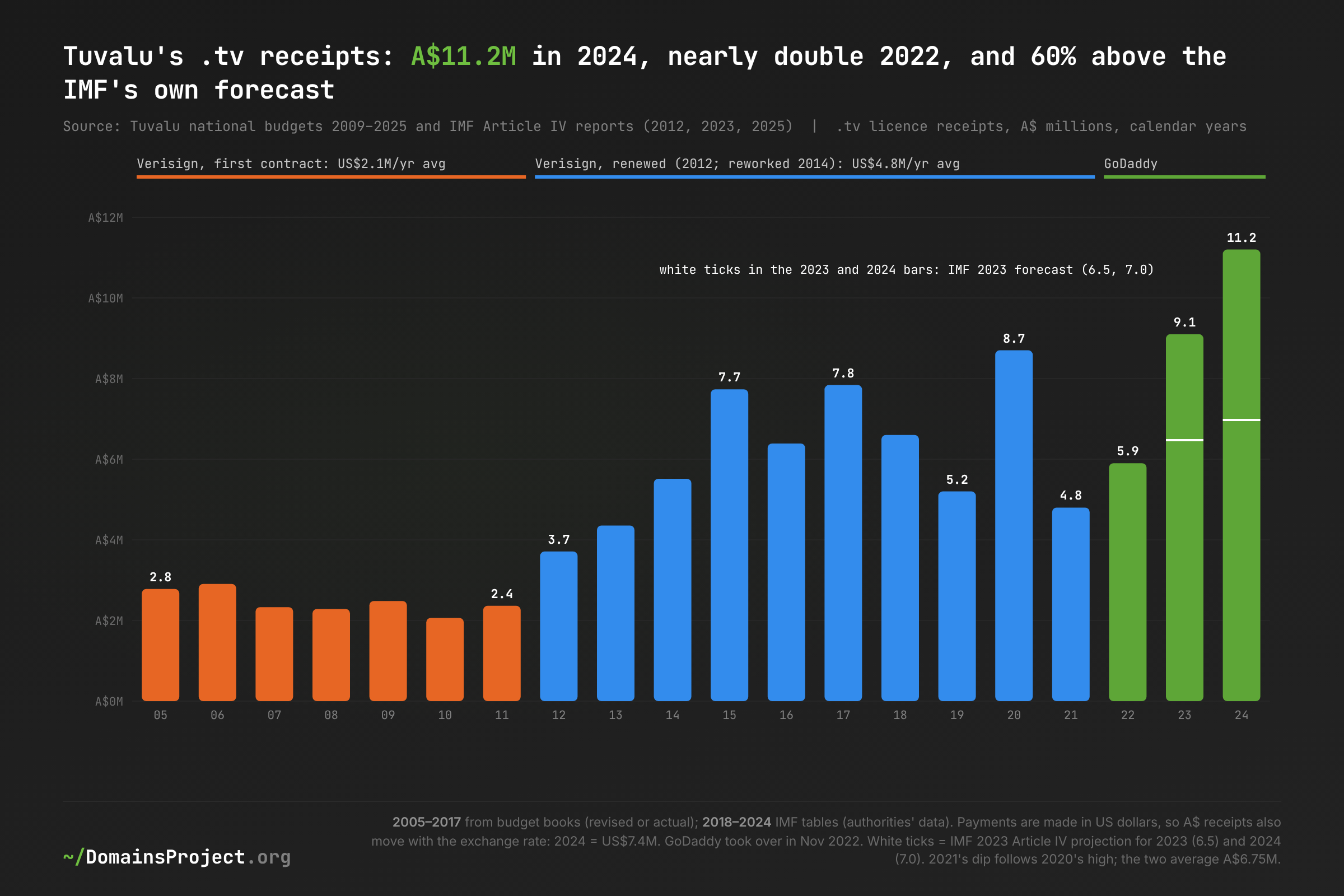
- Receipts went from A$5.9M (2022) to A$9.1M (2023) to A$11.2M (2024). In US dollars, the currency the registry pays in, that is US$4.1M to US$7.4M. The budget books put the rise down to the switch to GoDaddy. The IMF had forecast A$7.0M for 2024, and that
.tvfees would shrink "given the increasing use of other internet domains". - No year on record reaches US$10 million. The 2024 peak is US$7.4M. Verisign's renewed contract paid about US$5.0M a year from 2015 to 2021. Across 2005–2024 the documented total is A$104.3M, about US$80M.
- The number of names did not grow. 298,344
.tvnames resolved in April 2023 and 298,195 in September 2026. In the last 15 months, with our crawl coverage steady, the count rose 1.4%, while.aidoubled and.iogrew by a third. - It is a replacement market. 37.8% of the names resolving in April 2023 no longer resolve. In the last year 46,959 names (15.9%) dropped out and 50,436 came in. The fastest-growing group is short letter-and-digit strings, many of them on Chinese DNS providers.
- Each name is now worth more to Tuvalu. Depending on how many
.tvnames are actually registered, the 2024 receipts come to US$9–25 per name. A standard.tvrenewal costs about US$26 at retail. The contract terms that would explain this have never been published.
Download: tuvalu-tv-receipts.csv: A$ and US$ by year, contract era, basis (revised, actual or IMF) and the budget book or IMF table each figure comes from
The Data
| Source | What it measures | Scope |
|---|---|---|
| Tuvalu national budget books, 2009–2025 (15 books plus the 2025–26 budget speech and citizen guide, finance.gov.tv) | .tv receipts by year (".TV Marketing Agreement", later "Commercial Contracts"), commentary on contract changes, government-funded marketing |
Calendar years 2005–2023, FY 2024/25 and 2025/26 budgets |
| IMF Article IV reports 2012, 2023, 2025 (Country Reports 12/259, 23/267, 25/257) | "License fees for .TV domain" next to total revenue, fishing licences, grants and GDP; IMF projections |
2008–2011, 2018–2024 outturns; projections to 2030 |
| ECB euro reference rates, annual averages | US dollars per Australian dollar | 2005–2025 |
DomainsProject dataset, .tv file (Nov 2026) |
Every observed host name under .tv |
2,519,675 host names; 607,023 registered names |
| 29 A-record passes, Apr 7 2023 – Sep 17 2026 | What each resolving name answers with: a live website, GoDaddy's front door, another parking operator, a sinkhole | 489,101 distinct .tv names resolving at least once; 298,195 in Sep 2026 |
| Nameserver passes, Apr 10 2025, Apr 17 2026, Sep 2026 | Nameserver operator of each delegated name | 283,327 / 300,184 / 284,470 delegated names |
| Newly observed host names, Dec 24 2024 – Sep 27 2026 | First sighting of each registered name in our daily feed | 202,157 .tv names; 111,895 not seen resolving in any earlier pass |
| OpenPhish public feed history (git), Jul 1 2025 – Nov 26 2026 | First listing of each registered domain | 58,890 registered domains; 9 under .tv |
| Press and third-party reporting | Contract dates, rebid, retail prices, registration estimates | Domain Name Wire, Domain Incite, The Register, ABC, NamePros/DomainNameStat |
Tuvalu's government does not publish the registry's figures, and GoDaddy Registry does not publish a .tv registration count. The money is therefore the best-documented number in this post, and the registration total is the least. Our DNS passes sit in between: they count every .tv name that answers, and they cannot see registered names that don't. Russian-territorial TLDs are excluded from every cross-TLD comparison.
Methodology
Definitions.
- Receipts: what the government of Tuvalu records as income from the
.tvagreement in a calendar year. The budget line was ".TV Marketing Agreement" until 2021. After that it sits under "Commercial Contracts", which also holds upper-airspace fees (A$40,000 budgeted for 2024). The IMF tables call it "License fees for.TVdomain". - Basis: revised means the budget book's revised estimate for a year that had just ended. Preliminary and actual are the book's own labels. IMF means the outturn printed in an Article IV table, which the IMF attributes to the country authorities.
- Contract eras: Verisign, first contract (2005–2011, the years we have, under the agreement Verisign took over when it bought dotTV in 2001); Verisign, renewed (2012–2021: renewed in 2012, reworked in 2014); GoDaddy Registry (2022 onward; GoDaddy completed the migration in November 2022).
- Domestic revenue: total government revenue minus grants.
- Registered name: a name directly under
.tv(example.tv)..tvhas no public second-level structure. - Resolving: the bare name or its
wwwreturns an A record in that pass. The passes record successful answers only, so a name absent from a pass either did not resolve or was not crawled that month. - GoDaddy front door: the addresses GoDaddy uses for its default "coming soon" pages, its parked landers, its aftermarket ("this domain is for sale") pages and its CashParking product.
- Other parking: the addresses of 17 other parking and for-sale operators, including Sedo, Bodis, Above, Team Internet, Dynadot and HugeDomains.
- Live website: a resolving name that is neither on a parking front door nor sinkholed.
- Left / arrived: a name that resolves in the earlier of two passes and not the later one has left. A name that resolves only in the later one has arrived.
- Chinese DNS providers: nameservers at Alibaba Cloud (
alidns.com,hichina.com), Gname (share-dns.com,gname-dns.com), Xundns (xundns.com), Tencent DNSPod (dnspod) and DNS.com. - Per-name receipts: a year's receipts in US dollars divided by a count of registered names. We show several counts, because the true one is not published.
Classification heuristics.
- Lexical classes are rules on the label, applied in order, first match wins: IDN (
xn--); all digits; short letter-and-digit strings (2–6 characters with at least one of each); adult, gambling and faith keywords; video, streaming and broadcast vocabulary (tv,live,stream,iptv,film,sport,game,media,newsand similar); everything else. Substring rules over-match:betalso catchesalphabet-style words. These counts show composition, not intent. - Front-door classes come from our registry of parking and lander addresses, built by auditing the most-used addresses in each pass. Any lander missing from it counts as "live", so live counts are upper bounds.
- Revenue series. Where a later book revises an earlier figure, we use the later one. Where an IMF outturn exists (2018–2024), we use it. Budget and IMF figures agree to within A$0.1M where both exist (2008–2011, 2018, 2019, 2022, 2023). For 2020 and 2021 the IMF's A$8.7M and A$4.8M differ from the budget's partial-year figure for 2020 (A$7.1M to October) and its estimate for 2021 (A$8.2M). The two years average A$6.75M (about US$4.8M), in line with the US$5M a year the contract was reported to pay.
- Currency. The registry pays in US dollars ("foreign exchange gains on dot TV revenue", 2021 budget). We convert with annual averages of ECB reference rates (US$ per € divided by A$ per €). The budget books' own conversions agree: A$6.3M = US$4.5M for 2016, A$7.0M = US$5.5M for 2017.
Dataset scope.
- The 29 passes are roughly monthly from November 2024, and one to six months apart before that.
- Our crawl list barely grew during 2024. Each 2024 pass added only 460–1,300
.tvnames it had never seen resolve before, even the July pass that came five months after the one before it. Passes in 2025 added 2,200–12,300 each. Names registered in 2024 entered the list in January 2025, when the newly-observed-names feed began feeding it (34,620 first-seen names in one pass). The 2024 dip from 298,344 to 241,122 and the January 2025 jump are therefore mostly coverage, and the same step shows up in every TLD we track. For trends we use the April 2023 and September 2026 endpoints, the 15 months from June 2025 when coverage was steady, and fixed cohorts. - Newly observed names are deduplicated against the 29 passes: a name counts as new only if it never resolved in a pass before its first sighting. Before July 2025 the series still includes 2024 registrations reaching the list late.
Known limitations.
- No registration count. Neither the government nor the registry publishes how many
.tvnames exist. Registered names that are not delegated, or that answer on neither the bare name norwww, do not appear in our passes. Every per-name figure here is a range. - The contract is confidential. We can observe receipts, not the terms that produce them. A revenue share, a guaranteed minimum, premium-name income and marketing contributions would all show up in the budget as the same line.
- Budget figures are not audited accounts. "Revised" and "preliminary" figures are estimates made weeks after a year closed. Tuvalu also changed its fiscal year from January–December to July–June in 2024, so the newest figures (FY 2024/25) are not comparable month for month with the calendar series.
- One budget table contradicts the rest. The 2024 half-year budget prints "Dot TV Marketing Agreement" values of A$1.58M and A$1.65M for "2021 Actual" and "2022 Actual". They look like half-year amounts and clash with the full-year figures elsewhere (A$5.9M for 2022), so we do not use them.
- Nameservers stand in for registrars. Registrar data needs registry WHOIS/RDAP, which we did not sample. The nameserver passes also have a known pass-level artifact in which large numbers of names return no NS record; we use them only for operator shares.
- One phishing source. OpenPhish's public feed is one sample of phishing, not a census.
Dataset vs external counts. The dataset's 607,023 registered .tv names include every name we have ever observed, expired ones among them. 489,101 resolved in at least one pass, and about 298,000 resolve at any one time. Press reports put the namespace at about 500,000 names in 2021 (The Register; Domain Name Wire). A NamePros analysis citing DomainNameStat gives 784,120 in October 2025 and "just over 394,000" in early 2024. We test that doubling below.
Correction to our earlier post. Our March post on island country codes said .tv "generates an estimated $10 million per year" and put Tuvalu's cumulative take at an estimated $127 million, assuming US$10M a year from 2022. Tuvalu's budget books and the IMF's tables show no year at US$10M: the 2024 peak is US$7.4M, and 2022–2024 together came to US$17.5M. The documented 2005–2024 total is about US$80M; the sources we used do not cover 2000–2004. The figures in this post supersede those.
Reproducibility. Every chart links its CSV. The 29-pass series is in tuvalu-tv-series.csv, and the lexical classes with their 12-month flows are in tuvalu-tv-lexical.csv. The budget books are public at finance.gov.tv; the IMF reports at imf.org (the 2025 report is also on adb.org). OpenPhish's feed history is the public openphish/public_feed repository. Per-TLD resolution counts are on the .tv statistics page and the full name list is part of the dataset.
The Scorecard
| Measure | Value | Context |
|---|---|---|
.tv receipts, 2024 |
A$11.2M (US$7.4M) | A$5.9M in 2022, A$9.1M in 2023 |
| Share of GDP, 2024 | 13.1% | 7.5% in 2022 |
| Share of domestic revenue (excluding grants), 2024 | 15.9% | 9.2% in 2022 |
.tv receipts as a share of all tax revenue, 2024 |
77.2% | Taxes: A$14.5M |
| Receipts per resident, 2024 | A$1,053 (US$695) | 2022 census population 10,632 |
| IMF's 2023 forecast for 2024 | A$7.0M | Outturn 60% higher |
| Documented total, 2005–2024 | A$104.3M (US$79.8M) | Payments for 2000–2004 not in these sources |
Resolving .tv names, Apr 2023 → Sep 2026 |
298,344 → 298,195 | +1.4% in the last 15 months; .ai +110%, .io +32% |
| Names resolving in Apr 2023 that still resolve | 62.2% | 112,789 gone; 112,640 arrivals since |
| Annual turnover, Sep 2025 → Sep 2026 | 15.9% left, 50,436 arrived | Net +3,477 |
| Resolving names parked or for sale | 30.9% | 24.6% on GoDaddy's own front door |
GoDaddy's share of delegated .tv nameservers |
27.3% | GoDaddy is also the registry |
| Receipts per registered name, 2024 | US$9–25 | Standard retail renewal about US$26 |
| OpenPhish listings per 10,000 resolving names | 0.30 | .com 1.25; all TLDs 2.02 |
The numbers point in two directions at once. Tuvalu's dependence on .tv has never been higher: one line of the budget is worth 13% of GDP. Yet the namespace that produces it is no bigger than three years ago, and it replaces about a sixth of itself every year. The budget books attribute the gain since 2022 to the new contract, and a flat namespace with unchanged standard prices leaves little else to explain it. The rest of this post looks at each half.
Three Contracts: What Each One Paid
| Era | Years on record | Average receipts | In US$ | What is public about the terms |
|---|---|---|---|---|
| Verisign, first contract | 2005–2011 | A$2.46M | US$2.07M | Quarterly payments cut "from $1 million to $550,000" after Verisign bought dotTV in 2001, i.e. US$2.2M a year (Wikipedia, citing The Domains and Island Studies Journal) |
| Verisign, renewed | 2012–2021 | A$6.08M | US$4.77M | Renewed Feb 2012 to Dec 2021, terms undisclosed. Reworked in 2014: "US$4.5 million per annum", plus "approximately US$500,000 in addition revenue while subscriptions are maintained above the agreed level" (2015 budget) |
| GoDaddy Registry | 2022–2024 | A$8.73M | US$5.84M | Selected Dec 2021 after a closed rebid that Verisign "declined to participate in"; signed March 30, 2022; "terms have not been disclosed" (Domain Incite). The 2022 budget adds A$2.0M of .tv marketing support whose "cost will be absorbed by the government based on the new contract arrangement" |
Each contract stepped the payment up, and none of the steps tracks the namespace. The 2005–2011 receipts hardly move: A$2.1M to A$2.9M, or US$1.9M to US$2.4M, close to the US$2.2M a year the renegotiated quarterly payments imply. The renewed Verisign deal more than doubled the payment, and the 2015 budget book shows its structure: a fixed US$4.5M plus a bonus of about US$0.5M "while subscriptions are maintained above the agreed level". That reads as a fixed fee with a volume bonus rather than a share of sales. The 2018–2021 figures (A$6.6M, 5.2M, 8.7M, 4.8M) bounce around that level. The budget books say nothing about why 2020 was high and 2021 low. The two years average A$6.75M, about US$4.8M.
Under GoDaddy, receipts have risen every year so far. They were A$5.9M in the transition year 2022 (US$4.1M), A$9.1M in 2023 (US$6.0M) and A$11.2M in 2024 (US$7.4M). The 2024–25 budget gives the reason in so many words: the increase "is a result of the successful transition of Tuvalu's ccTLD dotTV to a new registry service provider, GoDaddy, in late 2022", which "led to higher quarterly receipts in 2023". The exchange rate explains little of it: the Australian dollar averaged US$0.694 in 2022 and US$0.660 in 2024, which accounts for about 5 points of the 90% rise in A$ terms.
The new deal also moved some cost onto Tuvalu. Under Verisign, the operator "operated and marketed the domain". The 2022 budget instead set aside A$2,000,400 for "DoT TV Marketing Support", absorbed by the government "based on the new contract arrangement". Later budgets show that money spent slowly: A$660,738 was still unspent and rolled over into 2023, and A$10,738 remained by mid-2024. GoDaddy Registry runs its own campaign, TurnOn.tv, and a 2023 agreement gave .tv marketing to a ".tv Unit" at Tuvalu Telecommunications Corporation (Wikipedia, citing Tuvalu's foreign ministry). Even after subtracting the whole A$2.0M marketing budget, 2024's receipts (A$9.2M) were above any year under Verisign.
The forecast that missed
The IMF's 2023 Article IV report projected .tv fees of A$6.5M for 2023 and A$7.0M for 2024. It wrote that they "are projected to fall to 5 percent of GDP given the increasing use of other internet domains" (IMF Country Report 23/267, Table 3 and the medium-term assumptions). The outturns were A$9.1M and A$11.2M, 40% and 60% above the projections, and in 2024 the fees reached 13.1% of GDP against the 5% the report expected in the medium term. The 2025 report now projects A$10.1M for 2025, rising to A$13.1M by 2030.
The forecast treated .tv as a market product that would lose share. It behaved like a contract. Our passes start in April 2023, and from then on the number of .tv names in use did not move, as the next sections show. What changed was the payment formula.
How Much of Tuvalu Runs on Two Letters
| Revenue source, 2024 | A$ millions | % of GDP |
|---|---|---|
| Fishing licence fees | 38.1 | 44.6% |
| Grants (budget support) | 23.8 | 27.8% |
| All taxes (income, company, consumption and others) | 14.5 | 17.0% |
.tv licence fees |
11.2 | 13.1% |
| Other non-tax revenue | 6.6 | 7.7% |
| Total revenue | 94.2 | 110.2% |
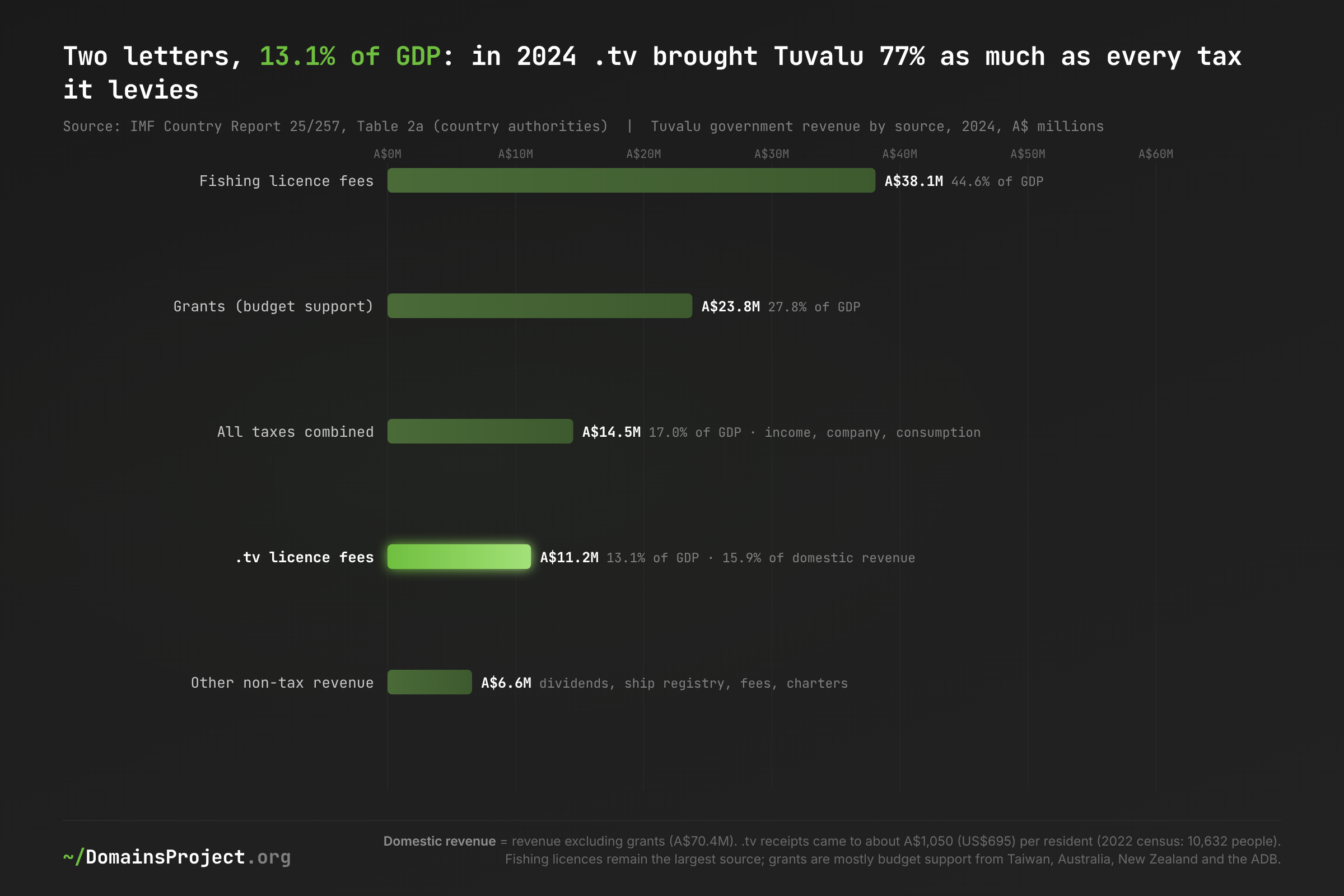
Download: tuvalu-tv-budget.csv: IMF Country Report 25/257, Table 2a, calendar 2024; total revenue includes grants, so shares of GDP exceed 100%
Tuvalu's government spends more than its whole economy produces, and most of the money comes from outside the economy. Fishing licences are sold to foreign fleets, grants come from Taiwan, Australia, New Zealand and the ADB, and .tv is paid by an American registry. .tv is the smallest of the three, but in one sense the steadiest. Fishing receipts swing with El Niño and the price of vessel days: A$51.4M in 2018 and A$38.1M in 2019 (IMF, 2023 report), A$43.8M in 2023 and A$38.1M in 2024 (IMF, 2025 report). Grants swing with donors. Under GoDaddy, .tv has gone in one direction so far.
.tv's weight in the budget rose by three-quarters in two years. It was 9.2% of domestic revenue in 2022, 11.9% in 2023 and 15.9% in 2024. For a government of about 10,600 people, A$11.2M pays for a great deal. In fiscal 2024/25 the government spent an estimated A$6.6M on scholarships and A$11.7M on its overseas medical treatment scheme (IMF, Table 2b).
The 2025–26 budget lists a one-off on top. Under "Potential Revenue Estimates ... subject to negotiation outcomes and foreign government decisions", the citizen budget guide lists a "Premium Sale DotTV" of A$11.0M. That is a full year's receipts from a single sale, presumably of premium or reserved names. Nothing more about it has been published.
The Namespace: Flat While the Money Doubled
| Resolving second-level names | Apr 2023 | Jun 2025 | Sep 2026 | Jun 2025 → Sep 2026 |
|---|---|---|---|---|
Tonga (.to) |
23,342 | 20,846 | 49,252 | +136.3% |
Anguilla (.ai) |
89,721 | 525,649 | 1,102,547 | +109.7% |
Cocos Islands (.cc) |
443,699 | 1,104,684 | 1,706,917 | +54.5% |
Chagos / BIOT (.io) |
523,975 | 779,404 | 1,028,221 | +31.9% |
Samoa (.ws) |
95,115 | 125,806 | 162,627 | +29.3% |
Montenegro (.me) |
655,942 | 772,097 | 884,320 | +14.5% |
Micronesia (.fm) |
14,225 | 14,503 | 16,527 | +14.0% |
Colombia (.co) |
1,784,488 | 2,455,064 | 2,585,636 | +5.3% |
Tuvalu (.tv) |
298,344 | 294,055 | 298,195 | +1.4% |
Niue (.nu) |
194,874 | 166,403 | 157,940 | −5.1% |
United States (.us) |
1,208,250 | 1,826,095 | 1,503,483 | −17.7% |
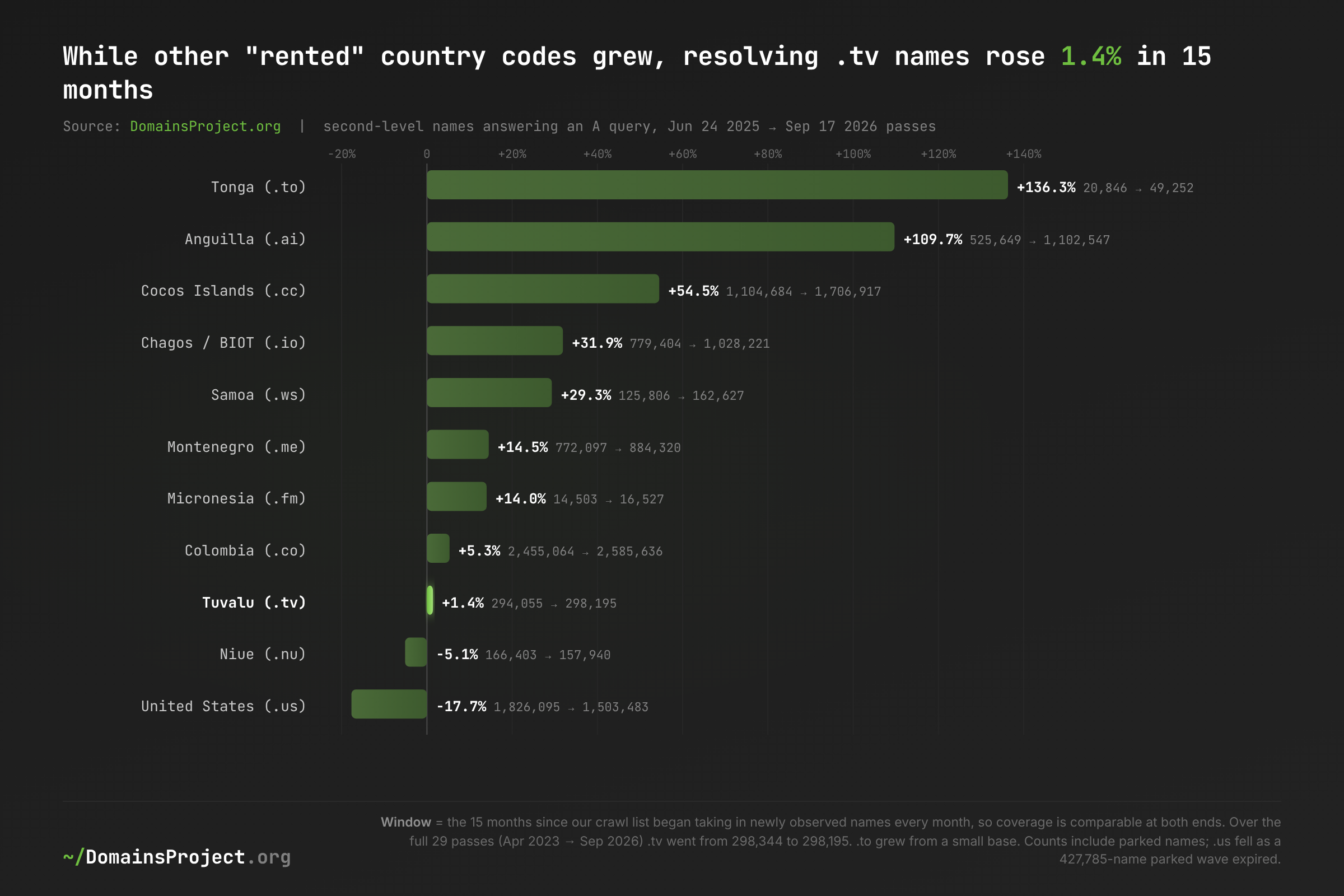
Download: tuvalu-tv-peers.csv: resolving second-level names in three passes, changes and parked share; counts include parked names
.tv is the flattest of the country codes that sell mostly to foreigners. Over the full 29 passes it went from 298,344 to 298,195 names, and in the 15 months of steady coverage it grew 1.4%. In the same months .ai doubled, .cc grew by more than half and .io by a third. The comparison is fair on coverage, because all these TLDs went through the same crawl list and the same January 2025 step. It is not fair on fashion: .ai is riding the AI boom, and .us is shedding the 427,785-name parked wave we described in the .us handover.
There is no sign of growth before our passes start, either. Press estimates of about 500,000 names in 2021 and "just over 394,000" in early 2024 point down, if anything. We have no pass from 2022, so we cannot rule out a short-lived rise between the rebid and April 2023. What we can say is that receipts kept rising after April 2023, by A$2.1M from 2023 to 2024, while the number of names in use did not change, and that the outside estimates on either side of 2022 point down.
Did registrations double in 2025?
The third-party figure of 784,120 registered .tv names in October 2025, against about 394,000 in early 2024, would mean roughly 390,000 new registrations in under two years. Our data argues against that, at least for names that are used:
- Our new-name feed saw about 68,000 genuinely new
.tvnames from December 2024 to October 2025. These are names first sighted in that window and never seen resolving in an earlier pass. That is under a fifth of the implied increase, and the count includes 2024 registrations reaching the list late. Since July 2025 the feed has seen 3,200–5,200 new names a month, not the 20,000 a doubling requires. - Resolving and delegated counts stayed near 300,000. 283,327
.tvnames had working delegations in April 2025 and 300,184 in April 2026. 784,120 registrations would leave 62% of all.tvnames not resolving. In.us, where the registry publishes its count, the share is under a quarter.
The doubling is possible only if almost all of it is names that never appear in DNS. We cannot see those, so we cannot rule them out. But nothing in the receipts suggests it either: the IMF's 2025 projection (A$10.1M) and the fiscal 2024/25 estimate (A$10.6M) are slightly below calendar 2024.
A Replacement Market
| April 2023 cohort (298,344 resolving names) | Names | Share |
|---|---|---|
| Still a live website in Sep 2026 | 133,213 | 44.7% |
| Now on GoDaddy's front door | 39,494 | 13.2% |
| Now on other parking or sinkholed | 12,848 | 4.3% |
| No longer resolves | 112,789 | 37.8% |
| Still resolving | 185,555 | 62.2% |
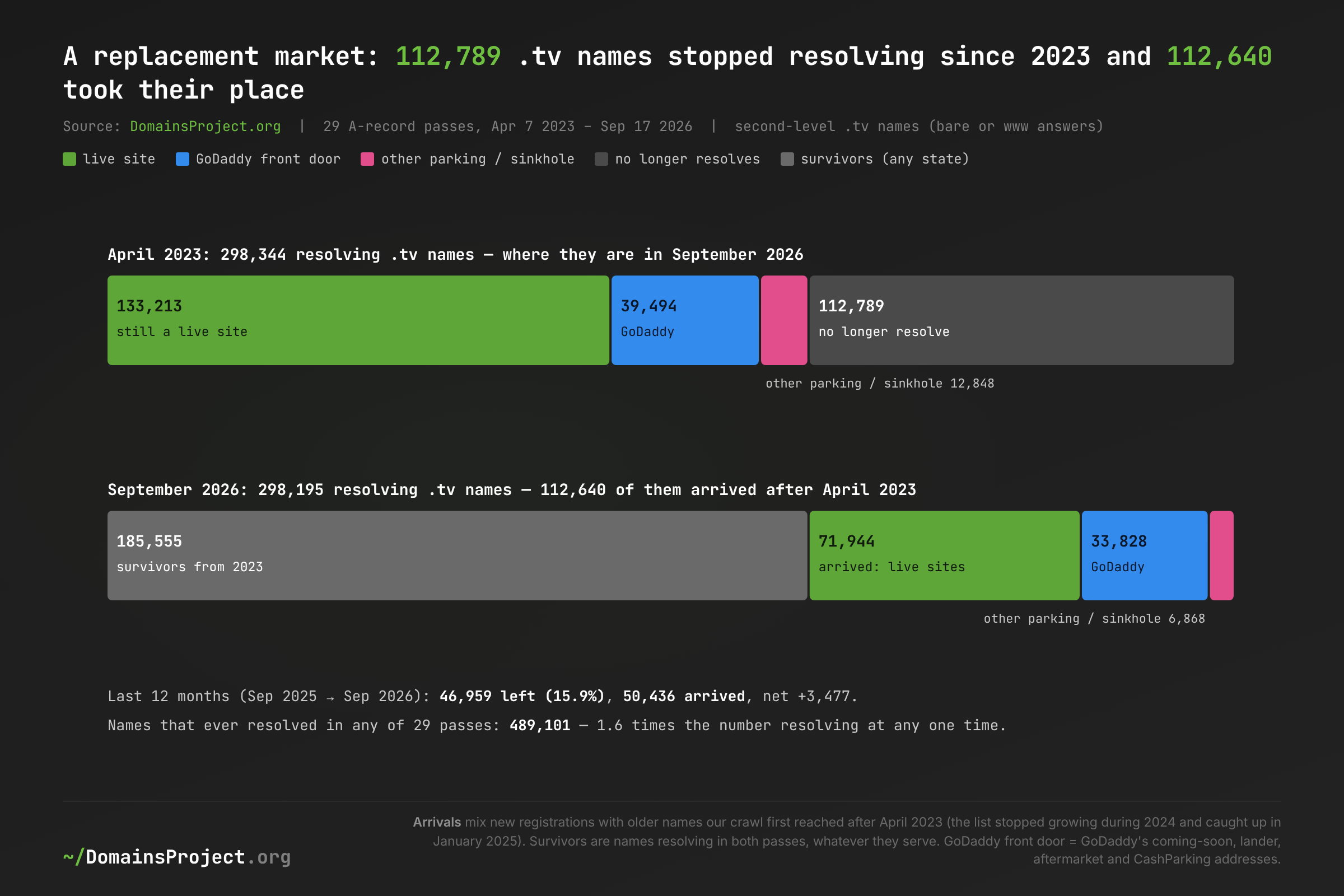
Download: tuvalu-tv-turnover.csv: fates of the April 2023 cohort and make-up of the September 2026 namespace; arrivals mix new registrations with older names our crawl reached later
.tv holds its size by replacing what it loses. Over three and a half years 112,789 names stopped resolving and 112,640 took their place, within 149 of each other. In the most recent 12 months, 46,959 names (15.9%) dropped out and 50,436 came in. Among names that were live websites in April 2023, 58.3% are still live websites. In .us, the comparable figure is 50.9%.
For a registry paid by the renewal, that churn is the business. Each year roughly one name in six has to be replaced just to stand still. The renewed Verisign contract made the threshold explicit: its bonus was due only "while subscriptions are maintained above the agreed level".
What the names are
| Lexical class (Sep 2026) | Resolving | Share | Live | Left in last 12 months | Arrived in last 12 months |
|---|---|---|---|---|---|
| Names, brands, other words | 220,658 | 74.0% | 65.3% | 14.7% | 30,941 |
| Short letter-and-digit strings (≤6 characters) | 34,901 | 11.7% | 89.4% | 24.7% | 11,823 |
| Video, streaming and broadcast words | 30,159 | 10.1% | 68.4% | 15.7% | 5,432 |
| All digits | 5,300 | 1.8% | 87.4% | 19.3% | 895 |
| Faith and church | 2,293 | 0.8% | 51.7% | 11.3% | 268 |
| Gambling | 2,059 | 0.7% | 67.6% | 16.8% | 515 |
| Adult | 1,576 | 0.5% | 79.9% | 21.1% | 238 |
IDN (xn--) |
1,249 | 0.4% | 61.8% | 18.4% | 324 |
The television story describes about a tenth of .tv. Only 10.1% of resolving names carry video, streaming or broadcast vocabulary, and the class is a mixed bag: twitch.tv, pluto.tv and eurovision.tv sit next to 0123movie.tv. Three-quarters of the namespace is personal names, brands, agencies and other words that use .tv as a short, memorable ending.
The growth is in short letter-and-digit strings, and much of it runs on Chinese DNS. The class is 11.7% of resolving names but took 23.4% of the last year's arrivals, and it churns fastest (24.7% a year). 11,233 of its names follow one pattern, four digits and a letter (0005a.tv, 0005b.tv, …), and 62% of those with working delegations use Alibaba Cloud, Gname, Xundns or DNSPod. Across all of .tv, the share of delegated names on Chinese DNS providers rose from 3.8% in April 2025 to 6.5% in September 2026. These names are mostly "live" by our definition (89.4%), which means they answer with something other than a known parking page. What they serve we did not classify.
GoDaddy sits on both sides of the .tv revenue. As registry operator it pays Tuvalu. As a registrar and DNS host it holds 27.3% of delegated .tv names (chiefly domaincontrol.com and afternic.com), more than Cloudflare's 15.1%. And 24.6% of resolving .tv names, 73,322 of them, answer from GoDaddy's own parking, coming-soon and for-sale front door. Of those, 12,326 are on its aftermarket pages. Parked and for-sale names renew like any other, so speculation is part of the registry's revenue base: 30.9% of resolving .tv names are parked or for sale.
A clean namespace
.tv drew 0.30 OpenPhish listings per 10,000 resolving names (9 names from July 2025 to November 2026; exact 95% interval 0.14–0.57). That is a quarter of .com's rate (1.25) and a seventh of the all-TLD average (2.02). .io (1.18) and .co (1.42) are also well above it. A namespace that sells at around US$26 a year and does not grow by volume has not drawn the bulk abuse seen in cheap TLDs. That matters for the revenue: the cautionary case among island country codes is Tokelau's .tk, whose free registrations ended in mass abuse and lawsuits, as our island country codes post describes.
Revenue per Name: What the Undisclosed Contract Implies
| Denominator | Names | US$ per name, 2024 receipts | Source of the count |
|---|---|---|---|
Resolving .tv names, Sep 2026 |
298,195 | 24.8 | DomainsProject, floor for registrations |
| Third-party count, early 2024 | 394,000 | 18.8 | NamePros (source not named) |
| Press estimate, 2021 | 500,000 | 14.8 | The Register, Domain Name Wire |
| Third-party count, Oct 2025 | 784,120 | 9.4 | NamePros citing DomainNameStat |
| Verisign era, 2015–21 average, at 500,000 | 500,000 | 9.9 | Budget/IMF series |
Anguilla .ai, 2025 |
~1,000,000 | ~93 | Earlier DomainsProject .ai posts, Anguilla budget |
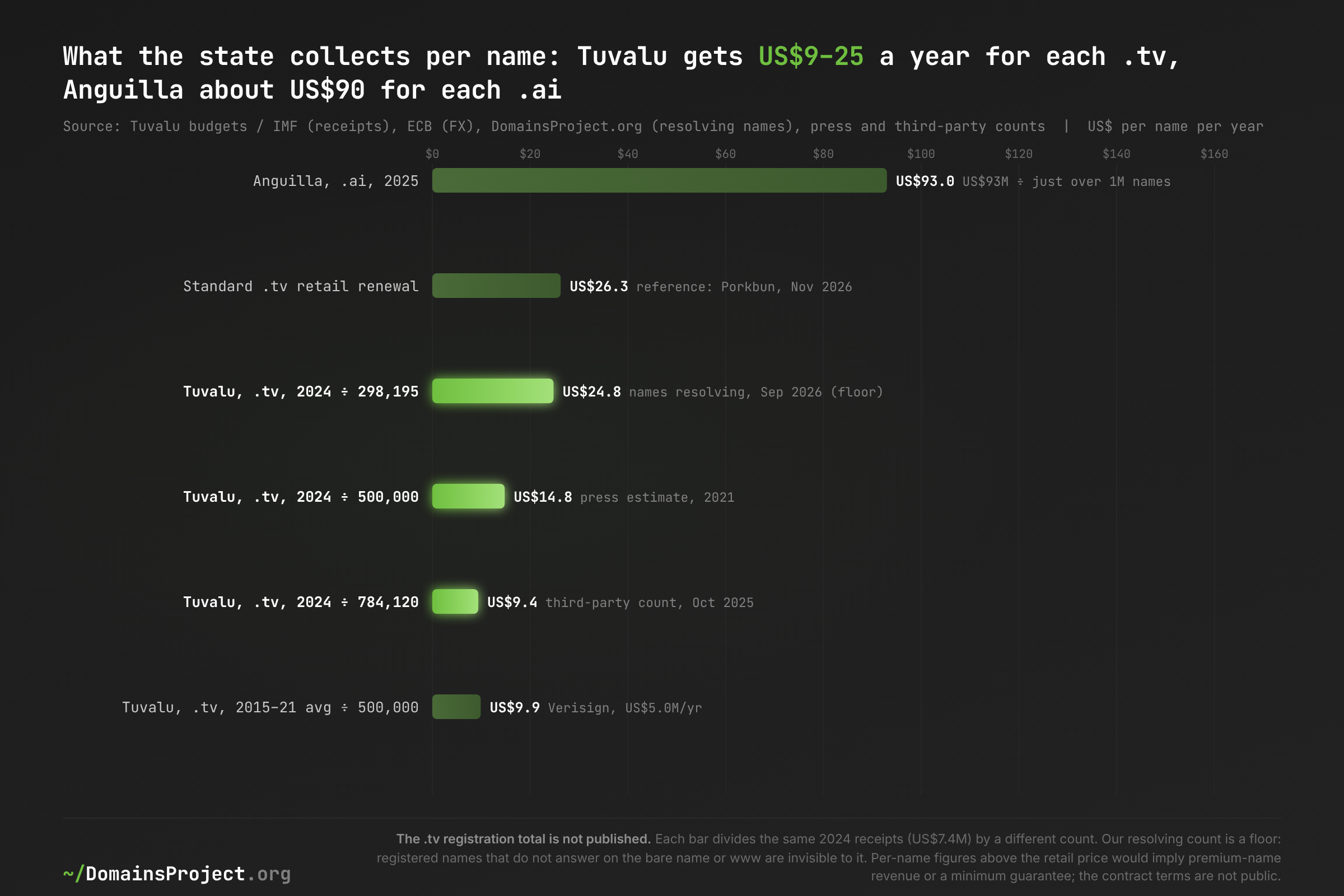
Download: tuvalu-tv-per-name.csv: numerators, denominators and sources for each bar; retail price from price aggregators for Porkbun, November 2026
Unless the namespace grew a great deal, Tuvalu now gets more per name than it did under Verisign. At the 500,000 names reported in 2021, Tuvalu's take rose from about US$9.9 per name a year (2015–2021) to US$14.8 in 2024. At the ~300,000 names that resolve, the 2024 figure is US$24.8. Only if registrations really reached 784,120 is the 2024 figure (US$9.4) no higher than Verisign's, and as shown above our data argues against that number.
Some of these per-name figures are close to the retail price. A standard .tv renewal costs about US$26 at Porkbun ($26.24 in November 2022 and $26.26 now) and US$24.98 at Spaceship. Domain Name Wire reported in 2022 that GoDaddy Registry kept standard pricing unchanged and planned a premium tier. The wholesale price has to be below that retail price, so a registry cannot pay the government US$25 per standard name. So if the registered count is near the low end, a large part of the money must come from somewhere else: premium names, which renew at many times the standard price; a guaranteed minimum; or both. If the count is near 500,000, a large revenue share at standard prices is enough. Without the contract we cannot tell these apart, and the budget books record only the total.
Anguilla shows what the same two-letter asset can earn on different terms. .ai brought Anguilla about US$93M in 2025, roughly US$90 per name, on wholesale prices that rose from US$70 to US$90 in 2026. That is four to ten times Tuvalu's take per name. Some of the gap is price: .ai's wholesale price alone is more than three times .tv's retail price. Some of it is volume: .ai has grown twelvefold in our passes since April 2023, and .tv not at all.
Three scenarios
- Base case: the IMF's. Receipts settle around A$10–11M and grow with GDP to A$13.1M by 2030, holding near 11.4% of GDP. This assumes the contract's payment keeps tracking a flat namespace the way it has since 2023.
- Downside: the namespace shrinks. A 15.9% annual loss without matching arrivals would cut the base by a sixth a year. Under a per-name or revenue-share formula, receipts would follow. A minimum guarantee would protect Tuvalu, if the contract has one. The renewed Verisign deal's threshold bonus is the only public sign of how such terms were written.
- Upside: premium sales. The A$11.0M "Premium Sale DotTV" in the 2025–26 budget would double one year's receipts. Selling a premium name outright turns a stream of premium renewals into a single payment, unless the sale keeps a renewal fee for the registry and Tuvalu.
What's at Stake
- One budget line equals 13.1% of GDP —
.tvnow carries more of Tuvalu's own revenue (15.9%) than at any time on record, and it rests on a single confidential contract with a single counterparty. - The counterparty is on both sides — GoDaddy runs the registry that pays Tuvalu, hosts 27.3% of delegated
.tvnames as registrar and DNS provider, and serves 24.6% of resolving names from its own parking and for-sale front door. Its incentives as registry and as registrar are not the same. - The namespace is flat and turns over 16% a year — 112,789 of the names resolving in 2023 are gone. Revenue that depends on renewals depends on that churn being refilled, and the fastest-growing segment, short letter-and-digit strings, many on Chinese DNS providers, also churns fastest (24.7% a year).
- Forecasts miss when they model demand instead of terms — the IMF projected 2024 at A$7.0M and a decline "given the increasing use of other internet domains". The outturn was A$11.2M. Budget planning built on the wrong model will be wrong in both directions.
- A premium sale is a one-time conversion of a recurring asset — A$11.0M is a year's income. How it is priced, and whether renewal fees survive the sale, will decide whether it adds to the stream or borrows from it.
- The asset is portable, the islands are not —
.tvis tied to Tuvalu's ISO 3166 code, not to land. Australia's Falepili Union treaty, in force since August 28, 2024, "recognises that Tuvalu's statehood and sovereignty will continue, notwithstanding the impacts of climate change-related sea level rise" (Prime Minister of Australia). Fishing licences depend on maritime boundaries drawn from the coastline;.tvdepends only on Tuvalu remaining a recognised state.
What Would Help
1. Tuvalu's Ministry of Finance: publish .tv as its own line, with the formula. Since 2022 .tv has been folded into "Commercial Contracts" alongside upper-airspace fees and, from 2025–26, the ship registry. A separate line, the payment basis (revenue share, minimum, premium split) and the marketing costs the government carries would let citizens and lenders see what the contract is worth. The 2014 Verisign rework was described in a budget book in two sentences; that level of disclosure would be enough.
2. GoDaddy Registry: publish .tv names under management. Monthly registry reports are routine elsewhere: GoDaddy filed them for .us with NTIA for years. A published count would settle whether .tv has 300,000 registrations or 784,120, which is the difference between US$25 and US$9 per name in what Tuvalu receives.
3. Fiscal analysts and the IMF: model .tv as a contract, not as a market share. The relevant inputs are the payment formula, the registered base and its 16% turnover, not the popularity of other TLDs. Our 29-pass .tv series (tuvalu-tv-series.csv) and the .tv statistics page give a monthly check on the base.
4. Tuvalu's government: price the premium sale against the premium renewals it replaces. Before selling names for A$11.0M, compare that with the renewal stream those names generate at premium prices, and keep a renewal fee on anything sold. A sale that ends the renewals trades a recurring income for one budget year.
5. Researchers and journalists: stop citing US$10 million a year. Tuvalu's budget books and the IMF's tables show US$7.4M in the best year so far, and about US$80M from 2005 to 2024. That includes our own earlier post, which this one corrects. The receipts are A$ figures; convert with the year's exchange rate.
Revenue figures come from Tuvalu's national budget books (2009–2025, Ministry of Finance and Economic Development) and IMF Article IV reports 12/259, 23/267 and 25/257, converted to US dollars at annual averages of ECB reference rates. Namespace figures come from the DomainsProject dataset's .tv file (2,519,675 host names, 607,023 registered names, November 2026), 29 A-record passes from April 7, 2023 to September 17, 2026, nameserver passes from April 2025, April 2026 and September 2026, our newly-observed-names feed (December 2024 – September 2026) and OpenPhish's public feed history (July 2025 – November 2026). Registration counts from third parties are labelled as such; the registry does not publish one. Russian-territorial TLDs are excluded from all comparisons. Per-TLD resolution data is on the statistics dashboard and the full name lists are in the dataset.