A data breach has a timeline everyone knows: the intrusion, the discovery, the notice, the lawsuit, the settlement. What happens afterwards to the breached website's own domain is rarely followed. Years later, that domain may still carry the trust of the people who once had accounts there. Their password-reset emails went to it, their saved links point to it, and other systems still accept its mail.
Sometimes the domain no longer belongs to the breached service. When a domain lapses and someone else registers it, the new owner inherits that residual trust. In "Domain-Z: 28 Registrations Later" (IEEE S&P 2016), Lever and colleagues counted 27,758 blacklisted and 238,279 malware-contacted domains that had expired and been re-registered maliciously. We have not found the same count for breached services, whose domains come with the leaked addresses of their users attached: a median of 840,000 accounts per breach in the set studied here.
There is a second open question: what breached organisations change afterwards. Breach notices promise "enhanced security measures". Some of those measures show up in DNS — a new mail provider, a new DNS operator, a CDN in front of the website, an email-authentication policy — and DNS is what we measure.
This post follows two groups of breached organisations through our crawls.
- 948 breached websites: every site breach in the Have I Been Pwned catalogue with a domain, covering 8.64 billion breached accounts (HIBP data, CC BY 4.0). Spam lists, malware logs and fabricated breaches are excluded.
- 58 public companies: every company that filed a material cybersecurity incident under Item 1.05 of SEC Form 8-K from the rule's start on December 18, 2023 to November 27, 2026. They are compared with 3,501 other SEC registrants.
- History: 11 of our 29 monthly hosting crawls (April 2023 → September 2026), 12 mail (MX) and 10 DNS (NS) crawls since April 2025, and the May 2026 DMARC census.
- Live check, November 27–28, 2026: DNS, the registry's RDAP record (registration date and registrar), the HTTP response and the page title of every breached domain.
The headline: most breached sites survive, but one domain in ten has left the breached service, and 34 now belong to new owners who registered them years after the breach.
- Survival: 74.1% of the 948 domains are still with the breached service (68.9% online, 5.2% redirecting, mostly to a successor brand). Of the breached sites that were live in April 2023, 93.9% are still live, against 58.3% of all websites live then.
- Out of the service's hands: 92 domains (9.7%).
- 50 are parked, for sale or unregistered. Anyone can buy them.
- 42 belong to someone else: 34 were re-registered by a new owner more than 90 days after the breach (median 5.8 years later), and 8 now serve an unrelated operator's site.
- Of the 34 re-registered domains, 17 accept email, 32 have a website and 19 were caught by drop-catch registrars. Every one of their breaches exposed email addresses; 29 also exposed passwords.
- After a breach is published, sites change their stack about twice as often as comparable domains:
- Mail provider: 11.0% changed, against 4.2–6.2% expected.
- DNS operator: 18.2%, against 7.3–10.9%.
- Cloudflare: 17.0% moved behind its proxy, against 5.3–9.7%.
- Public companies showed no measurable change. The 58 material-incident filers are indistinguishable from other SEC registrants in DMARC enforcement (67.9% vs 67.7%). Of those we could observe before and after filing, 1 of 18 changed mail provider and none of 15 changed DNS operator.
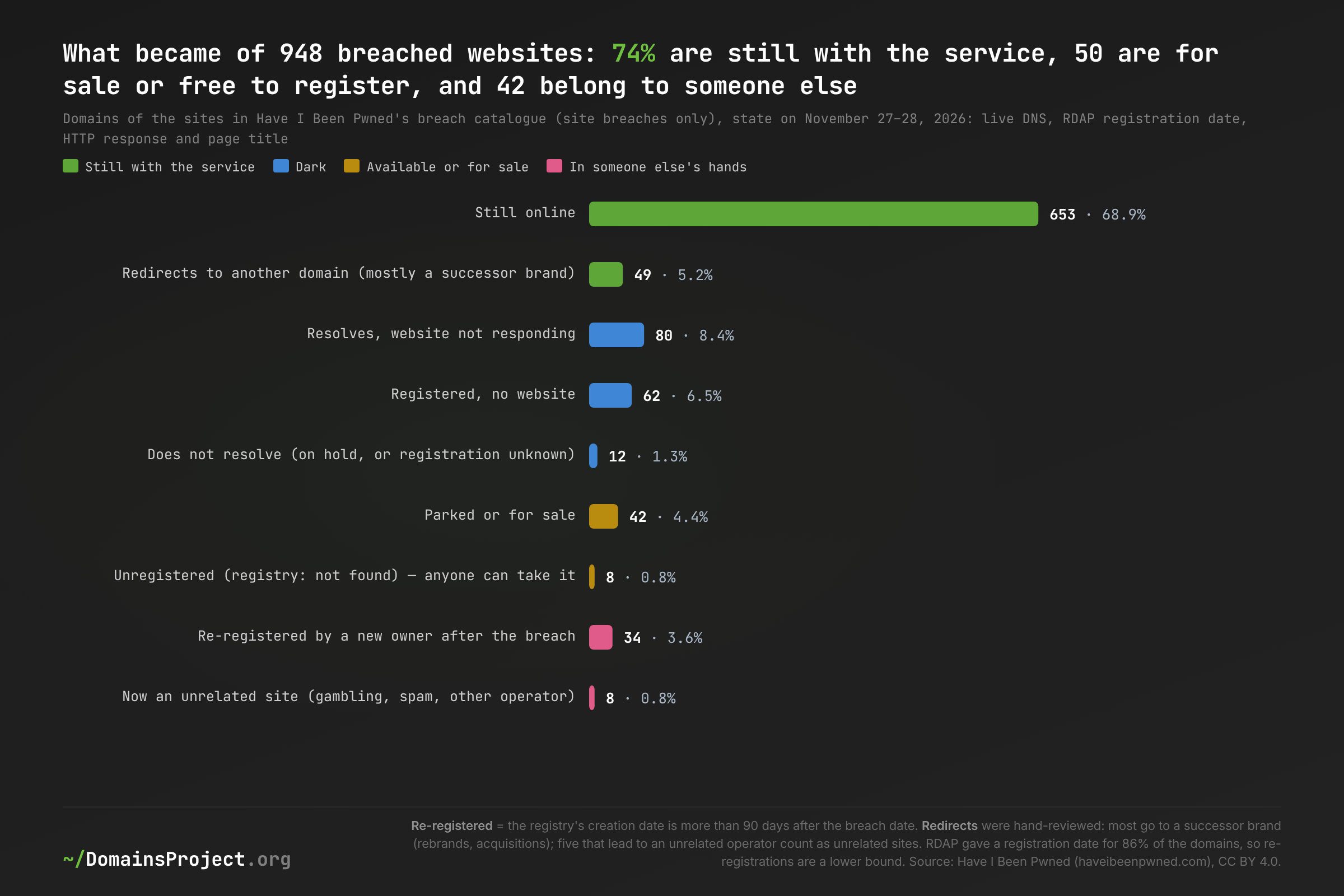
Download: breach-afterlife.csv — domains and breached accounts per state; source of the breach list: Have I Been Pwned, CC BY 4.0.
What this post does and does not measure.
- What it measures: the public DNS, registry and web footprint of breached organisations' domains, before and after their breach.
- What it does not measure: how secure the organisations are, or whether the measures in their breach notices happened inside their networks. A new mail provider is visible; a patched server is not.
- Which breaches: HIBP lists breaches whose data circulated and that its operator loaded, which tends to favour consumer services, forums and gaming sites. The SEC group is the opposite: large US companies.
- No domain is named. The post names no domain that is currently unregistered, for sale or held by a new owner, and no re-registered domain at all.
The Data
| Value | |
|---|---|
| Breach catalogue | Have I Been Pwned /api/v3/breaches, downloaded November 27, 2026: 1,055 breaches, 17.86 billion records (CC BY 4.0) |
| Breached-website cohort | 948 registrable domains after excluding 3 fabricated, 16 spam lists, 15 malware or stealer logs, 33 without a domain and 17 Russian-territorial or unparsable domains; one row per domain (latest breach); 8.64 billion accounts; breach dates 2007–2026 |
| Material-incident cohort | 58 companies with an SEC Form 8-K Item 1.05 filing, December 18, 2023 → November 27, 2026 (EDGAR full-text search, item metadata); 59 domains, 30 from Wikidata's CIK → official website, 28 matched by hand and checked against each site's page title |
| Controls | 3,501 domains of other SEC registrants (Wikidata, CIK + website); a systematic 1-in-8,000 sample of the April 2023 hosting crawl (22,051 domains, 18,528 of them live websites) |
| History | hosting crawls of Apr 2023, Dec 2023, Jul 2024, Nov 2024, Mar 2025, Jul 2025, Oct 2025, Dec 2025, Mar 2026, Jun 2026 and Sep 2026; MX crawls monthly from Nov 2025 plus Apr 2025; NS crawls Apr 2025 and Dec 2025 → Sep 2026 |
| Email authentication | DMARC policy of every apex in the May 2026 census of A State of TXT |
| Live check, November 27–28, 2026 | dig NS/A/www/MX/SOA; RDAP via the IANA bootstrap (registration date for 813 of 948 domains); HTTP final URL, status and page title |
What counts. A breached domain is the registrable domain HIBP lists for a breach. A domain counts once even if it was breached more than once. Breaches without a domain (combolists, aggregated leaks), spam lists and malware or stealer logs are excluded, because they are not breaches of a website.
Methodology
States of a breached domain on November 27–28, 2026. Each domain gets the first state that applies, in this order:
- Unregistered: the registry's RDAP returns "not found". Anyone can register it.
- Re-registered by a new owner after the breach: the registry's creation date is more than 90 days after the breach date. In gTLD and most ccTLD registries a domain is only "created" again after it was deleted, so a later creation date means it lapsed and was registered anew. The 90-day margin keeps an imprecise breach date from producing a false positive: two domains created 18 and 37 days after their breach are not counted as re-registered.
- Parked or for sale: parking or aftermarket nameservers, a parking page in the September 2026 crawl, or a redirect to a domain marketplace or broker.
- Unrelated site: the page title is gambling or spam content and the breached service was not itself a gambling site (checked against HIBP's description of the breach), or a hand review of the redirect target found an unrelated operator. That applies to five domains.
- Redirects to another domain: the website ends on a different registrable domain. We reviewed all 49 by hand. Most go to a successor brand after a rebrand or acquisition (a social network to its new name, a freelancing site to the marketplace that absorbed it, a payments brand to its new name).
- Still online: a website that answers.
- Dark: the domain is registered and delegated but nothing answers (resolves, website not responding), it has no website record (registered, no website), or it returns NXDOMAIN while the registry still lists it or has no RDAP to tell (does not resolve).
The charts group these states as follows:
- still with the service: 5 and 6 (online or redirecting);
- dark: 7;
- available or for sale: 1 and 3;
- in someone else's hands: 2 and 4.
Survival over time. A website is live in a crawl if its name resolves and the address is not a parking or for-sale page, using the front-door registry of The Parking Lot. We compare three groups that were all live in April 2023:
- breached sites whose breach predates that crawl (656);
- other SEC registrants (3,339);
- the random sample (18,528).
Changes after a breach is published.
- Start and end: for each breach we compare the last crawl before HIBP added it with the September 2026 crawl, and require at least 120 days in between. HIBP's "added" date is when HIBP loaded the breach and made it searchable; it is often later than the breach itself.
- Mail and DNS: a change is a different primary MX or NS registrable domain (breaches added April 12, 2025 → May 19, 2026, the span of the mail and DNS crawls).
- Cloudflare: for websites not on Cloudflare's network before, a move means their address was Cloudflare's in September 2026 (breaches added April 2023 → May 2026). The operator of an address is its origin AS in the RouteViews snapshot nearest the crawl.
- Expected rates: each control group is measured over exactly the same pairs of crawls, weighted by how many breached sites start in each.
- Uncertainty: 95% Wilson intervals, and exact binomial tests against the expected rate.
SEC filers vs other registrants.
- Population: companies with a live website and working mail in September 2026. Mail is classified by the MX first hop (Microsoft 365, Google Workspace, a security gateway such as Proofpoint or Mimecast, other).
- DMARC: the policy published at
_dmarcin May 2026. - Before and after: for filers who filed inside the mail and DNS crawl window, MX and NS are compared from the last crawl before the filing to September 2026.
Limitations.
- RDAP coverage: 135 domains (14%) have no registration date. 116 are in TLDs without RDAP in the IANA bootstrap (such as
.io,.meand.de); the rest are unregistered or were rate-limited. Re-registrations among them cannot be detected, so 34 is a lower bound. - Creation dates miss sales: a domain bought at an expiry auction, or sold privately, keeps its creation date. Those changes of hands appear only as parking, a marketplace redirect or unrelated content.
- The groups differ in more than breaches. Breached sites, SEC registrants and random websites differ in size, age and purpose. The survival comparison describes them; it does not isolate the effect of a breach.
- Small numbers: the change rates rest on 88–165 breached sites and the SEC before/after on 15–18 filers.
Dataset vs external counts. HIBP lists 1,055 breaches and 17.86 billion records. The 948 domains here cover 8.64 billion, because combolists, spam lists and stealer logs, which make up much of the remainder, have no website behind them. The 58 Item 1.05 filers are those whose filings carry the item code in EDGAR's index. Since the SEC staff's May 2024 statement, companies disclose incidents they have not judged material under Item 8.01 instead, so many publicly reported incidents are outside this group.
Reproducibility. Aggregate tables are in the CSVs under each chart; breach-after-changes.csv and breach-sec-profile.csv carry counts and intervals. Domain-level results are not published, to avoid listing domains that are unregistered or held by new owners.
The Scorecard
| State on November 27–28, 2026 | Domains | Share | Breached accounts |
|---|---|---|---|
| Still online | 653 | 68.9% | 5.91 billion |
| Redirects to another domain (mostly a successor brand) | 49 | 5.2% | 185 million |
| Resolves, website not responding | 80 | 8.4% | 392 million |
| Registered, no website | 62 | 6.5% | 599 million |
| Parked or for sale | 42 | 4.4% | 1.11 billion |
| Does not resolve (on hold, or registration unknown) | 12 | 1.3% | 20 million |
| Unregistered (registry: not found) | 8 | 0.8% | 3 million |
| Re-registered by a new owner after the breach | 34 | 3.6% | 381 million |
| Now an unrelated site | 8 | 0.8% | 48 million |
| Total | 948 | 8.64 billion |
Three in four breached websites' domains are still with the service that was breached. A breach is rarely the end of a website: many of the largest breaches belong to services that are still among the most visited sites in the world. 16.2% — about one in six — are dark: registered, with nothing answering.
The account totals are lumpy. One 2019 breach of 763 million records accounts for most of the 1.11 billion accounts behind parked or for-sale domains. Two credential lists of 227 million and 111 million records account for most of the re-registered total. The domain counts are the better guide.
The comparison in one table
| Measure | Breached | Comparison | Comparison group |
|---|---|---|---|
| Live in Sep 2026, of those live in Apr 2023 | 93.9% (n = 656) | 96.7% / 58.3% | SEC registrants / random websites |
| Mail provider changed after publication | 11.0% (10 of 91) | 6.2% / 4.2% | expected from SEC registrants / random websites |
| DNS operator changed after publication | 18.2% (16 of 88) | 7.3% / 10.9% | same |
| Moved behind Cloudflare after publication | 17.0% (28 of 165) | 9.7% / 5.3% | same |
| DMARC enforced, May 2026 | 52.4% (n = 597, still online) | 67.7% / 10.6% | SEC registrants / random websites |
| DMARC enforced, SEC Item 1.05 filers | 67.9% (38 of 56) | 67.7% | other SEC registrants |
Breached services look like established organisations in survival, sit between companies and the average website in email authentication, and change their stack more often than either after a breach becomes public.
The Afterlife: One Domain in Ten Has Left the Breached Service
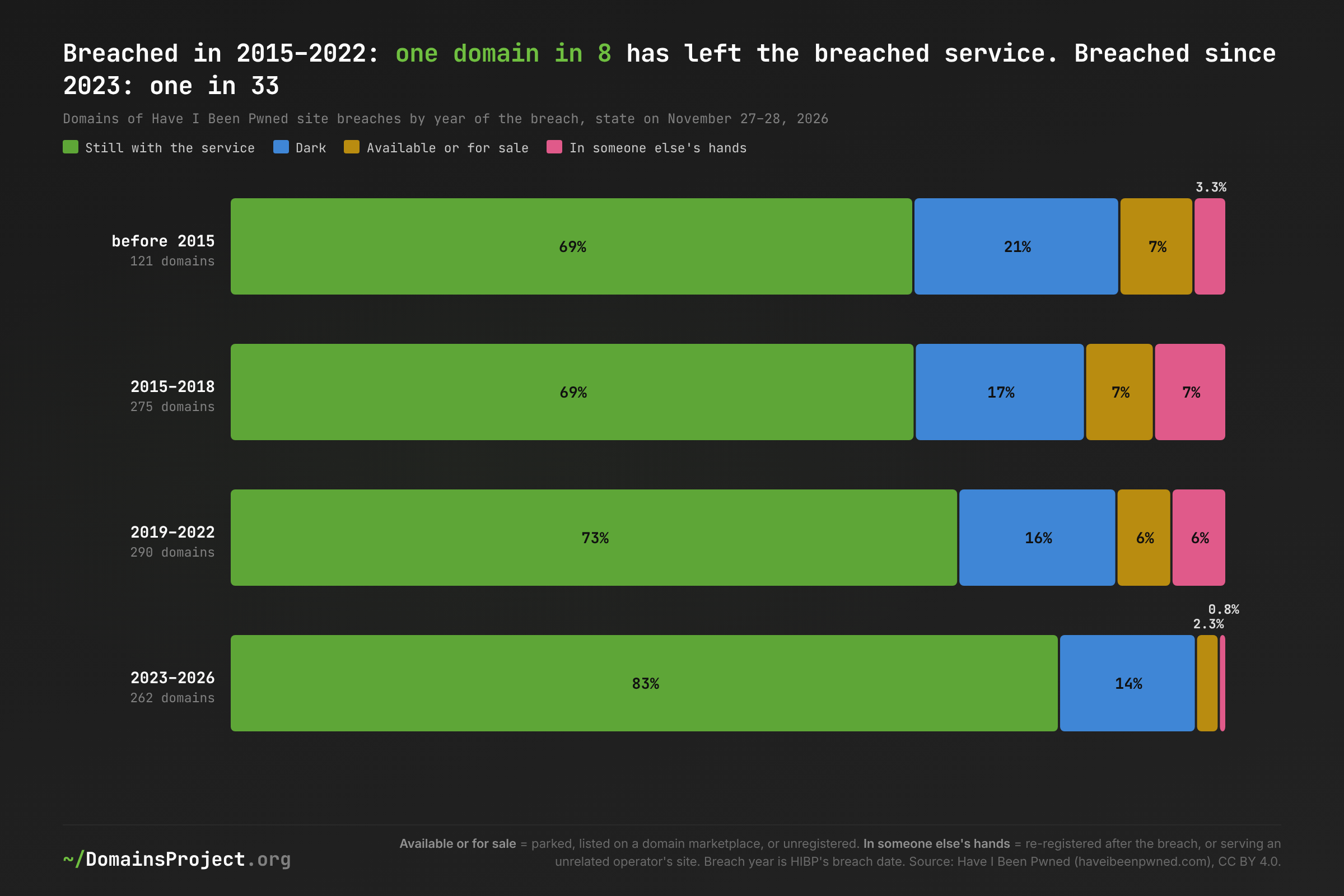
Download: breach-afterlife-age.csv — domains per group and breach-year bucket; HIBP breach dates.
| Breach year | Domains | Still with the service | Dark | Available or for sale | Someone else's |
|---|---|---|---|---|---|
| Before 2015 | 121 | 68.6% | 20.7% | 7.4% | 3.3% |
| 2015–2018 | 275 | 68.7% | 17.1% | 6.9% | 7.3% |
| 2019–2022 | 290 | 73.1% | 15.9% | 5.5% | 5.5% |
| 2023–2026 | 262 | 83.2% | 13.7% | 2.3% | 0.8% |
For breaches from 2015 to 2022, one domain in eight has left the breached service; for breaches since 2023, one in 33. Domains need time to lapse: most registrations run one to several years, then pass through grace and redemption periods before the registry deletes them. The oldest breaches have the largest dark share (20.7%) but fewer domains in new hands (3.3%). The data cannot say why; one reading is that owners of long-closed services kept renewing names they had held for many years.
Re-registered: the domains that changed hands
| Re-registered by a new owner | Domains |
|---|---|
| Total | 34 |
| Accept email (MX record) | 17 |
| Have a website | 32 |
| Registered through a drop-catch registrar | 19 |
| Page title is gambling content | 3 |
| Breach exposed email addresses | 34 |
| Breach exposed passwords | 29 |
| Median time from breach to re-registration | 2,102 days (5.8 years) |
Half of the domains that changed hands accept mail. For the old service's users this matters in three ways:
- Mail to the old service lands with the new owner. Anyone who still writes to an address at the domain is now writing to a stranger.
- Accounts tied to addresses at the domain can be taken over. The new owner can receive password resets for accounts elsewhere that were registered with an address at the domain, for example staff accounts at the service's suppliers.
- The domain borrows the old service's credibility. A message from a domain people once trusted, sent to the very people whose addresses leaked from it, is a phishing lure that needs no lookalike.
Every one of these 34 breaches exposed email addresses, and 29 exposed passwords.
Most re-registrations were caught at the moment of deletion. 19 of the 34 went through drop-catch registrars, which race to register domains the moment the registry deletes them. The rest sit at ordinary registrars. The new owners run redirect pages, investor landers, three gambling sites, a store using the old brand's name, and one "suspended" hosting page.
Available or for sale
50 domains can be bought by anyone today. 8 are unregistered and 42 are parked or listed for sale, on marketplaces or through brokers. A breached service's domain has a buyer pool that includes the people best placed to abuse its residual trust: those who already hold its users' email addresses.
Breached Sites Mostly Survive
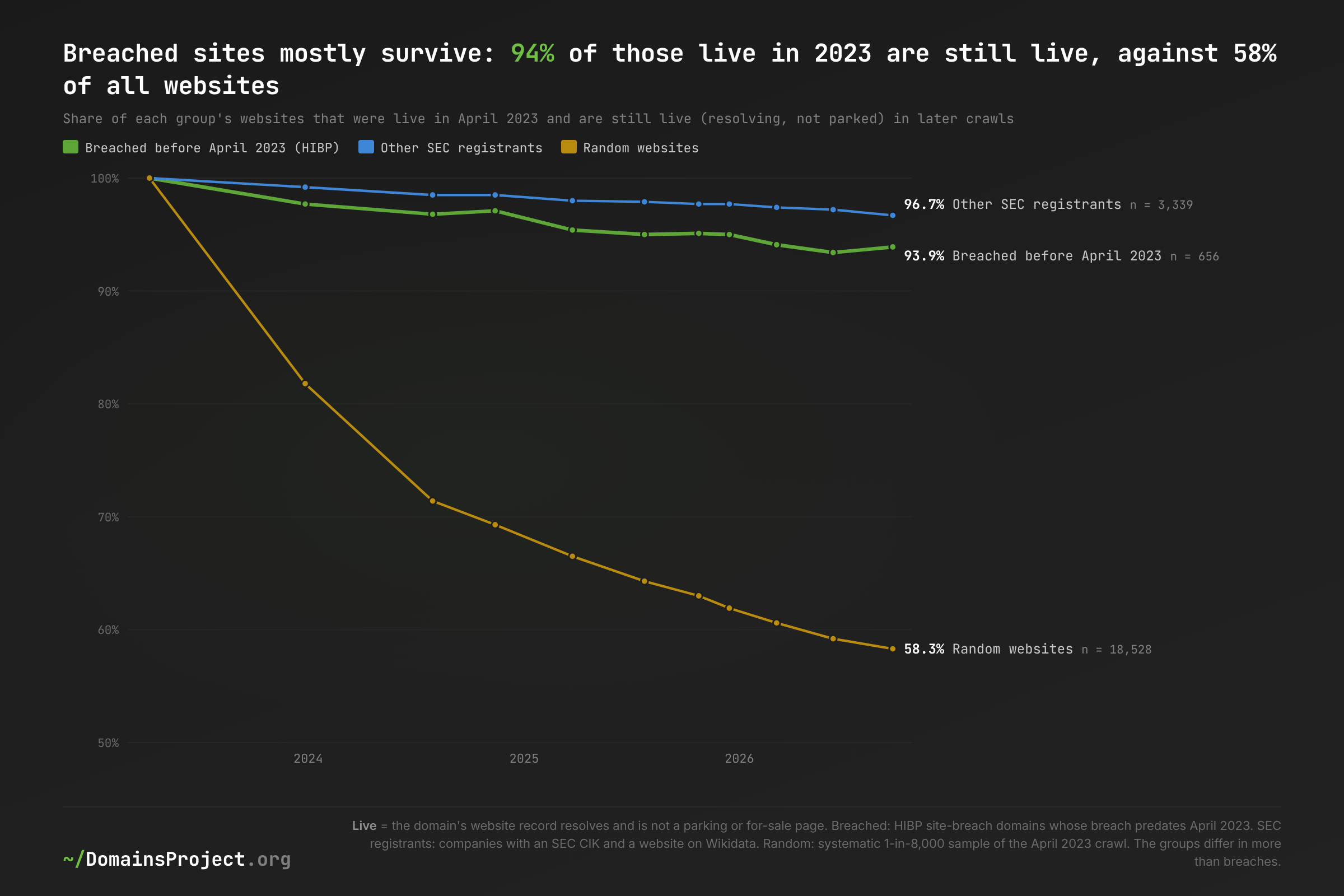
Download: breach-survival.csv — share live per crawl, April 2023 → September 2026, three groups.
93.9% of the breached sites that were live in April 2023 are still live three and a half years later, close to public companies (96.7%) and far above the average website (58.3%). This is consistent with what the afterlife table shows: breached services are mostly established businesses, and a breach does not usually end them. It is not evidence that breaches do no harm. These groups differ in age, size and purpose, and the random sample includes many short-lived sites. The comparison is inconsistent with the idea that a breach usually kills the website. Of the 6.1% of breached sites that were no longer live by September 2026, 2.3 points were parked and 3.8 no longer resolved.
After the Breach Is Published: Mail, DNS and the CDN
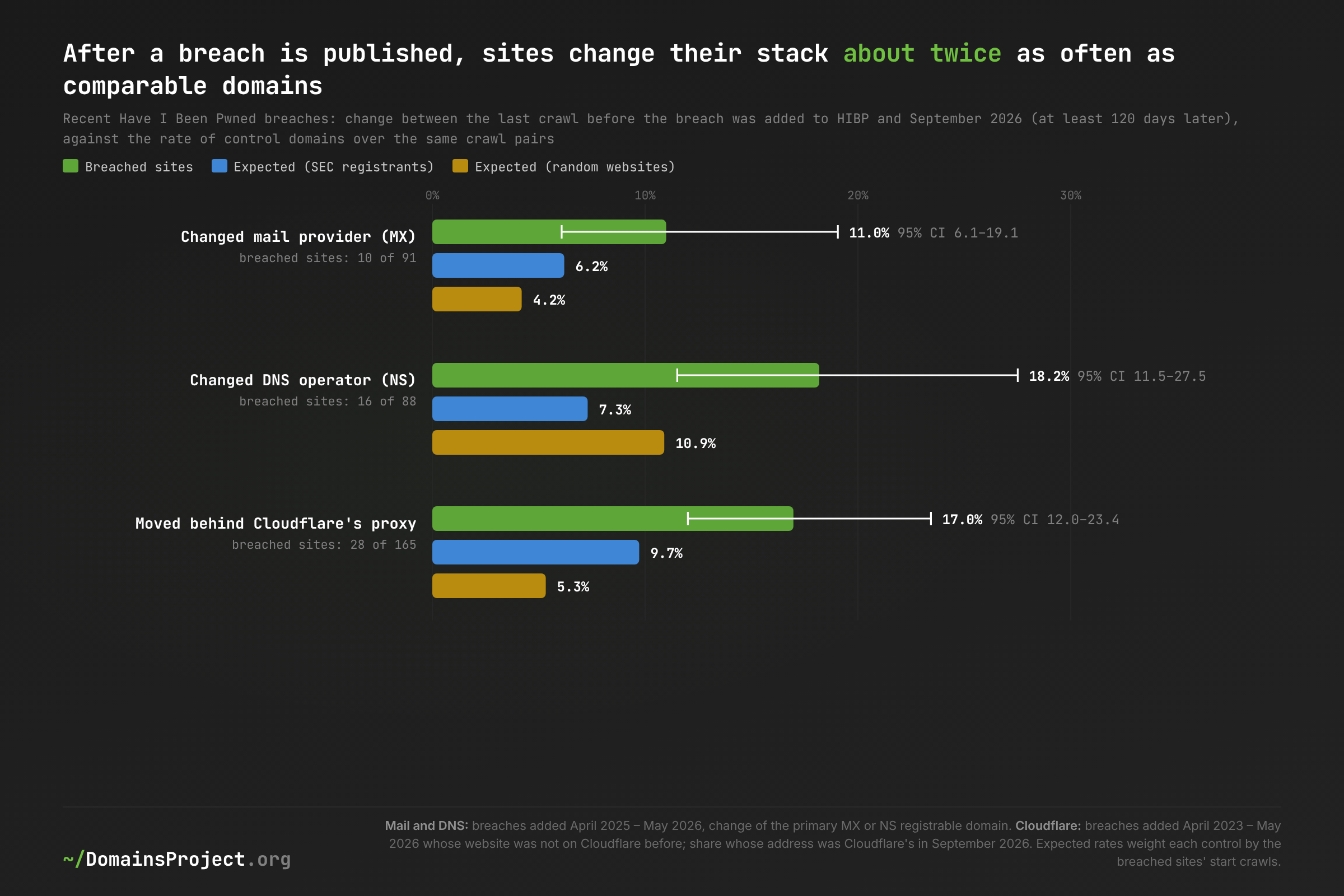
Download: breach-after-changes.csv — counts, 95% Wilson intervals and expected rates from both control groups.
| Change after HIBP published the breach | Breached sites | Expected, SEC registrants | Expected, random websites | p (vs SEC / random) |
|---|---|---|---|---|
| Mail provider (MX) | 11.0% (10 of 91) | 6.2% | 4.2% | 0.055 / 0.005 |
| DNS operator (NS) | 18.2% (16 of 88) | 7.3% | 10.9% | 0.0006 / 0.028 |
| Moved behind Cloudflare's proxy | 17.0% (28 of 165) | 9.7% | 5.3% | 0.003 / < 0.001 |
Breached sites change their visible stack about twice as often as comparable domains over the same months. The DNS and Cloudflare differences are statistically clear against both controls. The mail difference is clear against random websites and borderline against SEC registrants.
The moves are of the kind breach notices often summarise as "enhanced security measures":
- Cloudflare: 28 of the 165 sites not on Cloudflare moved behind its proxy, which can add a web application firewall and hides the origin server's address. 11 of the 83 that already were left it.
- DNS: four of the 16 DNS changes went to Cloudflare's DNS; two left it.
- Mail: three moves between Microsoft 365 and a security gateway, in both directions, and two to Google Workspace.
None of this shows whether the change helped. It shows that, for a minority of breached services, the breach was followed by a change visible from outside.
Email Authentication: Breached Services in Between
| May 2026, domains with a live website and mail | Domains | DMARC enforced (reject or quarantine) | reject | none | no DMARC |
|---|---|---|---|---|---|
| Breached services still online | 597 | 52.4% (48.4–56.4) | 28.5% | 29.0% | 18.6% |
| SEC registrants | 3,032 | 67.7% | 43.9% | 19.9% | 12.4% |
| Random live websites | 7,981 | 10.6% | 6.1% | 24.3% | 65.1% |
Half of the breached services still online enforce DMARC. That is five times the rate of the average website and 15 points below public companies. DMARC does not prevent a breach; an enforced policy lets receiving servers reject mail that falsely claims to come from the domain. For a service whose users' addresses are circulating in breach data, an unenforced policy leaves the easiest phishing route open: mail that claims to come from the service itself. 18.6% publish no DMARC record at all.
Material Incidents at Public Companies: No Visible Change
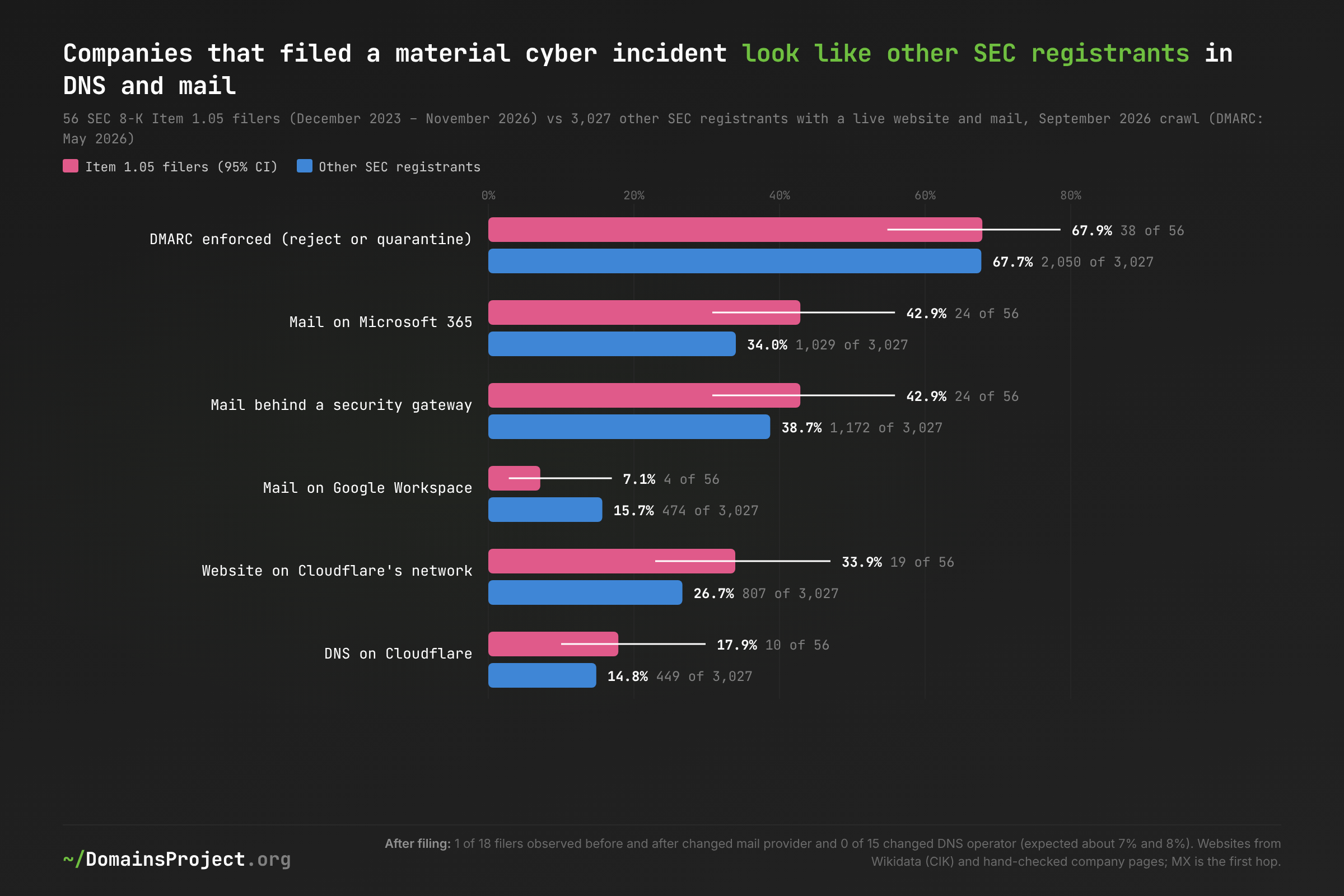
Download: breach-sec-profile.csv — counts and 95% Wilson intervals for filers, counts for other registrants.
Companies that filed a material cybersecurity incident look like other SEC registrants in DNS and mail.
- DMARC enforcement is the same: 67.9% against 67.7%.
- Mail and edge: filers lean slightly more towards Microsoft 365 and Cloudflare and less towards Google Workspace, but with 56 companies every difference is within the 95% interval.
- What filing a material incident does not imply: a visibly weaker email or DNS configuration than the companies that did not.
Nor do they change after filing. Of the filers we could observe before and after their filing, 1 of 18 changed mail provider and 0 of 15 changed DNS operator. For comparison, 7.4% and 8.4% of other registrants changed over the same crawls. The numbers are small, but the direction is the opposite of the breached websites'.
The SEC's rule asks for "the material aspects of the nature, scope, and timing of the incident" and its material impact, within four business days of the materiality determination. It does not ask about remediation. These companies' remediation, whatever it was, did not reach the layers DNS can see.
What's at Stake
- 34 breached services' domains are now owned by someone else, and 17 accept email — the new owners receive mail meant for the old service, and can receive password resets tied to its addresses, while its users' addresses are circulating in breach data.
- 50 more are for sale or free to register — the people best placed to exploit a breached domain's residual trust are those who already hold its users' addresses.
- Domains leave slowly, then steadily — one in 33 for breaches since 2023, one in eight for breaches from 2015 to 2022. Every breach in the catalogue is a future aftermarket listing unless someone keeps renewing the name.
- The most visible response to a breach is a CDN — 17% of breached sites not on Cloudflare moved behind its proxy after publication, against 5–10% of comparable domains. Changes deeper in the stack are not visible from outside.
- Public companies' material incidents leave little DNS trace — the filers' email and DNS posture matches other registrants', and almost none changed provider after filing.
What Would Help
1. Breached services and their successors: keep the domain. A domain costs tens of dollars a year. Letting the domain of a service whose users' addresses are in breach data lapse hands its residual trust to whoever registers it next. Acquirers and liquidators should treat the domain as a liability to hold or retire, not an asset to drop. Retiring it safely means keeping it registered with no mail exchanger (a null MX, RFC 7505) and an enforced DMARC policy of p=reject.
2. Registrars and drop-catch services: flag domains of known breached services before they are released. 19 of the 34 re-registrations went through drop-catch registrars. A breach catalogue such as HIBP is public. Holding such domains for the former owner, or warning buyers, would close the cheapest route to inheriting a breached service's trust.
3. Security teams: treat mail from a breached vendor's old domain as untrusted until ownership is verified. A domain's creation date is in RDAP. If a supplier, partner or service was breached years ago and its domain was "created" after the breach, the sender is probably not the company you knew. This check belongs in vendor-risk and mail-filtering rules.
4. Breach notification services: track the domain after the breach. HIBP and similar services know which domain each breach belongs to. Showing users when that domain lapses or changes hands would tell them when a password-reset address tied to it is no longer safe.
5. Researchers and regulators: measure remediation from outside. Material-incident filings describe the incident, not the fix. Externally visible changes (mail provider, DNS operator, CDN, email authentication) are a small and imperfect view of remediation, but they are measurable for every filer, every quarter. On that view, today, little changes.
Methodology: 948 breached-website domains from the Have I Been Pwned breach catalogue (CC BY 4.0; downloaded November 27, 2026; site breaches only) and 58 companies with an SEC Form 8-K Item 1.05 filing (December 18, 2023 → November 27, 2026), with 3,501 other SEC registrants and a 1-in-8,000 sample of the April 2023 crawl as controls. History from 11 hosting crawls (April 2023 → September 2026), 12 MX and 10 NS crawls (April 2025 → September 2026) and the May 2026 DMARC census; live DNS, RDAP and HTTP checks on November 27–28, 2026. Russian-territorial TLDs are excluded. No domain that is unregistered, for sale or held by a new owner is named. Browse TLDs on the stats dashboard and the full dataset.