Updated 23 June 2026 — refreshed against the June 2026 dataset snapshot (1,511 TLDs, 3,183,285,503 observed hostnames) and triangulated against our 9 June 2026 A-record crawl. The original March 2026 edition predated our data-journalism format standard and our first-party DNS resolution data. This revision adds a full Methodology section, restates every figure as deduplicated observed hostnames, and corrects the headline: the largest ccTLD in the dataset is Germany's .de at 117.7 million hostnames — not the 70 million the original title cited — so the largest-to-smallest ratio is now roughly 357,000 to 1. It also adds an A-resolution pass that exposes the central trap of this topic: several of the "largest" small-country namespaces (Tokelau, Gabon, Mali) are near-dead free-domain dumps, not thriving national webs.
North Korea's internet fits in a spreadsheet. The entire .kp namespace — every hostname visible to the outside world — contains 329 observed entries. Not 329,000. Not 329 million. Three hundred and twenty-nine. You could print them on six pages.
Among them: airkoryo.com.kp (the state airline), edu.kp (the education portal), dprkportal.kp (a government information site), and star-co.net.kp (the country's sole ISP, Star Joint Venture Company, a partnership with Thailand's Loxley Pacific). The rest are a mix of government infrastructure, mail servers, and DNS artifacts. There are no commercial registrations. There are no personal websites. There is no .kp aftermarket.
One country over, South Korea has 3.4 million .kr hostnames. Across the DMZ, the ratio is roughly 10,000 to 1.
We profiled the smallest national namespaces in the DomainsProject dataset alongside the territories whose ccTLDs are impossibly large relative to their populations, and found that "digital extremity" comes in distinct categories — each telling a different story about isolation, sovereignty, and the economics of the domain name system. Then we ran every one of them through our 9 June 2026 A-record crawl, which changes the reading materially: some of the largest tiny-country namespaces turn out to be almost entirely non-resolving.
The headline: North Korea's .kp holds 329 observed hostnames; Germany's .de holds 117,679,029. The ratio between the largest and smallest functional national namespaces is roughly 357,000 to 1. But raw size is the wrong lens at both ends. At the small end, the smallest namespaces split into hermit states (North Korea, Eritrea), genuine micro-states (Vatican City, San Marino), real micro-communities (Falklands, Gibraltar), and uninhabited territories (Heard Island). At the large-relative-to-population end, the apparent giants are an artifact: Tokelau's 7.2 million .tk hostnames and Gabon's 5.9 million .ga hostnames are free-registration dumps where fewer than 3% of names return a live address. The domain count for those namespaces measures global spam supply, not local internet development.
The Data
DomainsProject continuously crawls and indexes hostnames across every delegated TLD in the IANA root zone. For this analysis, we pulled every ccTLD's observed-hostname total from the June 2026 snapshot, ranked them from smallest to largest, sampled domain names to characterize each namespace, and grouped territories by the structural reason for their size. We then attached each ccTLD's A-record resolution rate from our 9 June 2026 crawl to separate names that merely exist from names that answer.
| Category | Count | Coverage |
|---|---|---|
| Active TLDs tracked | 1,511 | IANA root zone (Russian-administered TLDs excluded) |
| Total observed hostnames | 3,183,285,503 | Largest public dataset |
| ccTLD share of dataset | 971.4M (30.5%) | Country-code namespaces |
| Smallest functional national ccTLD | .kp (North Korea) | 329 hostnames |
| Largest ccTLD | .de (Germany) | 117,679,029 hostnames |
| Ratio largest to smallest national | ~357,687 : 1 | .de ÷ .kp |
| Whole-namespace A-resolution rate | 58.9% | 9 Jun 2026 A crawl |
A handful of ccTLDs sit below North Korea's 329 in the dataset, but none is a functional national namespace: .an (Netherlands Antilles, 4 hostnames) is a retired code; .sj (Svalbard and Jan Mayen, 162) and .bv (Bouvet Island, 191) are delegated but effectively unused; .gb (435, A-resolution 0.9%) is the legacy United Kingdom code that lost out to .uk decades ago. We treat .kp as the smallest active national ccTLD and flag those defunct or unused codes separately rather than ranking them as "countries."
Methodology
This post compares national namespaces of wildly different sizes and life stages, so the definitions and caveats carry most of the weight.
- Observed hostname (FQDN). Our base unit: a fully-qualified name our crawl has seen.
www.x.fk,mail.x.fk, and the barex.fkare three hostnames under one registrable domain. Every per-ccTLD figure in this post is deduplicated observed hostnames — not registry registrations and not apex-only counts. The original edition called these "domains" loosely; where we mean a registry figure (e.g. Tokelau's historical .tk registration peak) we cite the registry or public reporting and say so. - A-resolution rate. The share of a ccTLD's observed hostnames that returned a live IPv4 address in our 9 June 2026 A-record crawl. The crawl is positive-only, so this is a liveness floor: a live A record can still point at a parked page, and an IPv6-only name reads as non-resolving. The whole-namespace rate is 58.9%; we use the per-ccTLD rate to distinguish real national webs from registration dumps.
- Category labels. We assign each small ccTLD to one structural bucket, defined as: hermit state — namespace suppressed by state control of internet access (.kp, .er); genuine micro-state — sovereign entity whose small size reflects a tiny real population, with nearly all names institutional (.va, .sm); micro-community — a small but functioning local economy whose namespace maps to real organizations (.fk, .gi); uninhabited / research-only — territory with no permanent civilian population (.hm, .tf); free-domain dump — a ccTLD opened to free or near-free global registration whose count is dominated by non-resident bulk names with very low resolution (.tk, .ga, .ml, .cf, .gq); commercially repurposed — a ccTLD marketed globally as a generic string for its letters, not its country (.cc, .ai, .tv, .nu, .to, .sh, .pw). Labels are assigned from name sampling plus public registry history, not a fully automated classifier, so borderline territories (e.g. Cocos's .cc) are noted as such in the text.
- Population denominators use UN and territory-specific estimates (2025) and are intentionally rough; for curated "populations" like Vatican City's clergy, per-capita figures are illustrative, not market measures.
- Dataset vs. registry, and limitations. Our observed-hostname totals diverge from registry registration counts in both directions: a heavily-subdomained namespace reads higher than its registration base, while a parked or abandoned free-domain namespace can read lower than its peak registration count (many free names never produced a resolvable hostname, and lapsed ones drop out). This is a single snapshot — it measures presence and resolution, not query volume or uptime. The per-ccTLD breakdown is reproducible from the country statistics page, the TLD statistics, and the dataset.
The Scorecard: The Smallest National Namespaces
ccTLDs at the Bottom of the Scale
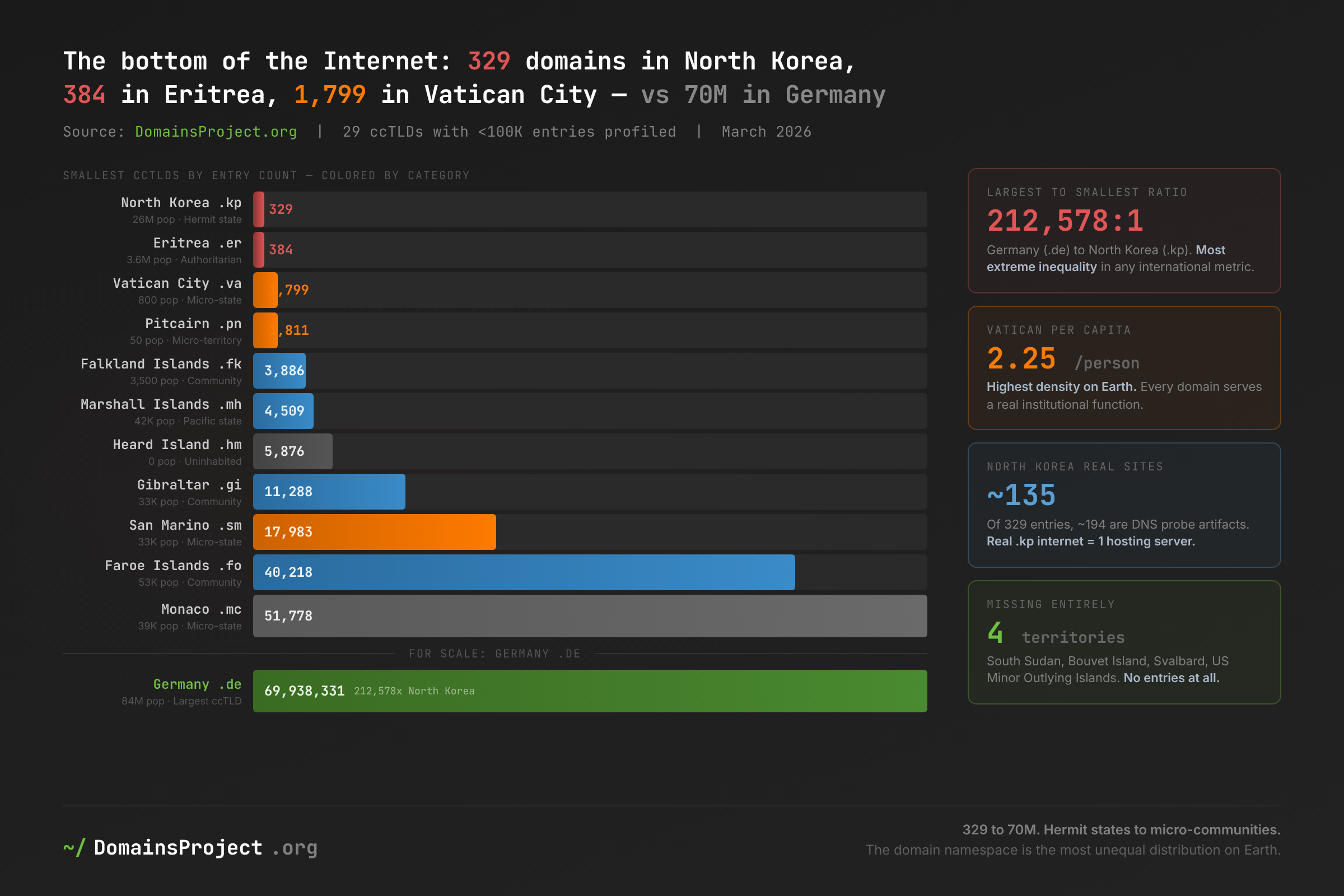
| Rank | Country/Territory | ccTLD | Hostnames | A-resolution | Population | Category |
|---|---|---|---|---|---|---|
| 1 | North Korea | .kp | 329 | 53.8% | 26,000,000 | Hermit state |
| 2 | Eritrea | .er | 384 | 16.4% | 3,600,000 | Hermit state |
| 3 | Vatican City | .va | 1,862 | 67.2% | 800 | Genuine micro-state |
| 3 | Pitcairn Islands | .pn | 1,862 | 57.8% | 50 | Micro-territory |
| 5 | Falkland Islands | .fk | 3,886 | 9.8% | 3,500 | Micro-community |
| 6 | Marshall Islands | .mh | 4,509 | 90.0% | 42,000 | Pacific island state |
| 7 | Heard Island | .hm | 6,065 | 66.4% | 0 | Uninhabited territory |
| 8 | Kiribati | .ki | 7,719 | 85.9% | 120,000 | Pacific island state |
| 9 | Gibraltar | .gi | 11,554 | 52.2% | 33,000 | Micro-community |
| 10 | San Marino | .sm | 18,111 | 77.9% | 33,000 | Genuine micro-state |
| 11 | Nauru | .nr | 18,891 | 94.3% | 12,500 | Pacific island state |
| 12 | Bermuda | .bm | 23,871 | 46.3% | 64,000 | Offshore territory |
| 13 | French Southern Territories | .tf | 37,865 | 62.5% | ~200 | Uninhabited (research) |
| 14 | Cayman Islands | .ky | 41,980 | 74.4% | 68,000 | Offshore territory |
| 15 | Faroe Islands | .fo | 42,136 | 61.7% | 53,000 | Micro-community |
| 16 | British Virgin Islands | .vg | 43,490 | 92.1% | 30,000 | Offshore territory |
| 17 | Norfolk Island | .nf | 47,750 | 62.1% | 2,200 | Micro-territory |
| 18 | Monaco | .mc | 52,189 | 18.6% | 39,000 | Micro-state |
| 19 | Greenland | .gl | 54,457 | 73.8% | 56,000 | Autonomous territory |
| 20 | Turks and Caicos | .tc | 59,016 | 53.2% | 45,000 | Offshore territory |
| 21 | Wallis and Futuna | .wf | 62,993 | 20.8% | 11,000 | Pacific territory |
| 22 | Andorra | .ad | 76,815 | 34.0% | 80,000 | Micro-state |
The bottom three — North Korea, Eritrea, and Vatican City — span just over 1,500 hostnames but three entirely different explanations for smallness. North Korea's 329 is consistent with totalitarian control over internet access. Eritrea's 384 is consistent with one of the world's most restrictive media environments — and its 16.4% A-resolution rate (just 63 live names) suggests most of even that tiny namespace is dormant DNS rather than running services. Vatican City's 1,862 reflect a sovereign state of roughly 800 residents where, by inspection, nearly every name serves an institutional function.
The resolution column rewards close reading, and one row stands out: the Falklands resolve at only 9.8%. Of 3,886 .fk hostnames, just 379 returned a live A record in our crawl. That does not mean the Falklands' web is dead — a small namespace can be dominated by a handful of mail and infrastructure hostnames that answer only over IPv6 or behind resolvers that refuse automated queries, both of which read as non-resolving here. It is a reminder that for very small namespaces the resolution rate is noisy, and we lean on name sampling, not the percentage alone, to judge whether a micro-community's web is genuine.
Hermit States: The Digitally Invisible
North Korea: 329 Hostnames for 26 Million People
North Korea's .kp namespace is the smallest functional national ccTLD in our dataset. It was delegated in 2007 — 17 years after China's .cn and 22 years after the UK's .uk — and has never been open to public registration.
.kp Composition (sampled)
| Category | Approx. share | Examples |
|---|---|---|
| Government / state media | ~30 names | dprkportal.kp, com.kp |
| State-owned enterprises | ~15 names | airkoryo.com.kp, star-co.net.kp |
| Education | ~10 names | edu.kp |
| Infrastructure (DNS, mail) | ~80 names | smtp.star-co.net.kp, 250-smtp.star-co.net.kp |
| DNS artifacts / probes | ~190 names | flag.kp, all.countries.kp, famfamfam-flags.kp |
More than half of North Korea's 329 entries appear to be DNS probe artifacts rather than real services. Names like all.countries.kp, famfamfam-flags.kp (a reference to the famfamfam flag icon set), and flag.kp recur in our dataset because resolvers worldwide test these hostnames during country enumeration. The functioning .kp internet is closer to 135 names — roughly what you would find on a single shared hosting server. Our crawl resolved 177 of the 329 (53.8%), consistent with a namespace where the live half is mail and government infrastructure and the dark half is probe debris.
North Korea operates two parallel networks: the global internet, accessible to a few hundred officials and foreign residents through Star JV's link to China Netcom, and Kwangmyong, a domestic-only intranet with an estimated 1,000–5,000 sites invisible to external crawlers. Our 329 entries capture only the surface North Korea chooses to expose.
The per-capita ratio is extreme: roughly 1 .kp hostname for every 79,000 North Koreans. Germany, by contrast, runs about 1.4 .de hostnames per person — a density gap of roughly 100,000x. No other pair in our dataset is further apart.
Eritrea: 384 Hostnames for 3.6 Million People
Eritrea is North Korea's closest peer — not geographically but digitally. The country has been under one-party rule since independence in 1993, ranks near the bottom of the Reporters Without Borders Press Freedom Index, and has an internet penetration rate below 7%.
.er Composition (sampled)
| Category | Approx. share | Examples |
|---|---|---|
| Telecom infrastructure | ~40 names | eritel.com.er, 220-st.eritel.com.er |
| Government / NGO | ~30 names | aics.org.er |
| Domain-hack speculation | ~50 names | answ.er, oth.er |
| DNS artifacts | ~260 names | all.countries.er, 0.er, 1.er |
Eritrea's .er namespace is dominated by DNS probes and a single ISP, and only 63 of its 384 names (16.4%) resolve. EriTel, the state-owned monopoly, generates most of the legitimate entries through mail servers and infrastructure hostnames. The speculative domain hacks — registrations exploiting the .er extension to spell English words — suggest the namespace was at some point open to international registration, though current availability is unclear and registration appears to require in-country presence. Either way, Eritrea has fewer functional domains than many individual websites have subdomains: its 3.6 million people are not absent from the internet — diaspora communities are active on global platforms — but they are nearly absent from the domain-based web.
Genuine Micro-States: Small by Definition
Vatican City: 1,862 Hostnames for 800 People
Vatican City's .va is the most purposeful micro-namespace in the dataset. With a population of roughly 800 — all affiliated with the Holy See — there is no consumer domain market, no aftermarket speculation, and no promotional pricing. By inspection, every .va name serves an institutional function.
.va Highlights (sampled)
| Domain | Purpose |
|---|---|
| vatican.va | Main Vatican portal |
| news.va | Vatican News service |
| salastampa.va | Press room |
| vaticanmedia.va | Media production (aod-01, aod-02 subdomains) |
| academyforlife.va | Pontifical Academy for Life |
| radiovaticana.va | Vatican Radio |
| sddc.va | IT infrastructure (active directory controllers) |
| annuarium.va | Pontifical yearbook |
On a per-curated-resident basis, Vatican City's namespace density is the highest in the dataset — roughly 2.3 .va hostnames per resident. The comparison is deliberately absurd: the Vatican's "population" is a curated group of clergy and officials, not a consumer market, so the figure illustrates how population denominators distort domain statistics rather than measuring real density. Among countries with genuine consumer markets, the Netherlands (2.03 hostnames per capita) and Switzerland (2.00) lead — and we return to them below. The .va namespace also doubles as a window into Vatican IT: names like ad-01.sddc.va and ad-02.sddc.va reveal Active Directory domain controllers in a software-defined data center. The Vatican runs modern enterprise IT, at a scale that fits in a single server room — and 67.2% of its names resolve, the highest among the bottom three.
Pitcairn Islands: 1,862 Hostnames for 50 People
Pitcairn is the least-populated jurisdiction in the dataset with a ccTLD. The island — a British Overseas Territory home to roughly 50 descendants of the HMS Bounty mutineers — was assigned .pn and maintains it as an active, commercially available namespace. In the June 2026 snapshot .pn and .va are tied at 1,862 hostnames apiece, a coincidence the original edition did not show (it had .pn just above .va); we read nothing structural into the exact tie.
Unlike Vatican City, Pitcairn's .pn is almost entirely speculative. The names tell the story: Unix-epoch timestamps (1595341416.pn, 1596565139.pn), random strings (009-ed3aee625619903.pn), and cs.pn subdomains (1759.cs.pn, 1800.cs.pn) that look like infrastructure for a domain-resale or testing platform. Virtually none of the 1,862 entries represent Pitcairn residents or businesses, because there are only 50 residents and no commercial businesses. Pitcairn earns revenue from .pn registrations — a meaningful income stream for a community with no airport and a GDP estimated under $1 million — making it one of the few cases where a micro-territory's ccTLD is a genuine economic asset rather than a bureaucratic artifact.
Micro-Communities: Small but Real
Falkland Islands: 3,886 Hostnames for 3,500 People
The Falkland Islands' .fk namespace is what a micro-community's internet looks like when it is genuine. Its entries map to real organizations and real economic activity, even though — as noted above — only 9.8% returned a live A record in our crawl.
.fk Highlights (sampled)
| Domain | Purpose |
|---|---|
| saeri.fk | South Atlantic Environmental Research Institute |
| education.ac.fk | Falkland Islands education system |
| sec.gov.fk | Government secretariat |
| ci.gov.fk | Customs and immigration |
| fic.co.fk | Falkland Islands Company (primary employer) |
| beauchenefishing.co.fk | Fishing company (major industry) |
| sure.co.fk | Telecommunications provider |
| falklandmeat.co.fk | Agriculture / export |
The .fk namespace reads like a miniature economy in DNS form. Government (.gov.fk), education (.ac.fk), and commercial (.co.fk) hierarchies mirror the UK's .uk pattern, which fits a British Overseas Territory. Fishing companies (the main employer), research institutes, and the telecoms provider are all represented. The low resolution rate is consistent with a namespace dominated by mail and infrastructure hostnames rather than public web servers — a pattern we see across very small offshore namespaces — so we judge the Falklands' web genuine from its name composition, not from its A-record percentage.
Gibraltar: 11,554 Hostnames for 33,000 People
Gibraltar's .gi at 11,554 hostnames shows what happens when a micro-community also hosts a significant financial-services sector. Online gambling companies (Gibraltar is a major igaming licensing jurisdiction), law firms (hassans.gi, the territory's largest firm), and tech companies alongside local businesses create a namespace that punches above its population weight, with 52.2% of names resolving — squarely mid-pack. For a territory of 6.7 square kilometers, the namespace is remarkably active and commercially diverse.
The Paradox Territories: More Hostnames Than People
The most intellectually interesting category is not the smallest ccTLDs but the ones that are impossibly large relative to their populations. Here the A-resolution column is decisive — it splits the paradox cases into commercially-repurposed namespaces with real usage and free-domain dumps that are mostly dead.
Population vs. Hostname Count vs. Resolution
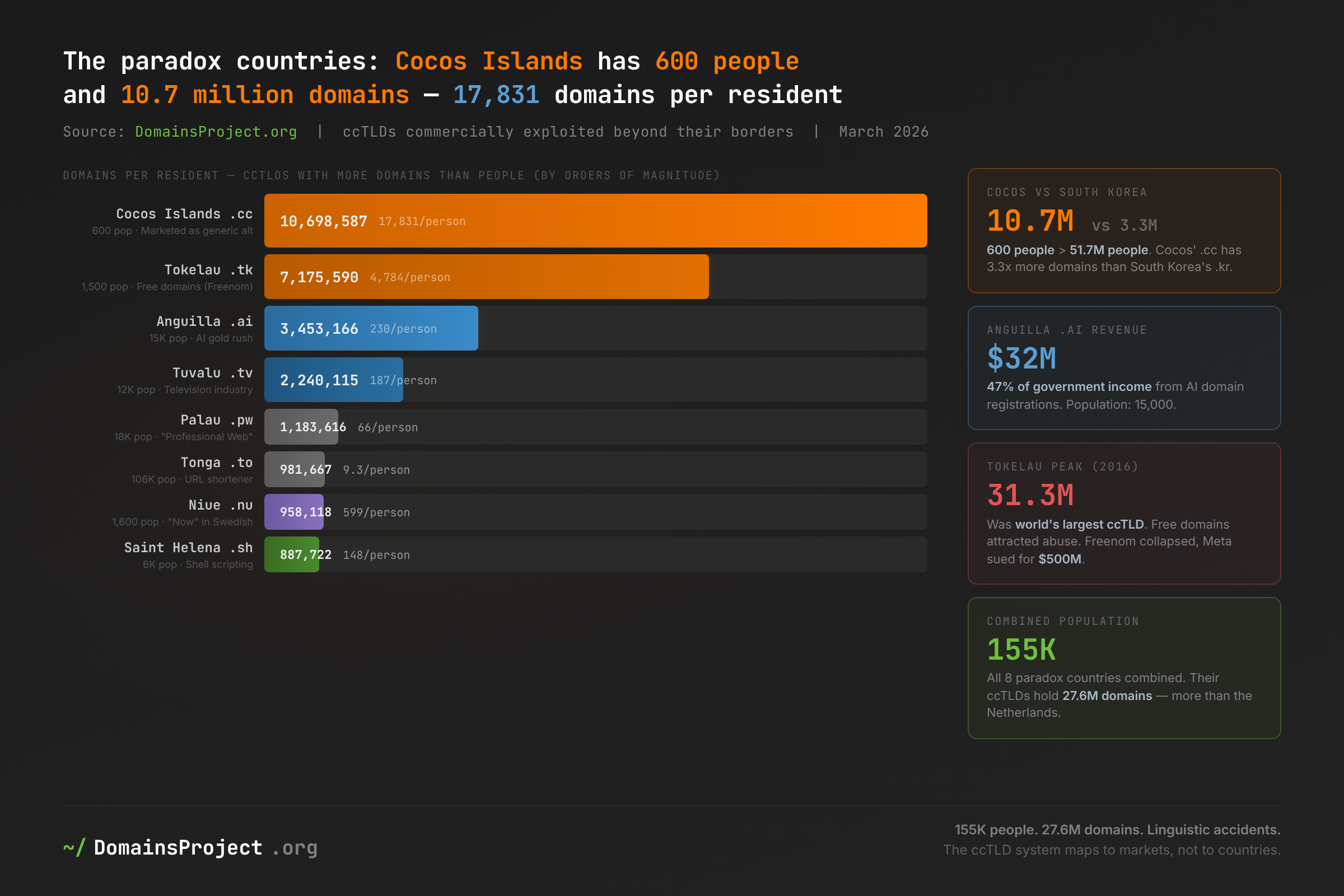
| Country | Population | ccTLD | Hostnames | A-resolution | Driver |
|---|---|---|---|---|---|
| Cocos Islands | 600 | .cc | 11,611,565 | 49.7% | Marketed as generic alternative |
| Tokelau | 1,500 | .tk | 7,178,636 | 2.5% | Free registration (Freenom) |
| Gabon | 2,400,000 | .ga | 5,893,889 | 1.4% | Free registration (Freenom) |
| Mali | 22,000,000 | .ml | 5,889,840 | 1.7% | Free registration (Freenom) |
| Central African Rep. | 5,500,000 | .cf | 5,181,303 | 2.1% | Free registration (Freenom) |
| Eq. Guinea | 1,700,000 | .gq | 4,489,383 | 1.7% | Free registration (Freenom) |
| Anguilla | 15,000 | .ai | 4,132,471 | 77.2% | AI-industry demand |
| Tuvalu | 12,000 | .tv | 2,301,158 | 57.8% | Television industry |
| Palau | 18,000 | .pw | 1,214,005 | 19.8% | "Professional Web" marketing |
| Tonga | 106,000 | .to | 1,003,965 | 76.5% | URL-shortener convention |
| Niue | 1,600 | .nu | 999,118 | 62.4% | "now" in Swedish/Dutch |
| Saint Helena | 6,000 | .sh | 913,075 | 88.0% | Shell-scripting convention |
The five Freenom free-domain namespaces — Tokelau (.tk), Gabon (.ga), Mali (.ml), Central African Republic (.cf), and Equatorial Guinea (.gq) — are the trap in any "extremes" table. Each shows millions of hostnames, which would make several of the world's poorest territories look like internet powerhouses. They are not. These ccTLDs were operated under Freenom's free-registration model, which attracted bulk and abusive registration at industrial scale; our crawl resolves 1–3% of their names, an order of magnitude below the 58.9% whole-namespace floor. The hostname count for these namespaces measures the supply of free domains, not local internet development — and with Freenom having ceased new registrations, much of that supply is now lapsing into non-resolution. We flag them explicitly so they are not read as national webs.
Cocos Islands' .cc tells the opposite story: 11.6 million hostnames, but 49.7% resolve. The two atolls in the Indian Ocean (about 600 residents) had .cc licensed to eNIC, later Verisign, which marketed it globally as a short generic alternative to .com. The result is a genuinely-used commercial namespace — its near-50% resolution rate sits close to .com's own 57.2% — that simply has nothing to do with the 600 islanders. Cocos is the clearest "commercially repurposed" case: large and alive, but not local.
Anguilla's .ai is the standout among the repurposed ccTLDs at 4.1 million hostnames and 77.2% resolution. Demand from AI startups has driven Anguilla's namespace past South Korea's .kr (3.4 million hostnames) — a country of 51.7 million people. Public reporting put Anguilla's .ai revenue in the tens of millions of dollars, a transformative share of government income for a 15,000-person island, and the high resolution rate is consistent with names that are actually deployed rather than parked. The .tk cautionary tale applies regardless: Tokelau's namespace was briefly, by registration count, the largest ccTLD on Earth before the free-domain model collapsed.
The Uninhabited: Domains Without People
Two ccTLDs in our bottom group belong to territories with no permanent civilian population.
| Territory | Population | ccTLD | Hostnames | A-resolution | Status |
|---|---|---|---|---|---|
| Heard Island and McDonald Islands | 0 | .hm | 6,065 | 66.4% | Uninhabited Australian territory |
| French Southern Territories | ~200 (rotating) | .tf | 37,865 | 62.5% | Research stations only |
Heard Island has zero permanent residents and 6,065 hostnames, two-thirds of which resolve. The .hm ccTLD exists because the territory appears in the ISO 3166-1 list, and IANA delegates ccTLDs on that basis. The names are entirely speculative — international registrants buying .hm for short-URL or novelty purposes — and the relatively high resolution rate simply reflects that novelty registrants who configure a name tend to point it somewhere. Nobody on Heard Island is checking a website, because nobody lives on Heard Island. The French Southern Territories' .tf follows the same pattern: 37,865 names that have nothing to do with sub-Antarctic penguin research.
The Scale of Inequality
To place the full range side by side:
The Full Spectrum
| Country | Hostnames | A-resolution | Comparison | |
|---|---|---|---|---|
| Smallest | North Korea (.kp) | 329 | 53.8% | A single web page's DNS footprint |
| Eritrea (.er) | 384 | 16.4% | One shared hosting server | |
| Vatican City (.va) | 1,862 | 67.2% | One small company's infrastructure | |
| Pitcairn (.pn) | 1,862 | 57.8% | One developer's side-project portfolio | |
| Mid-range | Gibraltar (.gi) | 11,554 | 52.2% | A single datacenter's output |
| Faroe Islands (.fo) | 42,136 | 61.7% | A single ISP's customer base | |
| Large | Netherlands (.nl) | 36,326,261 | 71.7% | ~110,000x North Korea |
| Largest | Germany (.de) | 117,679,029 | 75.2% | ~357,687x North Korea |
The ratio between the largest and smallest functional national namespaces is roughly 357,000 to 1. No other metric of national development — GDP, population, internet users, literacy, life expectancy — produces a ratio this extreme between any two countries. And critically, the resolution column shows the gap is not an artifact of dead inventory at the top: .de resolves at 75.2% and .nl at 71.7%, both well above the 58.9% whole-namespace floor, so the giant namespaces are predominantly live. The inequality is real at both the registration and the resolution layer.
Per-Capita: Density vs. Size
Raw counts favor large countries. Normalizing by population shows where the internet is dense rather than merely big (observed hostnames per capita):
| Country | ccTLD | Hostnames | Population | Hostnames per Capita |
|---|---|---|---|---|
| Netherlands | .nl | 36.3M | 17.9M | 2.03 |
| Switzerland | .ch | 17.8M | 8.9M | 2.00 |
| Sweden | .se | 15.5M | 10.6M | 1.46 |
| Germany | .de | 117.7M | 84.5M | 1.39 |
| Denmark | .dk | 7.4M | 6.0M | 1.24 |
| Australia | .au | 32.2M | 26.6M | 1.21 |
| United Kingdom | .uk | 43.8M | 68.4M | 0.64 |
| China | .cn | 52.2M | 1.41B | 0.037 |
| India | .in | 22.6M | 1.45B | 0.016 |
The Netherlands and Switzerland lead at roughly two observed hostnames per capita — the densest national namespaces among major economies — consistent with their roles as European hosting and financial-infrastructure hubs rather than with their domestic market size. At the other end, India sits at 0.016 and China at 0.037 hostnames per capita, a hundred-fold gap below the leaders. India's 1.45 billion people run their internet presence overwhelmingly on .com and other global TLDs; China's parallel ecosystem, gated by ICP licensing, both limits and funnels .cn registrations. Per-capita density and raw size measure different things — the Vatican's curated 2.3 figure and India's 0.016 are not on the same axis as either.
What's at Stake
The extremes of the ccTLD spectrum reveal dynamics that aggregate statistics conceal:
-
North Korea's 329 .kp hostnames represent the most extreme digital isolation in the dataset — roughly 1 per 79,000 people versus Germany's 1.4 per person. More than half appear to be DNS artifacts, and the functional .kp internet visible to the outside world fits in a single text file.
-
Eritrea's 384 .er hostnames make it the second-most isolated national namespace — and at 16.4% resolution, most of even that is dormant. Unlike North Korea, Eritrea has no domestic-only intranet; its 3.6 million people are largely invisible on the domain-based web.
-
The "free-domain" ccTLDs are the single biggest trap in country-level domain statistics. Tokelau, Gabon, Mali, Central African Republic, and Equatorial Guinea each show 4.5–7.2 million hostnames but resolve at only 1–3%. Counting them as national web activity would rank some of the world's poorest territories above functioning mid-size economies. The count measures free-domain supply and abuse, not local presence.
-
The commercially-repurposed ccTLDs (.cc, .ai, .tv, .to, .sh) are large and live, but still not local. Cocos (49.7% resolution), Anguilla (77.2%), and Saint Helena (88.0%) host real, resolving namespaces — they simply belong to global registrants who chose the letters, not the country. Anguilla's .ai has overtaken South Korea's .kr in hostname count on the strength of one acronym.
-
The ~357,000:1 ratio between Germany and North Korea is the most extreme inequality in any international metric — and the resolution data confirms it is not an artifact of dead names at the top. The namespace captures something other development indicators do not: the capacity to exist on the open web.
What Would Help
1. Anyone citing country-level domain statistics: check the resolution rate before the size. Tokelau does not have 7.2 million web publishers; Gabon does not have 5.9 million. At 1–3% resolution, those namespaces are free-domain supply, not national internet activity. Our TLD statistics pages publish per-namespace resolution so the real and the artifactual can be told apart.
2. IANA/ICANN: acknowledge the disconnect between country codes and country presence. The ccTLD system was designed when country codes mapped to countries. It now maps to whatever the market wants — .ai for artificial intelligence, .tv for television, .cc for "anything." Explore the extremes on our country statistics page.
3. Researchers: use the smallest ccTLDs as case studies in digital sovereignty. North Korea, Eritrea, Vatican City, Pitcairn, and the Falklands each represent a different model of how a small entity relates to the global internet. The data is small enough to study exhaustively — 329 names can be analyzed by hand. Download the full dataset to profile any ccTLD.
4. Territories weighing ccTLD revenue: study the Tokelau outcome before depending on it. Free-registration models (Freenom's .tk, .ga, .ml, .cf, .gq) generated volume but collapsed under abuse, leaving namespaces that barely resolve. Anguilla's .ai revenue is transformative for a 15,000-person island — but it rests entirely on the continued relevance of "AI" as a brand. If the market moves to a new acronym, .ai demand could fade the way .tk demand did.
5. Development organizations: count what resolves, not just what registers. A namespace's hostname total and its resolution rate measure different things, and for small territories the gap is enormous. Per-capita density measures the capacity to publish, not just to consume — but only the resolving subset reflects activity. Both metrics, paired with resolution data, are needed for a complete picture.
This analysis is based on the DomainsProject dataset (June 2026 snapshot: 1,511 TLDs, 3,183,285,503 observed hostnames; Russian-administered TLDs excluded) and our 9 June 2026 A-record crawl for resolution figures. Hostname counts are deduplicated observed FQDNs and include subdomains and DNS artifacts; they are not registry registration totals. Population data uses UN estimates and territory-specific sources (2025). Per-namespace composition was characterized by sampling raw dataset files. Free-domain registration history and paradox-territory revenue references draw from public registry reporting and industry sources. Explore the full data on our country statistics page and TLD statistics, or download the complete dataset.