Updated 23 June 2026 — refreshed against the June 2026 dataset snapshot (50,604,376 observed .xyz hostnames, up from ~45M) and triangulated against our 9 June 2026 A-record crawl. The original March 2026 edition predated our data-journalism format standard and our first-party DNS resolution data. This revision adds a full Methodology section, updates every dataset-derived figure, and corrects the headline reading: the original argued the 3:1 subdomain ratio showed ".xyz being used as live infrastructure, not parked inventory." Our DNS pass shows only 42% of .xyz roots resolve — so this edition reframes .xyz as a barbell (a real developer/crypto core plus a large promotional-churn tail) and sizes both.
In January 2014, a 28-year-old entrepreneur named Daniel Negari launched .xyz into a market that did not want it. The domain industry called it a vanity project. Registrars questioned whether anyone would pay for a three-letter extension with no semantic meaning. Verisign held .com and .net with 140 million registrations between them. The new gTLD program had just opened the floodgates — over 1,200 new extensions were entering the market simultaneously, from .aaa to .zzz, and the conventional wisdom said most would fail.
Negari had paid $25,000 for the application fee alone. His company, XYZ.COM LLC (later 1.111B Registry), had no registrar partnerships, no marketing budget comparable to Google's .app or Amazon's .aws, and no built-in customer base. The thesis was simple: .xyz was the last three letters of the alphabet, universal, linguistically neutral, and available for $1.
Eleven years later, .xyz has 50.6 million observed hostnames in our dataset — making it the 4th-largest gTLD on Earth, behind only .com, .net, and .org. It is larger than the United Kingdom's .uk and level with Brazil's .br, though China's .cn has now edged just ahead of it. It is the only new gTLD ever to crack the top ranks. Of the 1,200+ extensions launched in the new gTLD program, .xyz alone holds 15.9% of all post-2012 new-gTLD hostnames — more than the next two new gTLDs combined.
We parsed all 50,604,376 hostnames in the .xyz namespace, categorized by subdomain depth, naming pattern, and infrastructure role, cross-referenced with ICANN registry reports and industry data, and then ran a fresh A-record crawl to test how much of it is actually live.
The headline: .xyz has 50.6 million observed hostnames — 13.3 million direct registrations generating 37.6 million subdomains. It is the new gTLD program's only unambiguous success. But "success" is barbell-shaped: a fresh DNS pass finds that only 42% of .xyz roots still resolve, so the namespace is best understood as a real developer-and-crypto infrastructure core sitting on top of a vast promotional-churn tail. The growth is driven less by traditional domain registration than by $1 pricing, cryptocurrency projects, and developer side-projects — and a large fraction of it is registered, observed once, and then abandoned.
The Data
DomainsProject continuously crawls and indexes hostnames across every delegated TLD in the IANA root zone. For this analysis, we parsed the full .xyz namespace — all 50,604,376 observed hostnames — and categorized every entry by subdomain depth, naming pattern, and keyword frequency.
| Category | Count | Coverage |
|---|---|---|
| Active TLDs tracked | 1,511 | IANA root zone (Russian TLDs excluded) |
| Total observed hostnames | 3.18B | Largest public dataset |
| .xyz observed hostnames | 50,604,376 | 1.59% of dataset |
| Direct .xyz registrations (apexes) | 13,347,826 | SLD.xyz |
| Subdomain hostnames | 37,627,391 | 74.4% of .xyz |
| .xyz rank among gTLDs | #4 | Behind .com, .net, .org |
| .xyz rank overall | #7 | Of 1,511 TLDs |
| Dataset file size | 1.0 GB | Single file |
Our 13.3 million direct registrations align with public ICANN registry reports, which place .xyz at roughly 12-13 million active second-level domains. The 37.6 million subdomains represent a 2.82x multiplier — substantially higher than parked-heavy TLDs, where subdomains are rare. Subdomains mean someone configured DNS records, which means someone, at some point, was running something. As the Methodology and the resolution section make clear, "at some point" is doing real work in that sentence: a large share of these names no longer answer in DNS.
Methodology
This post makes quantitative claims about a single TLD's namespace, so the definitions matter.
- Observed hostname (FQDN). Our base unit: a fully-qualified name seen in our crawl.
example.xyz,app.example.xyz, andapi.app.example.xyzare three hostnames under one registrable domain. The 50.6M figure is deduplicated observed hostnames, not registrations. - Direct registration / apex. A registrable
name.xyzdomain. .xyz is a flat namespace, so the apex is always the last two labels. We count 13,347,826 distinct apexes, deduplicated across the active dataset and its historical GitHub mirror. - Subdomain depth. We bucket each hostname by its label count — 2 labels (direct), 3 (one subdomain), 4, and 5+ — to distinguish bare registrations from layered infrastructure.
- Resolution. In the resolution section, an apex resolves if our 9 June 2026 A-record crawl returned a live IPv4 address. The crawl records positive resolutions; comparing its .xyz count to our observed-hostname inventory yields the share still live. A live A record does not prove an active site (it can be a parking page); a name that resolves only over IPv6 would read as non-resolving, mildly undercounting liveness.
- Keyword and naming counts are computed on the apex second-level label by prefix match (
crypto*,nft*); they are not mutually exclusive and capture naming intent, not verified site content.
Dataset vs. registry, and known limitations. Our 13.3M apex count runs slightly above registry-reported active-domain counts because we include any apex we have observed, including recently-lapsed names still visible in DNS; it is not a live zone-file snapshot. This is a single point in time, so registration trends cite ICANN and industry reports rather than our crawl. Keyword classification is heuristic. The per-level breakdown is reproducible from the .xyz statistics page and the dataset.
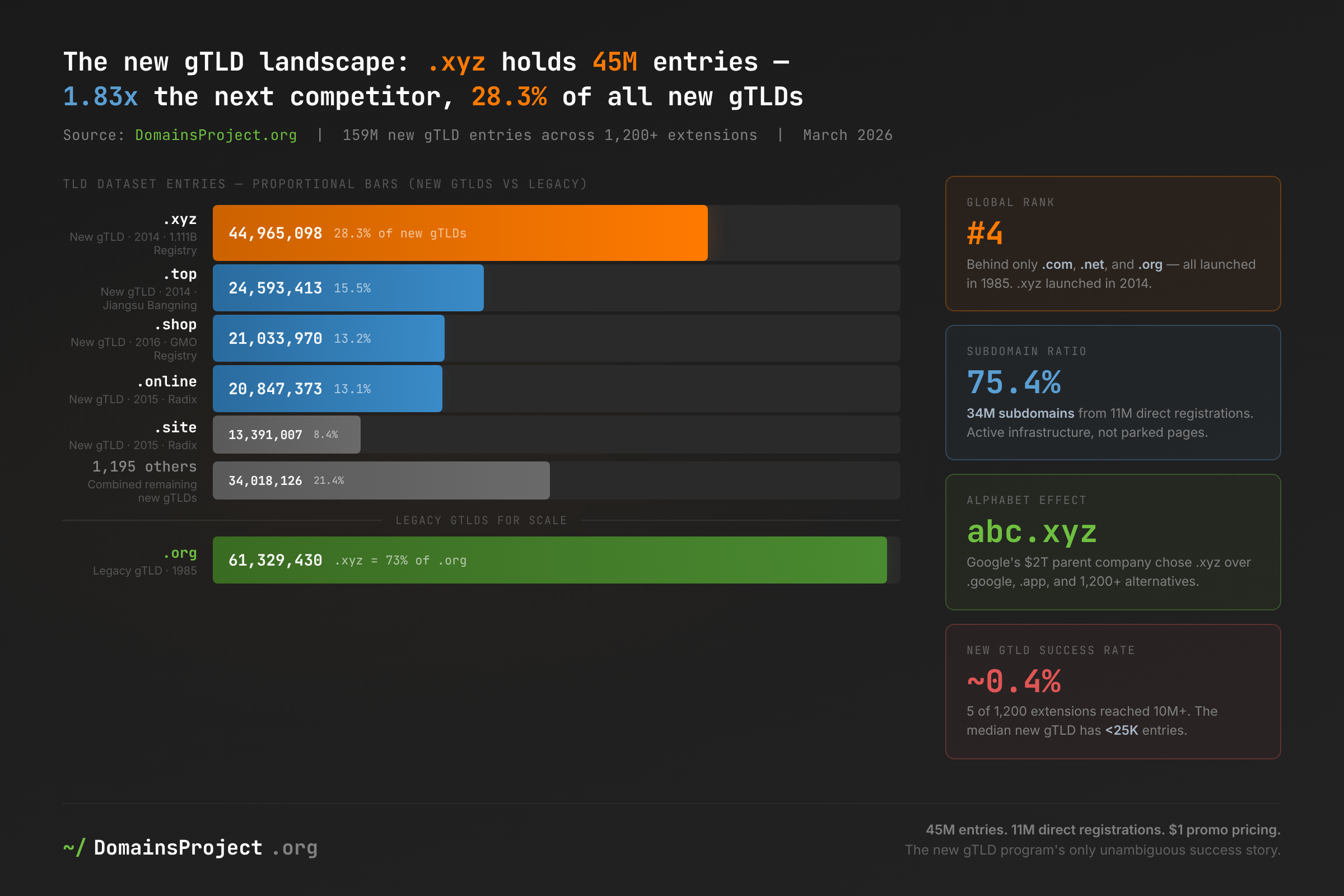
The Scorecard: The New gTLD Landscape
Top 10 gTLDs by Dataset Size
| Rank | TLD | Hostnames | Type | Year Launched |
|---|---|---|---|---|
| 1 | .com | 1,360,818,815 | Legacy gTLD | 1985 |
| 2 | .net | 400,819,790 | Legacy gTLD | 1985 |
| 3 | .org | 74,404,646 | Legacy gTLD | 1985 |
| 4 | .xyz | 50,604,376 | New gTLD | 2014 |
| 5 | .top | 29,340,850 | New gTLD | 2014 |
| 6 | .info | 24,103,175 | Legacy gTLD | 2001 |
| 7 | .shop | 23,509,923 | New gTLD | 2016 |
| 8 | .online | 22,540,102 | New gTLD | 2015 |
| 9 | .site | 16,566,305 | New gTLD | 2015 |
| 10 | .store | 11,050,885 | New gTLD | 2016 |
.xyz remains comfortably the largest new gTLD. At 50.6 million hostnames, it holds 1.72x more than .top (29.3M) and more than .shop and .online combined (46.0M). Among gTLDs — including the legacy giants that have had 40 years of compounding advantage — .xyz ranks 4th, behind only .com, .net, and .org. It took just 11 years to pass every legacy gTLD except the original three.
New gTLD Market Share
| TLD | Hostnames | Share of New gTLDs | Price (Retail) |
|---|---|---|---|
| .xyz | 50,604,376 | 15.9% | $1-2/year (promo) |
| .top | 29,340,850 | 9.2% | $1-3/year |
| .shop | 23,509,923 | 7.4% | $2-5/year |
| .online | 22,540,102 | 7.1% | $1-4/year |
| .site | 16,566,305 | 5.2% | $1-3/year |
| .store | 11,050,885 | 3.5% | $2-6/year |
| All others (1,200+) | 164,581,238 | 51.7% | Varies |
| Total new gTLDs | 318,193,679 | 100% |
The top 5 new gTLDs account for 44.8% of all new gTLD hostnames, and .xyz alone holds 15.9%. The concentration is real but less extreme than it once looked: the long tail has bulked up since the original edition, as a wave of ultra-cheap bulk strings (.bond, .click, .cyou and similar) filled in the bottom half of the cohort with promotional volume. The picture is still a handful of winners over a long tail — but it is now a fatter tail of churny, low-cost namespaces. .xyz remains the only new gTLD that competes at the scale of legacy TLDs.
The Alphabet Effect: How Google Made .xyz Legitimate
On August 10, 2015 — eighteen months after .xyz launched — Google restructured into Alphabet Inc. and registered its corporate homepage at abc.xyz. The stock market moved $24 billion in a day. And .xyz registrations surged.
The choice was not accidental. Larry Page and Sergey Brin explicitly wanted a domain that was short, memorable, and not .com. The selection of .xyz — over .inc, .corp, .company, or any of the other 1,200+ new extensions — was the single most significant endorsement a new gTLD has ever received. Google did not choose .app, which Google Registry owned. They did not choose .google, their own branded TLD. They chose .xyz, the $1 domain from a startup registry.
abc.xyz transformed .xyz from a novelty into a signal. After the Alphabet announcement, enterprise adoption accelerated. Block, Inc. (formerly Square) registered block.xyz. Ethereum Name Service launched on ens.xyz. Infrastructure projects across the crypto ecosystem adopted .xyz as a namespace convention. The logic was circular but effective: serious companies use .xyz because Google uses .xyz, and Google chose .xyz because it was short and neutral.
Inside the .xyz Namespace: What 45 Million Entries Look Like
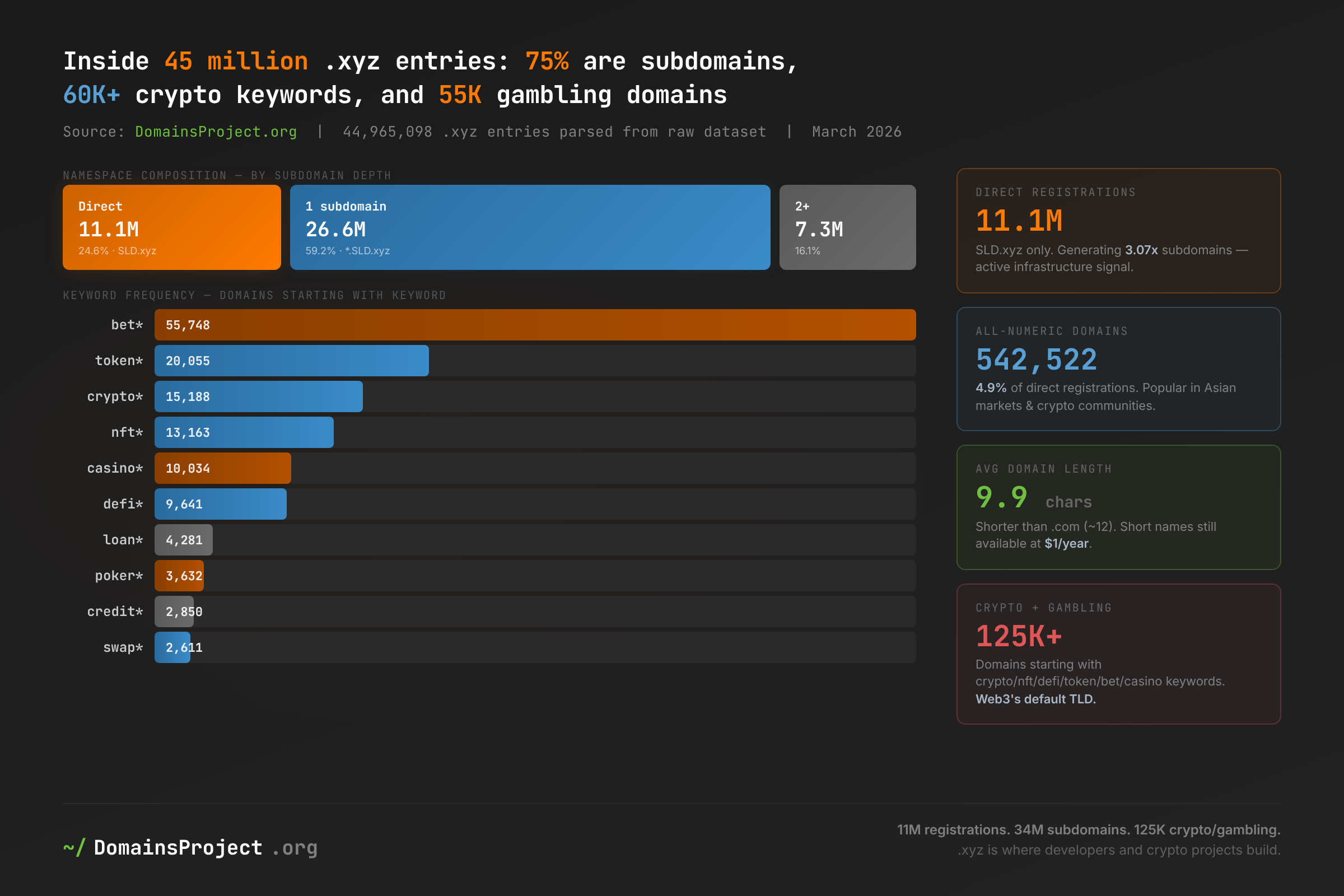
Entry Depth Distribution
| Depth | Example | Count | Share |
|---|---|---|---|
| 2 parts (direct) | example.xyz | 12,976,985 | 25.6% |
| 3 parts (1 subdomain) | app.example.xyz | 29,892,867 | 59.1% |
| 4 parts (2 subdomains) | api.app.example.xyz | 6,668,975 | 13.2% |
| 5+ parts (deep) | dev.api.app.example.xyz | 1,065,549 | 2.1% |
| Total | 50,604,376 | 100% |
74.4% of all .xyz hostnames are subdomains — three-quarters of the namespace is layered on top of registered domains rather than being the registrations themselves. That layering does signal configured DNS rather than dead inventory. But the original edition read it as proof of broad "active infrastructure," and the generator data does not support so clean a claim: the subdomain mass is heavily concentrated in a small number of high-volume producers, and their character is mixed.
| Parent Domain | Subdomains | What It Is |
|---|---|---|
| ddapps.xyz | 19,721 | Dynamic-app / DDNS platform |
| thedonald.xyz | 19,615 | Community forum (per-user subdomains) |
| elgenero.xyz | 17,085 | Content platform |
| wholebooks.xyz | 5,179 | Content / SEO operation |
| onappcdn-le-omega-{1..4}.xyz | ~3,400 each | CDN edge infrastructure |
The top generators are a barbell, not a Kubernetes cluster. The single largest is a dynamic-app platform; the second is a community forum minting a subdomain per user; a cluster of onappcdn-* domains is CDN edge infrastructure; and wholebooks.xyz-style content/SEO operations round out the top. Some of this is genuine infrastructure (the CDN nodes, the platforms); some is automated bulk that inflates the subdomain count without representing distinct projects. The honest read: .xyz does attract real developer and platform infrastructure — more than .online or .site — but its 2.82x subdomain ratio is dominated by a few dozen high-volume producers, not by a broad base of teams each running a stack.
Naming Patterns: What People Register
| Pattern | Count | Share |
|---|---|---|
| All alphabetic | 8,647,781 | 64.8% |
| Mixed (alpha + numeric) | 4,021,474 | 30.1% |
| All numeric | 678,571 | 5.1% |
| Short (1-3 chars) | 44,974 | 0.3% |
| Total direct (apexes) | 13,347,826 | 100% |
The average .xyz domain is 9.97 characters long — shorter than .com's estimated 11-12 and consistent with a namespace that still has short names available. At $1/year promotional pricing, the economics of .xyz registration are fundamentally different from .com. A developer can register project-name.xyz for less than a cup of coffee and spin up infrastructure immediately. The barrier to entry is not price — it is awareness.
The mix has shifted toward alphanumeric names: 30.1% of .xyz apexes now combine letters and digits, nearly double the share the original edition estimated. That drift — plus 678,571 all-numeric domains (5.1%, mirroring the Chinese .cn pattern) — is the fingerprint of automated and crypto-adjacent registration, where names like token2049launch.xyz or 0xvault7.xyz are generated rather than chosen. Numeric and alphanumeric naming is popular in Asian markets where number-based conventions carry cultural significance, and in crypto communities where short numeric strings serve as wallet-adjacent identifiers.
The Crypto Namespace: .xyz as Web3's Default
The keyword distribution in .xyz domain names reveals a TLD that has become the default namespace for cryptocurrency and Web3 projects.
Keyword Frequency in .xyz Domains
| Keyword Prefix | Count | Category |
|---|---|---|
| token* | 19,951 | Crypto/Web3 |
| bet* | 19,754 | Gambling |
| coin* | 14,378 | Crypto/Web3 |
| crypto* | 14,208 | Crypto/Web3 |
| nft* | 12,701 | Crypto/Web3 |
| defi* | 10,040 | Crypto/Web3 |
| wallet* | 7,629 | Crypto/Web3 |
| casino* | 7,436 | Gambling |
| dao* | 5,284 | Crypto/Web3 |
| airdrop* | 3,646 | Crypto/Web3 |
| loan* | 3,829 | Finance |
| poker* | 2,978 | Gambling |
| swap* | 2,473 | Crypto/Web3 |
More than 90,000 .xyz roots start with crypto/Web3 keywords — token, coin, crypto, nft, defi, wallet, dao, airdrop, stake, and swap combined. Add roughly 30,000 gambling domains (bet, casino, poker) and a pattern emerges: .xyz is the namespace of choice for two industries that traditional registrars and TLDs actively discourage — cryptocurrency and online gambling. This is also where the low resolution rate comes from: speculative crypto and gambling registrations churn fast, which is exactly what the DNS pass later in this post measures.
The reasons are structural. Crypto projects need domains fast, cheap, and without verification friction. .com aftermarket prices for crypto keywords run into six figures. .xyz promo pricing at $1 means a new DeFi protocol can register a domain, deploy a frontend, and go live in hours. The short lifecycle of many crypto projects — especially during speculative cycles — makes .xyz's low renewal cost an advantage: if the project dies, the loss is $1, not $10.
Ethereum Name Service (ENS) amplified this pattern. ENS adopted .xyz as its recommended web2 companion to .eth names, and the Ethereum Foundation itself hosts ethereum.org while many ecosystem projects run on .xyz. This created a self-reinforcing convention: new crypto projects see established ones on .xyz and follow suit.
The Price Paradox: $1 Domains at Scale
.xyz's growth is inseparable from its pricing strategy. While .com wholesale costs $10.26/year and most legacy gTLDs charge $8-12, .xyz promotional pricing starts at $1 — sometimes lower.
Registration Cost Comparison
| TLD | First-Year Promo | Renewal Price | Registry Wholesale |
|---|---|---|---|
| .xyz | $0.99-1.99 | $10-13 | $7.85 |
| .com | $8-12 | $15-20 | $10.26 |
| .net | $10-14 | $16-20 | $10.91 |
| .org | $8-10 | $12-15 | $10.29 |
| .top | $0.99-2.99 | $8-12 | $3.00 |
| .online | $0.99-3.99 | $30-40 | $4.00 |
The gap between first-year promotional price and renewal price is the new gTLD business model. .xyz acquires registrations at $1 and hopes enough registrants renew at $10-13 to sustain the registry. Industry-wide, new gTLD renewal rates hover around 25-35% — meaning roughly two-thirds of $1 registrations are abandoned after the first year. The hopeful hypothesis is that the survivors are the ones running real infrastructure. Our DNS pass, below, lets us test that directly rather than assume it.
This pricing model explains why .xyz is simultaneously the 4th-largest gTLD and not particularly profitable on a per-domain basis. Volume compensates: even at 25% renewal rates, 13 million direct registrations at $7-8 wholesale is substantial revenue. The question is whether .xyz can sustain growth without perpetual promotional pricing — or whether the $1 price is now so central to its identity that raising it would collapse the namespace.
Does It Resolve? The 42% Reality
The original edition argued from the subdomain ratio that .xyz is "active infrastructure, not parked pages." That was an inference. With our 9 June 2026 A-record crawl we can replace it with a measurement: of every observed .xyz hostname, how many still return a live IPv4 address?
| Slice | Count | Returns Live A Record | Resolution Rate |
|---|---|---|---|
| Registrable .xyz roots | 13,347,826 | 5,659,924 | 42.4% |
| All observed .xyz hostnames | 50,604,376 | 19,612,881 | 38.8% |
Fewer than half of registered .xyz roots — 42.4% — still resolve. That is the churn the $1 business model predicts, made visible: a name is registered for a dollar, observed once, and then never pointed anywhere. For comparison, our crawl puts whole-namespace resolution at 58.9%, mature ccTLDs at 70-81%, and .ai roots at 86.5%; .xyz sits near the bottom with the other promotional gTLDs (.shop 25%, .online 29%, .top 37%). The 50.6 million headline overstates the functional .xyz namespace by more than two to one.
This is the barbell, quantified. The ~5.7 million resolving roots are the real .xyz — the developer projects, the crypto frontends, the platforms generating those subdomain trees, and the corporate adopters like abc.xyz and block.xyz. The ~7.7 million non-resolving roots are the promotional tail: registered on impulse or in bulk, never configured, destined to lapse. Both are real, and both are large. Reading .xyz as only live infrastructure (as the original did) or only a churn machine (as critics do) misses that it is unmistakably both. (Caveat: a live A record can still point at a parking page, and IPv6-only names would read as non-resolving — so 42.4% is a liveness proxy, not an active-site census.)
The Long Tail: 1,200 Extensions, a Handful of Winners
.xyz's dominance illuminates the broader failure of the new gTLD program to achieve its stated goal of "increasing choice and competition."
New gTLD Program: Concentration Analysis
| Metric | Value |
|---|---|
| New gTLD strings in our dataset | 1,071 |
| New gTLDs with >10M hostnames | 6 (.xyz, .top, .shop, .online, .site, .store) |
| New gTLDs with >1M hostnames | 34 |
| New gTLDs with <10K hostnames | 617 |
| Top 5 share of all new gTLD hostnames | 44.8% |
| .xyz alone share of all new gTLD hostnames | 15.9% |
ICANN's new gTLD program produced a few dozen relevant extensions and a thousand marginal ones. The program charged $185,000 per application — collecting over $350 million in fees — and promised that new extensions would reduce .com's dominance and give users meaningful alternatives. A decade and a half later, .com still holds 42.7% of all observed hostnames, only 34 new gTLDs clear a million, 617 of the 1,071 hold fewer than 10,000, and the volume leaders compete on price rather than brand differentiation.
.xyz succeeded not because of the program's design but in spite of it. The Alphabet endorsement, the crypto adoption wave, and aggressive promotional pricing were all external factors that no amount of ICANN policy could have engineered. The hundreds of near-empty extensions — from .luxury to .security to .makeup — demonstrate what happens without those factors: a domain extension nobody has heard of, at a price nobody wants to pay, solving a problem nobody has.
What's at Stake
The .xyz data reveals structural dynamics in the domain industry that extend beyond a single TLD:
-
.xyz has 50.6 million observed hostnames — the 4th-largest gTLD on Earth — and is the only new gTLD ever to breach the top ranks. It is larger than the United Kingdom's .uk (43.8M) and level with Brazil's .br (50.3M), though China's .cn (52.2M) has now edged just ahead. Among gTLDs, only .com, .net, and .org are larger — all launched in 1985.
-
Only 42.4% of .xyz roots resolve. The 74.4% subdomain share shows configured DNS, but our A-record crawl finds that fewer than half of registered .xyz roots return a live address. The functional namespace is roughly 5.7 million resolving roots — real, but less than half the headline. Subdomain volume is concentrated in a few dozen high-output generators, not spread across a broad base of teams.
-
Crypto and gambling keywords account for over 120,000 direct .xyz registrations — token (19,951), coin (14,378), crypto (14,208), nft (12,701), defi (10,040), bet (19,754), and casino (7,436). .xyz is the default namespace for industries that face registration friction or content policies on traditional TLDs — and the same speculative churn that drives those registrations drives the low resolution rate.
-
The top 5 new gTLDs hold 44.8% of all new gTLD hostnames, and .xyz alone holds 15.9%. The program's $350 million in fees produced six strings above 10 million hostnames and 617 below 10,000. .xyz is the lone unambiguous winner; the long tail has filled with cheap, churny bulk rather than meaningful alternatives.
-
$1 promotional pricing is both .xyz's growth engine and its structural vulnerability. Our DNS pass confirms the churn directly: only 42.4% of roots resolve, so the 50.6 million headline overstates the functional namespace by more than two-to-one. The question is whether .xyz's real infrastructure users — the ~5.7 million resolving roots — will sustain the TLD as promotional registrations lapse.
What Would Help
1. Researchers: use .xyz as a case study in new gTLD adoption dynamics. With 50.6 million hostnames and 12 years of history, .xyz is the only new gTLD with enough data to study lifecycle patterns — promotional acquisition, renewal behavior, subdomain generation, resolution decay, and sector concentration. Download the full dataset to analyze registration patterns.
2. ICANN: publish granular renewal rates by TLD. The single most important metric for evaluating the new gTLD program — what percentage of registrations renew — is not publicly available at TLD granularity. Without it, the difference between a thriving namespace and a promotional churn machine is invisible. The .xyz data suggests active infrastructure, but only renewal data would confirm it.
3. Domain investors: treat .xyz as a distinct market from .com. The aftermarket dynamics are fundamentally different. .com derives value from scarcity and memorability. .xyz derives value from utility and sector convention. A crypto project will pay a premium for defi.xyz not because .xyz is memorable but because .xyz is where crypto projects live. Browse the .xyz TLD statistics for namespace analysis.
4. Developers: recognize .xyz as a legitimate production namespace, not a toy. abc.xyz runs a $2 trillion company. block.xyz runs a $40 billion payments company. The stigma against non-.com domains is eroding, and .xyz's developer adoption is accelerating it — the resolving core of the namespace is genuine platform and infrastructure traffic, more of it than on .online or .site.
5. New gTLD applicants (ICANN's next round): study .xyz's success factors before paying $185,000. .xyz succeeded because of an external corporate endorsement (Alphabet), an industry adoption wave (crypto), and aggressive below-cost pricing. None of these are replicable on demand. The 1,200 other new gTLDs that lacked all three factors collectively hold fewer entries than .xyz alone. The base rate for new gTLD success is approximately 0.4%.
This analysis is based on the DomainsProject dataset (50,604,376 .xyz hostnames in the June 2026 snapshot), our 9 June 2026 A-record crawl for resolution figures, ICANN new gTLD registry reports, and industry pricing data. Hostname counts include subdomains and are deduplicated across the active dataset and its historical mirror; keyword counts reflect apex names beginning with the specified prefix. The new gTLD comparison includes extensions launched through ICANN's 2012 application round (Russian-administered TLDs excluded). Explore the full .xyz data on our TLD statistics page, or download the complete dataset.